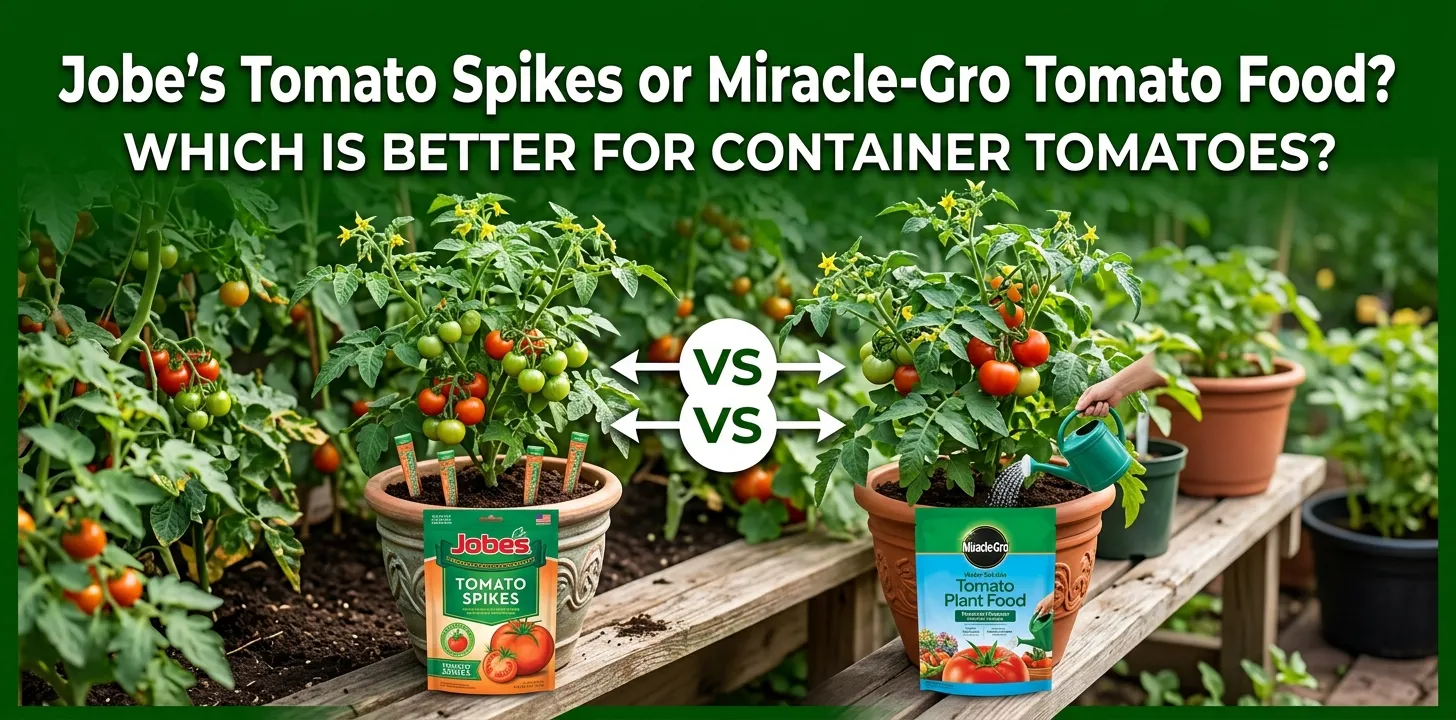
Jobes Tomato Spikes or Miracle-Gro Tomato Food? Which Is Better for Container Tomatoes?

For container tomatoes, Jobe’s Tomato Fertilizer Spikes are better for gardeners who want slow, low-maintenance feeding, while Miracle-Gro Water Soluble Tomato Plant Food is better when you want fast nutrient delivery and more control over feeding. Jobe’s 6-18-6 spikes feed for up to 8 weeks, while Miracle-Gro’s 18-18-21 water-soluble food is applied every 7–14 days.
The better choice depends less on which fertilizer is “stronger” and more on how you manage a tomato plant in a pot. Container tomatoes have limited root space, are watered often, and can lose nutrients through repeated watering. That makes the release pattern and application method especially important.
Jobe’s Tomato Spikes vs. Miracle-Gro Tomato Food at a Glance
| Feature | Jobe’s Tomato Spikes | Miracle-Gro Tomato Plant Food |
|---|---|---|
| Fertilizer type | Pre-measured spikes | Water-soluble powder |
| NPK | 6-18-6 | 18-18-21 |
| Nutrient release | Slow-release | Fast/soluble |
| Application | Insert spikes into soil | Mix with water |
| Typical feeding interval | Up to 8 weeks | Every 7–14 days |
| Best for | Low-maintenance container growing | Fast feeding and precise control |
| Mixing required | No | Yes |
| Good for containers | Yes, when used according to the label | Yes |
| Main advantage | Convenience | Speed and control |
| Main drawback | Less flexible feeding | Requires regular applications |
Jobe’s tomato spikes are designed to provide nutrients below the soil surface and are marketed as feeding tomato plants for up to eight weeks. The listed formula for the tomato spikes is 6-18-6. Miracle-Gro Water Soluble Tomato Plant Food has an 18-18-21 analysis and is designed to be mixed with water and applied every 7–14 days.
One important product-label detail
There are several Jobe’s tomato and vegetable fertilizer products, including organic 2-7-4 spikes and the 6-18-6 tomato spikes. They should not be treated as the same product. The comparison here is specifically for Jobe’s Tomato Fertilizer Spikes 6-18-6 versus Miracle-Gro Water Soluble Tomato Plant Food 18-18-21.
Which One Is Better for Container Tomatoes?
For most container gardeners, Miracle-Gro Tomato Plant Food has the advantage when a tomato plant needs quick, easily available nutrients. Water-soluble fertilizer dissolves in water and makes nutrients available quickly, which is particularly useful in containers where nutrients can be lost through frequent watering.
Jobe’s spikes make more sense when your priority is convenience. You do not have to mix fertilizer each time you water, and the slow-release format means you are not constantly measuring and applying plant food.
So the choice is fairly simple:
- Choose Jobe’s if you want less frequent feeding.
- Choose Miracle-Gro if you want faster feeding and greater control.
- Choose Miracle-Gro if a container tomato is showing signs of nutrient shortage and you need nutrients delivered through watering.
- Choose Jobe’s if your plant is healthy and you want a simple maintenance routine.
Why Fertilizer Works Differently in Containers
A tomato growing in a five- or ten-gallon container does not have access to the same volume of soil as a plant growing in the ground.
Water also passes through containers more frequently. That can carry some soluble nutrients away from the root zone.
The University of Minnesota Extension notes that soluble fertilizers are especially useful for container plants because nutrients can be lost through frequent watering. It also explains that slow-release and soluble fertilizers can both be useful, depending on the situation.
That is why a fertilizer that works well in a large garden bed may not be the easiest choice for a potted tomato.
Jobe’s Tomato Spikes: Where They Stand Out
Jobe’s Tomato Fertilizer Spikes are built around convenience. They are pre-measured, so you do not have to measure fertilizer powder every time you feed.
The 6-18-6 formula supplies nitrogen, phosphorus, and potassium, with phosphorus being higher than nitrogen. The spikes are designed to release nutrients over time and feed for up to eight weeks when used as directed.
The biggest advantage is convenience
Imagine you have three tomato containers on a patio.
With Jobe’s spikes, you can apply the appropriate number according to the product directions and then continue with normal watering. You do not need to prepare a fertilizer solution every week.
That can be useful for someone who enjoys growing tomatoes but does not want fertilizer application to become another weekly gardening task.
The trade-off is less control
Slow-release spikes are not as flexible as a soluble fertilizer.
If your tomato suddenly needs additional nutrients, you cannot simply adjust the next watering to deliver a specific fertilizer dose. The existing spike continues releasing nutrients according to its formulation and conditions.
That makes Jobe’s a convenient maintenance option rather than the most flexible feeding method.
Miracle-Gro Tomato Plant Food: Where It Stands Out
Miracle-Gro Water Soluble Tomato Plant Food uses an 18-18-21 NPK formula. The manufacturer says it begins working immediately and recommends feeding every 7–14 days during active growth.
For container tomatoes, that fast availability can be useful.
It gives you more control
Because you mix the fertilizer with water, you can follow the product label and adjust your feeding schedule based on the plant’s growth and needs.
This is helpful when a tomato plant is growing rapidly, producing flowers, or developing fruit and you want a readily available source of nutrients.
The downside is the extra work
Miracle-Gro requires measuring and mixing.
The manufacturer’s current directions for the water-soluble tomato food call for 1½ tablespoons per 1½ gallons of water when using a watering can, with applications every 7–14 days. Always follow the current package label because application directions can change.
For one or two pots, that is not a major chore. For a patio filled with many containers, however, the repeated mixing can become inconvenient.
NPK: Does 18-18-21 Mean Miracle-Gro Is Better?
Not necessarily.
The three numbers represent the percentage by weight of nitrogen, phosphate, and potash in the fertilizer analysis. A higher number does not automatically mean a fertilizer is better for every tomato plant.
Jobe’s 6-18-6 and Miracle-Gro’s 18-18-21 have different nutrient concentrations and are delivered differently.
The important question is what your container tomato needs and how you prefer to supply those nutrients.
A stronger-looking number on the package should not be used by itself to decide which fertilizer is best.
Which Is Better for Different Container Tomato Situations?
| Your situation | Better choice | Why |
|---|---|---|
| You want the least work | Jobe’s | Pre-measured spikes require no mixing |
| You want fast nutrient availability | Miracle-Gro | Water-soluble nutrients are readily available |
| You forget regular fertilizer applications | Jobe’s | Longer feeding interval |
| You have several patio containers | Depends | Jobe’s is simpler; Miracle-Gro is easier to apply uniformly across many plants |
| Your plant needs nutrients quickly | Miracle-Gro | Soluble fertilizer is available quickly |
| You like precise feeding schedules | Miracle-Gro | You control when the fertilizer solution is applied |
| You want a simple maintenance routine | Jobe’s | Slow-release feeding reduces repeat applications |
What About Tomato Flowers and Fruit?
Tomatoes need a steady supply of nutrients while they grow, flower, and produce fruit. But adding more fertilizer than the plant needs is not a shortcut to a larger harvest.
Container plants are especially easy to overfeed because the root system is confined to a small amount of growing media.
The goal should be consistent nutrition rather than maximum fertilizer.
If a tomato is already growing well, producing healthy foliage, flowering, and setting fruit, adding extra fertilizer simply because you want more tomatoes can create an unnecessary nutrient imbalance.
A Realistic Container Example
Suppose you are growing one determinate tomato in a large patio container.
If you want a simple routine and do not want to mix fertilizer every week, Jobe’s spikes are attractive. The slow-release design lets you provide ongoing nutrition without repeated liquid applications.
Now consider a second gardener who checks the plants several times a week and does not mind mixing fertilizer. Miracle-Gro may be the better fit because the soluble formula provides nutrients quickly and allows a more regular feeding routine.
Neither gardener is making a bad choice. Their priorities are different.
Can You Use Both?
It is generally a bad idea to combine fertilizer products simply because you want to give a tomato “more food.”
Jobe’s and Miracle-Gro already provide nutrients. Adding another fertilizer without accounting for the nutrients already being supplied can increase the chance of overfeeding.
If you want to switch from one fertilizer program to another, follow the labels rather than automatically applying both at full rates.
Also remember that different Jobe’s products have different formulas. A 2-7-4 Jobe’s Organics vegetable and tomato spike is not the same fertilizer as the 6-18-6 Jobe’s tomato spike.
Container Size and Watering Matter More Than Many Gardeners Expect
Fertilizer is only one part of growing tomatoes in pots.
Container tomatoes can require daily or even more frequent watering during prolonged dry periods, according to University of Illinois Extension.
A plant in a small container may dry out much faster than one in a large container. Frequent watering can also affect nutrient availability.
This means a gardener should not try to solve every tomato problem with fertilizer.
If a plant is wilting, first consider whether the container is drying out too quickly. If leaves look unhealthy, check watering, sunlight, root space, pests, and disease before assuming fertilizer is the problem.
Common Mistakes to Avoid
Using more fertilizer because the plant looks weak
More fertilizer is not always the answer. If the underlying problem is drought stress, poor drainage, root problems, or disease, additional fertilizer may not solve it.
Mixing multiple fertilizers without a plan
Using spikes plus liquid fertilizer plus another granular product can make it difficult to know how many nutrients the plant is actually receiving.
Ignoring the product label
Fertilizer formulas and application rates vary. Even products with similar names can have different directions.
Fertilizing without considering watering
Container tomatoes are frequently watered, so their nutrient supply can change faster than that of plants growing in the ground.
FAQs
Are Jobe’s Tomato Spikes good for tomatoes in pots?
Yes. Jobe’s tomato spikes are designed to provide nutrients directly in the soil around tomato roots and are suitable for tomato plants when used according to the product directions. The 6-18-6 tomato spikes are formulated as a slow-release product that can feed for up to eight weeks.
Is Miracle-Gro Tomato Plant Food safe for container tomatoes?
Miracle-Gro Water Soluble Tomato Plant Food is labeled for tomatoes and other vegetables, and the manufacturer provides directions for mixing it with water and applying it around the base of plants. Follow the current label directions and avoid using more than recommended.
Which is easier to use, Jobe’s spikes or Miracle-Gro?
Jobe’s spikes are easier if you want a low-maintenance approach because they are pre-measured and do not require mixing. Miracle-Gro takes more effort because you need to measure the product, mix it with water, and repeat applications every 7–14 days.
The Final Choice
Jobe’s Tomato Spikes are the better choice for convenience and low-maintenance container growing. They are pre-measured, slow-release, and designed to feed tomato plants for up to eight weeks.
Miracle-Gro Tomato Plant Food is the better choice for fast feeding and control. Its water-soluble 18-18-21 formula is designed to provide readily available nutrients and is applied every 7–14 days during active growth.
For a busy gardener with a few patio tomatoes, I would lean toward Jobe’s. For a gardener who enjoys monitoring plants and wants a faster, more adjustable feeding routine, Miracle-Gro is the stronger fit.
The practical tip is simple: choose one fertilizer program, follow its current label, and pay as much attention to container size and watering as you do to the fertilizer.