Dr. Earth or Espoma? Which Is Better for Organic Gardening?

Dr. Earth is the better overall choice if you want a wide range of organic formulas, strong certification coverage on specific products, and fertilizer blends built around soil microbes and specialty plant needs. Espoma is often the better choice for gardeners who prefer its long-running Tone line, simple plant-specific feeding options, and Bio-tone microbial blends. Neither brand wins for every garden; the right pick depends on your plants, soil, and fertilizer needs.
If you’re standing in a garden center looking at a bag of Dr. Earth next to Espoma, the decision can be confusing. Both brands sell organic and natural fertilizers, both offer plant-specific formulas, and both focus heavily on soil health rather than simply delivering a quick shot of nutrients.
The important point is that Dr. Earth vs. Espoma is not really a brand-versus-brand question. The specific fertilizer matters. A Dr. Earth tomato fertilizer and an Espoma tomato fertilizer may have different nutrient ratios and ingredients, so choosing the right formula for your plants is more useful than choosing a brand based on reputation alone.
Dr. Earth vs. Espoma at a Glance
| Factor | Dr. Earth | Espoma |
|---|---|---|
| Organic gardening focus | Strong | Strong |
| Plant-specific formulas | Excellent | Excellent |
| Beneficial microbes | TruBiotic® on many products | Bio-tone® on many products |
| Mycorrhizae | Included in many formulas | Included in some products |
| Organic certifications | Many specific products are OMRI listed and/or carry other organic registrations | Products are marketed as organic approved; certification depends on product |
| Specialty fertilizers | Very broad selection | Very broad selection |
| Long-term brand history | Organic-focused since 1991 | Family-owned since 1929 |
| Best fit | Gardeners wanting specialized formulas and strong organic-certification options | Gardeners wanting the classic Tone system and simple plant-based feeding choices |
| Overall winner | Slight edge for certification and specialty options | Slight edge for simplicity and established Tone lineup |
The biggest mistake would be treating every product from either company as interchangeable. Always compare the N-P-K ratio, ingredients, application rate, and certification on the exact bag you’re buying.
What Makes Dr. Earth Different?
Dr. Earth has focused exclusively on organic gardening since its founding in 1991. Its current fertilizer lineup includes general-purpose, vegetable, starter, flowering, acid-loving, bulb, citrus, and other specialty formulas.
One of Dr. Earth’s main selling points is its TruBiotic® system. Many of its dry fertilizers contain beneficial soil microbes and mycorrhizae intended to support nutrient cycling and root development. For example, its Home Grown Tomato, Vegetable & Herb Fertilizer is listed as 4-6-3 and includes organic certification information from OMRI, OIM, CCOF, and NOP.
That doesn’t mean every Dr. Earth product has identical ingredients or certifications. The label of the particular product should be your final reference.
Where Dr. Earth stands out
Dr. Earth makes sense if you want:
- A large selection of specialized organic fertilizers
- Formulas for vegetables, flowers, trees, shrubs, and specialty plants
- Products with documented organic certifications
- Fertilizers containing beneficial microbes and mycorrhizae
- Options for gardeners who want to avoid synthetic ingredients
- A product line designed specifically around organic gardening
For example, Dr. Earth’s Acid Lovers fertilizer is designed for acid-loving plants and is listed as OMRI certified and CDFA OIM registered.
What Makes Espoma Different?
Espoma has an even longer history. The company began in 1929 and remains family-owned. Its famous Tone family includes Garden-tone, Tomato-tone, Plant-tone, Rose-tone, Holly-tone, Berry-tone, and several other plant-specific fertilizers.
Espoma’s fertilizers use Bio-tone® beneficial microbes in many of its products. The company describes its Tone fertilizers as slow-release natural organics that provide steady feeding while adding organic matter to the soil.
Its Bio-tone Starter Plus is another good example. It combines natural and organic ingredients with beneficial microbes, humates, and mycorrhizae and is intended for new flowers, vegetables, trees, and shrubs.
Where Espoma stands out
Espoma is a strong choice if you want:
- A familiar plant-specific fertilizer system
- Simple choices such as Garden-tone or Tomato-tone
- Slow-release granular feeding
- Bio-tone microbial blends
- Fertilizers for vegetables, flowers, shrubs, trees, and specialty plants
- A brand with a very long history in organic fertilizer
Its product range also extends beyond dry garden fertilizer into soil mixes, liquid fertilizers, lawn products, and individual soil amendments.
Which Brand Is More Organic?
This is one area where it’s easy to oversimplify.
Both brands sell products designed for organic gardening, but you should judge the exact product rather than assume every product from a brand has the same certification.
Dr. Earth specifically lists OMRI, OIM, CCOF, and NOP information for several of its products, including its Home Grown fertilizer. Espoma states that its organic fertilizers are “Organic Approved” and notes CDFA certification for its products generally.
If you are simply gardening organically in your backyard, either brand can provide suitable choices.
If you’re following a formal certified-organic production standard, check the certification of the exact product before purchasing it. A brand-level claim isn’t enough.
Which Is Better for Vegetable Gardens?
For a typical home vegetable garden, both are good options.
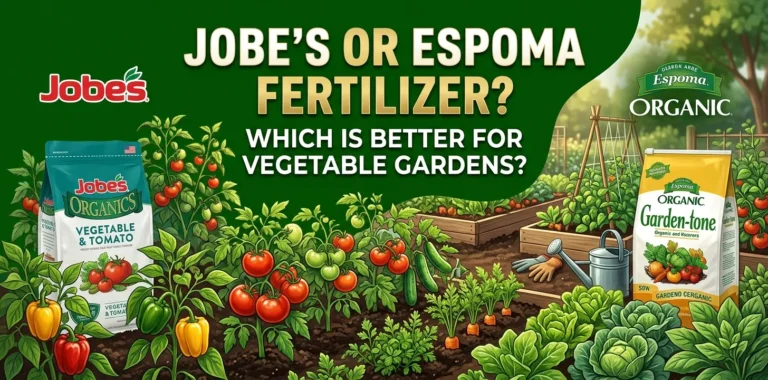
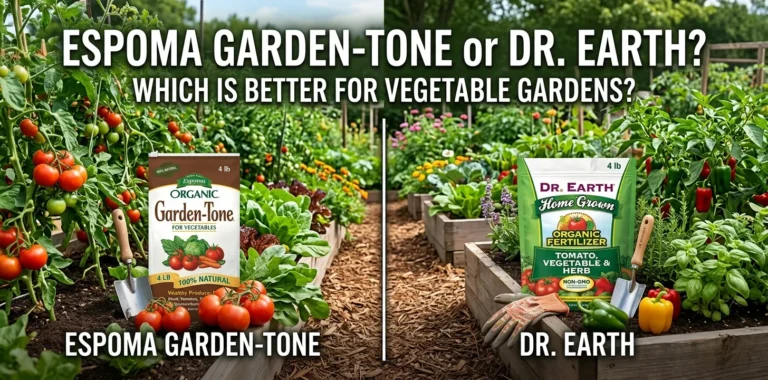
Dr. Earth has dedicated vegetable products such as Home Grown Tomato, Vegetable & Herb Fertilizer. Espoma offers products such as Garden-tone and Tomato-tone that are designed specifically for vegetables.
The better choice depends on what you’re growing and what your soil needs.
For example, imagine you have a raised bed containing tomatoes, peppers, lettuce, and beans. You don’t necessarily need the fertilizer with the biggest list of ingredients. You need a product whose nutrient profile fits the crop and your soil.
A soil test can be more useful than switching brands blindly.
For tomatoes
Slight edge: Dr. Earth for gardeners who want a dedicated organic vegetable formula; Espoma is also an excellent option.
Dr. Earth Home Grown is specifically formulated for tomatoes, vegetables, and herbs and carries organic certification information on its product page.
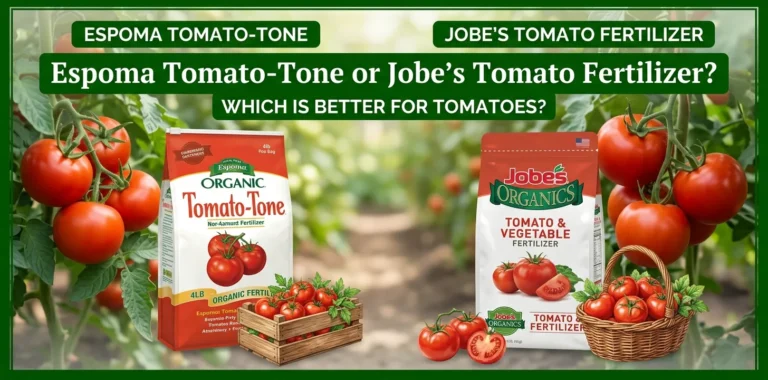
Espoma’s Tomato-tone is another dedicated tomato fertilizer within its Tone family.
The practical choice is to compare the two labels and choose the formula that fits your soil and feeding plan.
For mixed vegetable beds
Espoma gets a slight simplicity advantage.
Garden-tone is designed as a general vegetable and herb food, so it can be convenient when you grow many different crops together.
Dr. Earth may be preferable if you want to build a more specialized feeding plan around individual crops.
Which Is Better for Flowers?
This depends heavily on the type of flowers.
Espoma offers several specialized Tone products, including Flower-tone and Rose-tone. Dr. Earth also has formulas designed for flowering plants and specialty ornamentals.
For a mixed flower bed, Espoma is a very easy choice because its Tone lineup makes plant matching straightforward.
For gardeners who want a more specialized fertilizer program, Dr. Earth deserves a closer look.
Neither brand should be selected simply because the package promises bigger or more beautiful flowers. Match the fertilizer to the plant and follow the label rate.
Which Is Better for Soil Health?
This one is close.
Both companies emphasize beneficial biology rather than treating fertilizer as nothing more than N-P-K.
Dr. Earth uses its TruBiotic® system on many products, while Espoma uses Bio-tone® in many of its organic fertilizers. Some Espoma products also include mycorrhizae.
But adding microbes to a fertilizer doesn’t automatically make one product better for every soil.
Soil health also depends on:
- Organic matter
- Compost
- Moisture
- Drainage
- Soil pH
- Existing nutrient levels
- Plant diversity
- Mulching
- Avoiding unnecessary fertilizer applications
A good fertilizer works best as part of a healthy soil-management plan.
Which Is Easier for Beginners?
Espoma has a slight advantage for beginners.
Its Tone naming system is easy to understand. If you’re growing tomatoes, you can look for Tomato-tone. Growing roses? Rose-tone. Growing berries? Berry-tone. Growing a mixed vegetable garden? Garden-tone is an obvious starting point.
Dr. Earth is also beginner-friendly, but its larger range of formulas can make the shelf look more complicated.
For a new gardener, simplicity has real value. You’re more likely to get good results when you can easily understand what you’re buying and how to use it.
Which Has Better Specialty Options?
Dr. Earth has the edge.
Its lineup covers a wide range of specialized needs, including acid-loving plants, vegetables, flowers, bulbs, tropical plants, citrus, starters, and general-purpose feeding.
This is useful if your garden includes plants with very different nutrient requirements.
For instance, blueberries prefer acidic conditions, while many common vegetables are happier in a different soil environment. Using one generic fertilizer for every plant isn’t always the best approach.
Dr. Earth’s specialty formulas can make it easier to build a more targeted feeding plan.
Which Is Better for Organic Gardening on a Budget?
There isn’t a universal winner.
The cost of the bag is only part of the calculation. Compare:
- Bag price
- Bag weight
- Application rate
- Coverage
- N-P-K ratio
- Whether you actually need the specialty ingredients
- How often you need to reapply it
A cheaper bag isn’t necessarily cheaper per garden bed if you need to use substantially more of it.
Likewise, paying more for a highly specialized formula isn’t useful if your soil already has the nutrients your plants need.
The best value is the fertilizer that matches your soil and crop without unnecessary inputs.
Dr. Earth vs. Espoma: Which One Should You Buy?
Use this simple decision guide:
| Your situation | Better starting point |
|---|---|
| First organic fertilizer | Espoma |
| Mixed vegetable garden | Espoma |
| Tomatoes and vegetables | Either |
| Many specialty plants | Dr. Earth |
| Want specific organic certifications | Dr. Earth, after checking the exact product |
| Prefer the classic Tone system | Espoma |
| Want specialty formulas | Dr. Earth |
| Want microbial-based organic fertilizer | Either |
| Need a starter fertilizer | Either |
| Want one brand for many different plant types | Either, with a slight Dr. Earth edge for specialty choices |
Two Things Gardeners Often Get Wrong
Choosing the brand before testing the soil
A fertilizer can’t fix every soil problem.
If your garden has a nutrient deficiency, excessive nutrients, poor pH, or another soil issue, changing from Espoma to Dr. Earth may not solve the underlying problem.
For a vegetable garden that has struggled for more than one season, a soil test is often a smarter first step.
Assuming more fertilizer means better growth
Organic fertilizers are not harmless simply because they are organic.
Follow the application instructions on the specific product. Espoma itself recommends following the labeled application rates, even though its Tone products have relatively slow-release, low-salt characteristics.
Too much fertilizer can create nutrient imbalances and waste money.
So, Is Dr. Earth or Espoma Better for Organic Gardening?
For most gardeners, there is no dramatic winner.
Choose Espoma if you value a simple, familiar plant-specific fertilizer system and want products such as Garden-tone, Tomato-tone, or Plant-tone.
Choose Dr. Earth if you want a broader selection of specialty formulas, strong organic-certification information on specific products, and its TruBiotic-focused approach.
If I had to choose one brand for a gardener who wants the most flexibility, I’d give Dr. Earth a slight overall edge. For a beginner who wants an easy, straightforward fertilizer system, Espoma may be the better choice.
The more important decision, though, is the exact fertilizer—not the logo on the bag.
Frequently Asked Questions
Can you use Dr. Earth and Espoma together?
You generally don’t need to combine two similar granular fertilizers unless you have a specific reason to do so. Their nutrient inputs can overlap, so using both without considering the N-P-K ratios and application rates can result in unnecessary fertilization.
Is Espoma better than Dr. Earth for vegetables?
Not automatically. Espoma’s Garden-tone and Tomato-tone make it easy to choose vegetable-focused products, while Dr. Earth offers dedicated vegetable and tomato formulas. The better product depends on your crop, soil conditions, and nutrient needs.
Which is better for certified organic gardening, Dr. Earth or Espoma?
Check the certification of the exact product rather than relying only on the brand name. Several Dr. Earth fertilizers specifically list OMRI and other organic registrations, while Espoma identifies its organic fertilizers as Organic Approved and notes CDFA certification.
The Bottom Line
Dr. Earth gets the slight overall advantage for gardeners who want specialty options and clearly documented organic certifications on specific products. Espoma is an excellent alternative, especially for beginners who like its simple Tone system and established organic fertilizer lineup.
Before buying, look at your soil test, the crop you’re feeding, and the exact N-P-K and application directions on the bag. Expert tip: choose the fertilizer that solves your garden’s actual nutrient need rather than choosing a brand simply because it has a stronger reputation.