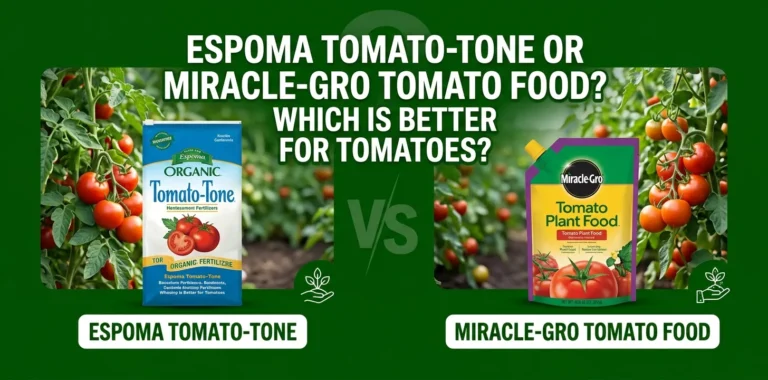
Espoma Tomato-Tone or Jobe’s Tomato Fertilizer? Which Is Better for Tomatoes?

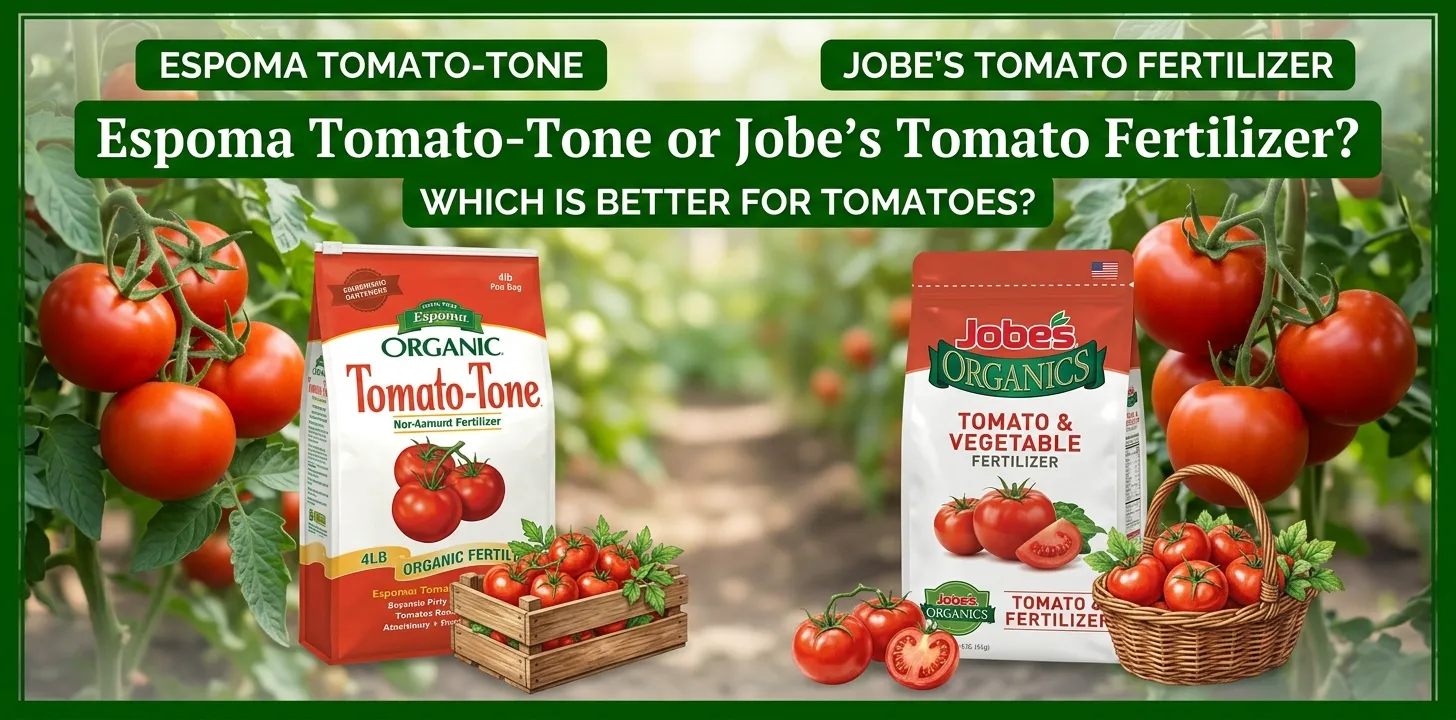
If you are choosing between Espoma Tomato-Tone and Jobe’s Organics Vegetable & Tomato Granular, both are organic granular fertilizers made for tomatoes. But they are not identical. Espoma Tomato-Tone has a 3-4-6 analysis, 8% calcium, slow-release nitrogen, and beneficial microbes, while Jobe’s current Vegetable & Tomato Granular is 2-5-3 and is applied every 4–6 weeks.
For most home gardeners growing tomatoes, Espoma Tomato-Tone is the better overall choice because its higher potassium level and stated calcium content fit the needs of fruiting tomatoes well. Jobe’s is still a good option if you want a tomato-and-vegetable fertilizer with a longer interval between applications and a 2-5-3 nutrient profile.
Espoma Tomato-Tone vs. Jobe’s: The Quick Comparison
| Feature | Espoma Tomato-Tone | Jobe’s Organics Vegetable & Tomato |
|---|---|---|
| NPK | 3-4-6 | 2-5-3 |
| Designed for | Tomatoes and other fruiting crops | Tomatoes and vegetables |
| Calcium listed | 8% | Calcium is supplied through ingredients, but no percentage is listed on the current product page |
| Beneficial microbes | Yes, Bio-tone® microbes | Yes, Biozome® |
| Release | Slow-release organic fertilizer | Granular organic fertilizer |
| Application interval | About every 2 weeks during the growing season | Every 4–6 weeks |
| Best fit | Gardeners focused on tomato fruit production and steady feeding | Gardeners who want fewer fertilizer applications |
| Overall pick for tomatoes | Espoma Tomato-Tone | Good alternative |
Espoma lists Tomato-Tone as a 3-4-6 fertilizer with 8% calcium, magnesium, sulfur, slow-release nitrogen, and several beneficial microbial species. Jobe’s lists its Vegetable & Tomato Granular as 2-5-3 and highlights bone meal, potash, processed manure, and Biozome microorganisms.
Why Espoma Tomato-Tone Gets the Edge for Tomatoes
Tomatoes need more than just nitrogen. Once plants move into flowering and fruit production, potassium becomes especially important, while excessive nitrogen can encourage too much foliage and delay fruit production. Penn State Extension notes that tomatoes need high levels of potassium during fruit production and recommends matching fertilizer sources and rates to soil conditions.
That makes Tomato-Tone’s 3-4-6 analysis attractive for a tomato-focused fertilizer. It provides less nitrogen than a high-nitrogen lawn or general-purpose fertilizer and more potassium than Jobe’s 2-5-3 formula.
There is another reason Tomato-Tone stands out: 8% calcium is specifically listed on its guaranteed analysis. That does not mean the fertilizer alone prevents blossom-end rot, but it gives gardeners a clearly stated calcium source.
The calcium advantage is useful, but don’t overstate it
Blossom-end rot is often blamed simply on a lack of calcium. The real situation is more complicated.
Penn State Extension explains that blossom-end rot is strongly associated with environmental stress, including inconsistent moisture, heat, and other factors. University of Minnesota Extension also emphasizes that fluctuating soil moisture is a major contributor.
So buying a fertilizer with calcium is not a substitute for good watering.
If your soil already contains enough calcium, adding more calcium may not solve the problem. Keeping the soil evenly moist is often just as important.
Where Jobe’s Organics Makes Sense
Jobe’s Organics Vegetable & Tomato Granular is not a weak fertilizer. Its current formula is 2-5-3, and Jobe’s recommends applying it every 4–6 weeks. The product is designed for both tomato and vegetable plants.
Its ingredient approach is also different. Jobe’s highlights:
- Bone meal as a source of phosphorus and calcium
- Potash for potassium
- Processed manure for nutrients and organic matter
- Biozome® beneficial microorganisms, including bacteria, mycorrhizal fungi, and archaea
That makes Jobe’s a reasonable choice if you grow a mixed vegetable garden rather than tomatoes alone.
The longer 4–6 week application interval can also appeal to gardeners who do not want to remember a more frequent feeding schedule.
NPK: 3-4-6 vs. 2-5-3
The numbers on a fertilizer bag represent the percentage of nitrogen, phosphate, and potash by weight.
For these two products:
| Nutrient | Tomato-Tone | Jobe’s |
|---|---|---|
| Nitrogen | 3% | 2% |
| Phosphate | 4% | 5% |
| Potash | 6% | 3% |
The biggest difference is the potassium level.
Tomato-Tone has twice as much listed potash as Jobe’s. Potassium plays an important role in plant functions and fruit production, making that difference relevant when choosing a fertilizer for a tomato-focused garden.
Jobe’s has more phosphate, but that does not automatically make it better for tomatoes. More of one nutrient is not necessarily better when the soil already has adequate levels.
This is why a soil test can be more useful than simply choosing the fertilizer with the biggest number.
Which Is Better for Blossom-End Rot?
Tomato-Tone has the clearer advantage on the label because it specifically lists 8% calcium. However, neither fertilizer should be viewed as a guaranteed cure or prevention for blossom-end rot.
Blossom-end rot is linked to the plant’s ability to move calcium into developing fruit, and inconsistent moisture can interfere with that process. Penn State and University of Minnesota Extension both emphasize moisture management as an important part of reducing the problem.
If your tomatoes are developing blossom-end rot, focus on:
- Keeping soil moisture consistent.
- Mulching around plants to reduce moisture swings.
- Avoiding excessive fertilizer.
- Checking your soil test before adding large amounts of calcium.
- Avoiding root damage during cultivation.
So, choose Tomato-Tone if you specifically want a fertilizer that provides a clearly stated calcium amount, but don’t expect calcium in a bag to fix poor watering habits.
Which Is Better for Flowering and Fruit Production?
For a gardener primarily interested in tomatoes, Tomato-Tone gets the nod.
Its 3-4-6 analysis supplies more potassium than Jobe’s 2-5-3. Potassium is especially relevant during tomato fruit production.
That does not mean Jobe’s will produce poor tomatoes. A healthy tomato plant depends on much more than fertilizer, including sunlight, water, soil conditions, variety, temperature, and disease management.
The fertilizer is one part of the growing system.
Which Is Easier to Use?
This is where Jobe’s has a practical advantage.
Espoma’s current directions call for feeding established plants every two weeks during the growing season, with 3 tablespoons per individual plant. Jobe’s recommends applying its Vegetable & Tomato Granular every 4–6 weeks.
That means:
- Tomato-Tone: Better for gardeners comfortable with a regular feeding schedule.
- Jobe’s: Better for gardeners who prefer fewer applications.
Neither approach is automatically better for the plant. Following the product label and avoiding overfertilization matters more than simply feeding more often.
What About Container Tomatoes?
Both products can work for container-grown tomatoes, but container plants need closer attention because watering and nutrient levels can change faster in a limited amount of growing media.
Espoma provides specific container directions. For established potted tomatoes, it recommends 1.5 teaspoons for every 4 inches of pot diameter, followed by thorough watering.
For example, a 12-inch pot would use the equivalent of 1.5 tablespoons according to Espoma’s stated rate.
For a balcony or patio gardener growing just a few tomato plants, Tomato-Tone’s tomato-specific directions make it an easy choice.
Which Is Better for a Large Vegetable Garden?
For a garden containing tomatoes, peppers, and other vegetables, Jobe’s may be more convenient because its product is specifically formulated for both vegetables and tomatoes and has a 4–6 week application schedule.
Tomato-Tone can also be used on peppers, squash, and melons, so it is not limited strictly to tomatoes.
The better choice depends on whether your priority is a tomato-focused fertilizer or one product you can use across a broader vegetable garden.
Two Real-World Choices
Imagine you have four tomato plants in a backyard raised bed and your main goal is a strong fruit crop. You already water consistently and want a tomato-specific organic fertilizer. Tomato-Tone is the more logical pick because of its 3-4-6 analysis, higher potassium, and stated 8% calcium.
Now imagine you have tomatoes, peppers, cucumbers, and several other vegetables and would rather fertilize every month or so instead of following a more frequent tomato-feeding schedule. Jobe’s is a practical choice because its product is designed for tomatoes and vegetables and is applied every 4–6 weeks.
Don’t Choose Fertilizer by NPK Alone
A common mistake is assuming the fertilizer with the highest number must be the best.
That is not how tomato nutrition works.
Penn State Extension recommends using soil tests to determine existing nutrient levels and matching the fertilizer source and rate to the crop’s needs. Overfertilizing can create its own problems, and excessive nitrogen can encourage foliage at the expense of timely fruit production.
For a tomato garden, consider:
- Existing soil nutrient levels
- Soil pH
- Plant growth stage
- Amount of compost or organic matter already present
- Watering consistency
- Container vs. in-ground growing
- Whether you are growing tomatoes only or several vegetables
A fertilizer should fill a need rather than simply add more nutrients.
How to Use Tomato Fertilizer Without Overdoing It
If you choose Tomato-Tone, Espoma’s current directions recommend mixing 3 tablespoons into the soil for an individual plant at planting, then feeding established plants according to its growing-season schedule. The fertilizer should be kept at least 3 inches away from the stem and watered thoroughly after application.
If you choose Jobe’s, follow the current package directions rather than trying to match the amount used for Tomato-Tone. The two products have different nutrient analyses and application schedules. Jobe’s currently recommends application every 4–6 weeks.
Avoid the temptation to combine multiple tomato fertilizers just because each one looks useful. More fertilizer does not automatically mean more tomatoes.
Espoma Tomato-Tone or Jobe’s: Which Should You Buy?
For most tomato growers, I would choose Espoma Tomato-Tone.
Its 3-4-6 analysis is well suited to a fruiting crop, it supplies more listed potassium than Jobe’s 2-5-3 formula, and its guaranteed analysis specifically lists 8% calcium. It also provides slow-release nitrogen and beneficial microbes.
Choose Jobe’s instead if you want one organic granular fertilizer for both tomatoes and a wider vegetable garden, prefer a 4–6 week feeding schedule, or simply prefer its ingredient and nutrient approach.
The important point is that the “better” fertilizer is not automatically the one with more nutrients. Your soil, watering habits, plant growth, and existing fertility all matter.
Frequently Asked Questions
Is Espoma Tomato-Tone better than Jobe’s for tomatoes?
For most home tomato gardens, yes. Tomato-Tone has a 3-4-6 analysis, 8% listed calcium, and more potassium than Jobe’s current 2-5-3 Vegetable & Tomato Granular, making it the stronger tomato-focused choice.
Can Jobe’s Organics be used on tomato plants?
Yes. Jobe’s Vegetable & Tomato Granular is specifically formulated for tomato and vegetable plants and is currently labeled with a 2-5-3 analysis. The manufacturer recommends applying it every 4–6 weeks.
Will Tomato-Tone prevent blossom-end rot?
Not by itself. Tomato-Tone contains 8% calcium, but blossom-end rot is also strongly affected by inconsistent soil moisture and plant stress, so steady watering and good growing conditions are important.
Final Verdict
Espoma Tomato-Tone is the better overall pick for tomatoes, while Jobe’s Organics Vegetable & Tomato is a solid alternative for mixed vegetable gardens and gardeners who prefer less frequent feeding.
If you are growing a few backyard tomatoes and want a fertilizer specifically geared toward fruit production, start with Tomato-Tone and follow its label rate. More importantly, keep the soil evenly moist, avoid overfertilizing, and consider a soil test before adding extra nutrients. Consistent water and balanced nutrition can matter more than switching between two good organic fertilizers.