Jobe’s or Espoma Fertilizer? Which Is Better for Vegetable Gardens?

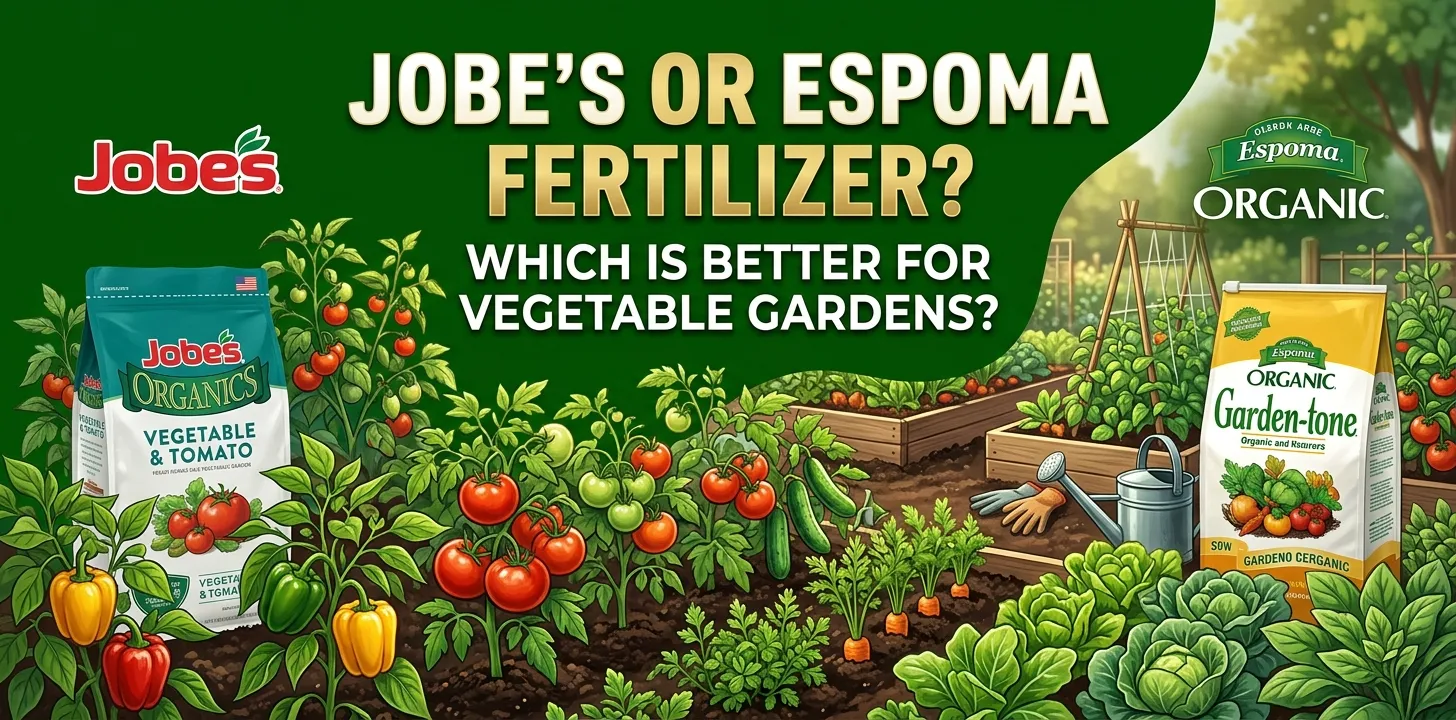
If you are choosing between Jobe’s Organics and Espoma for a vegetable garden, Espoma Garden-tone is the better all-around choice for mixed vegetable beds, while Jobe’s Organics can be a better fit when you want a more targeted vegetable formula or easier application. The exact Jobe’s product matters because the brand offers several fertilizer types with different NPK ratios and feeding schedules.
Jobe’s vs. Espoma for Vegetable Gardens
The first thing to understand is that this is not a perfect brand-to-brand comparison. Both companies sell several organic fertilizers, so comparing “Jobe’s” with “Espoma” without naming the product can be misleading.
For a typical home vegetable garden, a useful comparison is Jobe’s Organics Vegetable & Tomato Granular 2-5-3 versus Espoma Garden-tone 3-4-4. Both are designed for vegetables, but they take slightly different approaches to feeding.
| Feature | Jobe’s Organics Vegetable & Tomato | Espoma Garden-tone |
|---|---|---|
| NPK | 2-5-3 | 3-4-4 |
| Main use | Vegetables and tomatoes | Herbs and vegetables |
| Form | Granular | Granular |
| Organic | Yes | Yes |
| Beneficial microbes | Biozome | Bio-tone microbes |
| Typical feeding interval | Every 4–6 weeks | Monthly during growing season |
| Best fit | Targeted vegetable feeding | Mixed vegetable gardens |
| Application style | Granular feeding | Soil preparation and ongoing feeding |
Jobe’s lists its vegetable and tomato granular fertilizer as a 2-5-3 formula and recommends applying it every 4–6 weeks. Espoma Garden-tone is a 3-4-4 fertilizer intended for herbs and vegetables, with directions that include soil preparation before planting and monthly feeding during the growing season.
Why Espoma Garden-tone Gets the Edge for Mixed Vegetable Gardens
For a garden containing tomatoes, peppers, beans, cucumbers, greens, carrots, and other vegetables, Garden-tone is the more straightforward all-purpose pick.
Its 3-4-4 analysis gives the fertilizer a fairly balanced nutrient profile, and Espoma specifically formulates Garden-tone for herbs and vegetables. The company also says the product contains natural and organic ingredients, slow-release nutrients, humates, and beneficial microbes.
Garden-tone is also designed for more than just feeding individual plants. Espoma’s directions cover preparing an entire vegetable bed before planting, followed by feeding seedlings, transplants, and established vegetables.
That makes it particularly convenient if you have a mixed in-ground or raised-bed vegetable garden and do not want to choose a separate fertilizer for every crop.
When Jobe’s may be the better choice
Jobe’s becomes more attractive when you want a fertilizer specifically labeled for vegetables and tomatoes or prefer its particular feeding system.
The Jobe’s Organics Vegetable & Tomato Granular formula is 2-5-3 and is specifically designed for tomato and vegetable plants. It also contains Jobe’s Biozome blend, which the company describes as a combination of beneficial bacteria, mycorrhizal fungi, and Archaea.
Jobe’s also makes several other organic fertilizer formats, including spikes, water-soluble products, slow-release granular products, and different plant-specific formulas.
So if convenience or a specific application method matters more to you, Jobe’s deserves a close look.
NPK: Which Formula Makes More Sense?
The three numbers on a fertilizer bag represent nitrogen (N), phosphate (P₂O₅), and potash (K₂O).
For the two vegetable products discussed here:
- Jobe’s Vegetable & Tomato: 2-5-3
- Espoma Garden-tone: 3-4-4
The difference is not huge, but it can matter depending on your soil and plants.
Jobe’s 2-5-3 formula supplies a little more phosphorus relative to nitrogen and potassium.
Garden-tone’s 3-4-4 formula supplies slightly more nitrogen and potassium relative to its phosphorus content.
That does not mean one fertilizer will automatically produce more vegetables. Fertilizer should be chosen based on what your soil and plants actually need. A soil test can be more useful than simply choosing the fertilizer with the highest number on the bag.
Which Is Better for Tomatoes?
For a garden with several tomato plants, either can work, but the specific product matters more than the brand name.
Jobe’s Vegetable & Tomato Granular is specifically formulated for tomatoes and vegetables, making it a logical choice if tomatoes are a major part of your garden.
Espoma also makes Tomato-tone, a separate tomato-focused fertilizer with a 3-4-6 analysis. Espoma’s product lineup therefore gives tomato growers another option beyond Garden-tone.
For a mixed bed containing tomatoes plus many other vegetables, Garden-tone is simpler. If tomatoes are the main crop, compare the tomato-specific formulas rather than assuming the general vegetable fertilizer is automatically better.
Which Is Better for Raised Beds?
Espoma Garden-tone has a slight advantage for raised vegetable beds, especially when you are preparing the whole bed before planting.
Espoma recommends using Garden-tone during soil preparation and working it into the top 4–5 inches of soil. Its current directions recommend 3 pounds per 50 square feet for vegetable-garden soil preparation, followed by additional feeding for plants during the growing season.
Raised beds also benefit from good soil structure and organic matter. Fertilizer alone cannot fix poor soil.
A better approach is to start with quality soil and compost, test the soil when appropriate, and then use fertilizer to address nutrient needs.
A practical raised-bed example
Suppose you have a raised bed growing tomatoes, peppers, lettuce, and cucumbers.
Garden-tone makes sense if you want one vegetable-focused fertilizer that can be used across the bed. You can prepare the soil before planting and then follow the product’s directions for later feeding.
If you prefer Jobe’s, its Vegetable & Tomato Granular can also serve the same general purpose, provided you follow the label directions for that specific product.
Which Is Easier to Use?
This depends on which Jobe’s product you choose.
The standard Jobe’s Vegetable & Tomato fertilizer is granular and requires measuring and applying the correct amount. Espoma Garden-tone is also granular, so the basic application process is similar.
However, Jobe’s offers fertilizer spikes and water-soluble products for gardeners who prefer different application methods. Its vegetable spikes, for example, are pre-measured and intended specifically for vegetables.
For a traditional vegetable bed, though, granular fertilizer is usually the more practical format because you can distribute it across the soil around multiple plants.
What About Beneficial Microbes?
Both brands emphasize beneficial microorganisms, but their systems are not identical.
Espoma Garden-tone contains Bio-tone beneficial microbes. Its fact sheet identifies several Bacillus species and describes the product as a slow-release organic fertilizer.
Jobe’s Vegetable & Tomato Granular contains its proprietary Biozome blend, which Jobe’s describes as containing bacteria, mycorrhizal fungi, and Archaea.
These ingredients can be useful parts of an organic fertilizer program, but they should not be the only reason you choose one product. Your soil condition, nutrient needs, crop type, application rate, and gardening method matter more.
Which Fertilizer Is Better for Beginners?
For a beginner with a typical mixed vegetable garden, Espoma Garden-tone is the easier recommendation.
The reason is simple: the product is specifically positioned for herbs and vegetables, and its instructions cover several common situations, including soil preparation, seedlings, transplants, established plants, rows, and containers.
Jobe’s is also beginner-friendly, particularly if you choose a product designed specifically for vegetables or tomatoes. But its larger range of formulas means you need to pay closer attention to the exact product you are buying.
A common mistake is seeing “Jobe’s Organics” on a bag and assuming every Jobe’s fertilizer has the same NPK ratio. It does not. Jobe’s currently sells several organic granular formulas with different purposes and nutrient analyses.
Don’t Choose Fertilizer by NPK Alone
A higher NPK number is not automatically better for vegetables.
For example, if your soil already contains plenty of phosphorus, adding a fertilizer mainly because it has a higher phosphorus number may not be useful.
Your garden’s soil test can help identify nutrient deficiencies and excesses. Crop type also matters. Leafy greens, root crops, and fruiting vegetables do not always have identical nutrient needs.
Also remember that fertilizer is not a substitute for good soil.
Healthy vegetable beds need appropriate moisture, drainage, organic matter, sunlight, and nutrients. Compost can improve soil structure, but it should not be treated as a complete replacement for testing and balanced fertilization.
Common Mistakes When Using Organic Vegetable Fertilizer
Even a good fertilizer can cause problems when it is applied incorrectly.
Applying too much
More fertilizer is not necessarily better. Follow the rate on the current product label rather than estimating by eye.
Espoma specifically recommends following its application rates and notes that its products are slow-release and relatively low in salts, but gardeners should still use the recommended amount.
Putting fertilizer against the plant stem
Do not pile granular fertilizer directly against the main stem.
Espoma’s Garden-tone directions tell gardeners to apply around the drip line and avoid contact with the plant’s main stem or foliage.
Ignoring the soil
If plants are struggling, fertilizer may not be the answer.
Poor drainage, compacted soil, incorrect pH, insufficient sunlight, pests, disease, and inconsistent watering can all cause vegetable plants to perform poorly.
Comparing brands instead of products
This is one of the easiest mistakes to make with Jobe’s and Espoma.
A Jobe’s 2-5-3 vegetable fertilizer is not the same product as Jobe’s 4-4-4 all-purpose fertilizer. Likewise, Espoma Garden-tone is different from Plant-tone and Tomato-tone.
Always compare the exact product name and NPK analysis printed on the bag.
So, Which Is Better: Jobe’s or Espoma?
For most home gardeners growing a mixed vegetable garden, Espoma Garden-tone is my pick.
It is specifically made for vegetables and herbs, has a balanced 3-4-4 analysis, supports both initial soil preparation and ongoing feeding, and is available in several bag sizes.
Choose Jobe’s instead if you prefer its vegetable-specific 2-5-3 formula, want one of its specialized application methods, or already use Jobe’s products and prefer its Biozome-based system. Jobe’s offers a wider range of fertilizer formats, so it can be the more flexible brand for some gardeners.
The key is not simply “Jobe’s vs. Espoma.” It is which exact fertilizer fits your soil, crops, and application style.
Frequently Asked Questions
Is Jobe’s or Espoma better for vegetable gardens?
Espoma Garden-tone is the better all-around choice for a typical mixed vegetable garden. Jobe’s is also a strong option, especially its Vegetable & Tomato Granular fertilizer, but the best choice depends on the exact formula and your garden’s nutrient needs.
Can I use Jobe’s and Espoma fertilizer together?
There is usually little reason to combine two complete fertilizers unless a soil test or specific crop need supports doing so. Since both products supply multiple nutrients, using both without adjusting the total application rate can add more nutrients than your plants need.
Is Espoma Garden-tone good for tomatoes and peppers?
Yes. Espoma specifically lists tomatoes and peppers among the vegetables for which Garden-tone can be used. Its directions cover soil preparation, transplants, established plants, rows, and containers.
Final Takeaway
For most mixed vegetable gardens, choose Espoma Garden-tone. It is a straightforward, vegetable-focused fertilizer that works well for preparing beds and feeding plants through the growing season.
Jobe’s is worth choosing when you want a specific vegetable-and-tomato formula or prefer its different fertilizer formats. Before buying either one, check your soil needs and compare the exact product’s NPK ratio and label directions.
Expert tip: If you are unsure which fertilizer your garden needs, get a soil test before increasing fertilizer. Knowing what your soil already has can save money and prevent unnecessary nutrient buildup.