Espoma or Jobes Fertilizer? Which Is Better for Beginner Gardeners?

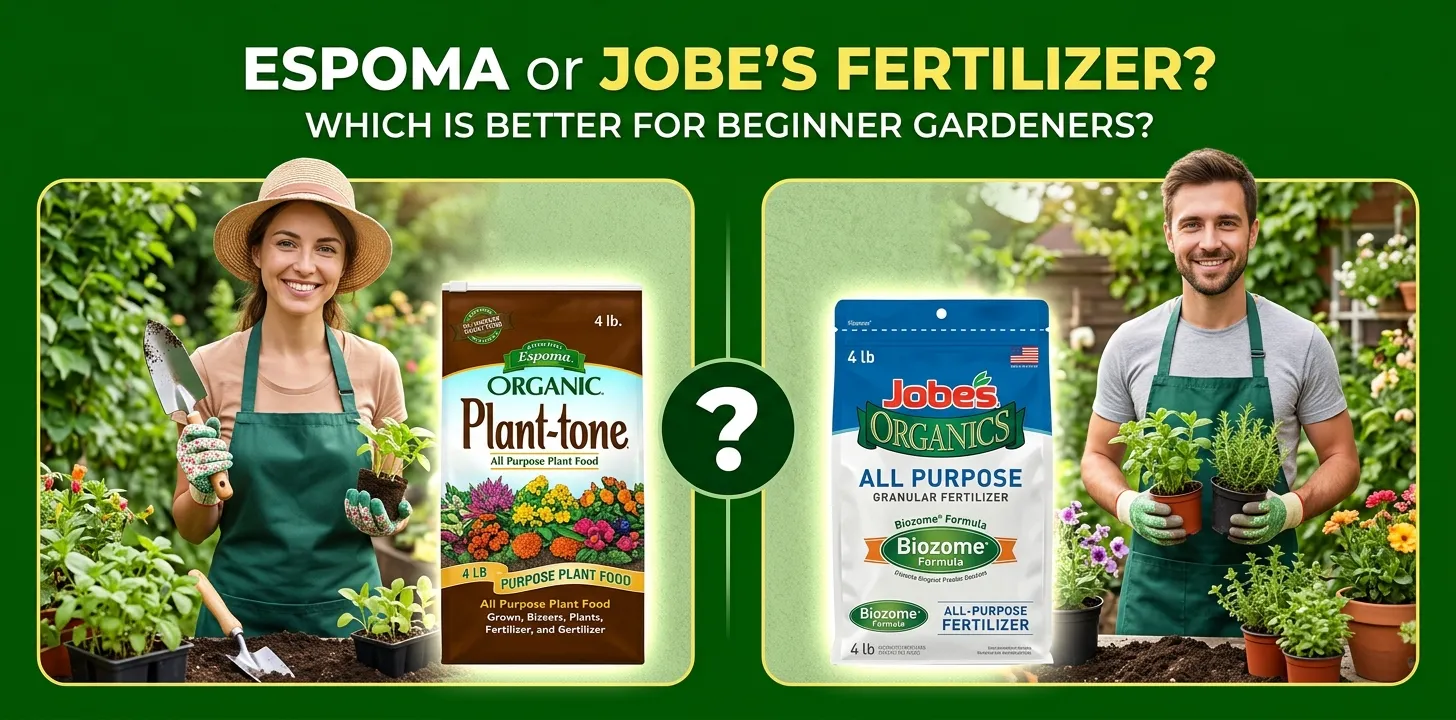
For beginner gardeners, Espoma is the better overall choice if you want simple, plant-specific organic fertilizers and clear application guidance. Jobe’s is a strong choice if you prefer flexible formats such as granular fertilizer, pre-measured spikes, or fast-acting water-soluble products. For a first garden, the best option depends more on how you plan to feed your plants than on the brand name alone.
Both Espoma and Jobe’s Organics make organic fertilizers designed for home gardens. The biggest difference is their approach. Espoma has a large family of plant-specific “Tone” fertilizers, while Jobe’s offers granular, slow-release, spike, and water-soluble options across many plant types.
The quick comparison
| Factor | Espoma | Jobe’s Organics |
|---|---|---|
| Best for | Beginners who want plant-specific formulas | Beginners who want flexible application methods |
| All-purpose option | Plant-tone 5-3-3 | All-Purpose 4-4-4 |
| Organic options | Yes | Yes |
| Granular fertilizers | Yes | Yes |
| Fertilizer spikes | Less central to the product line | Yes |
| Water-soluble options | Yes | Yes |
| Plant-specific formulas | Excellent selection | Excellent selection |
| Feeding approach | Often slow-release | Granular, spikes, slow-release, and water-soluble |
| Beginner friendliness | Excellent | Excellent |
| Best overall for a first garden | Espoma | Very good alternative |
Why Espoma is easier for many beginners
One reason Espoma stands out is its straightforward plant-focused product family. Instead of expecting a new gardener to figure out one fertilizer for every situation, Espoma offers formulas such as Plant-tone, Garden-tone, Tomato-tone, Rose-tone, Holly-tone, and Berry-tone.
For example, Espoma Plant-tone is a 5-3-3 all-purpose fertilizer intended for flowers, vegetables, trees, and shrubs. The manufacturer describes it as a slow-release organic fertilizer containing beneficial microbes.
That can make the first fertilizer purchase less confusing.
If you’re starting a mixed garden with flowers, vegetables, and shrubs, you can begin with an all-purpose product. As you learn more about your plants, you can move to formulas designed for particular crops.
Espoma’s plant-specific approach
Espoma’s product range is particularly useful when you know what you’re growing.
For example:
- Garden-tone is designed for herbs and vegetables.
- Tomato-tone is made specifically for tomatoes.
- Rose-tone is designed for roses.
- Holly-tone is intended for acid-loving plants.
- Berry-tone is formulated for berries.
- Plant-tone works as a general-purpose option.
This approach reduces guesswork. Instead of trying to adjust a general fertilizer yourself, you can select a formula intended for the plant you’re growing.
Where Jobe’s has an advantage
Jobe’s Organics may be the better fit if you want more ways to apply fertilizer.
Its current product range includes granular fertilizers, slow-release products, fertilizer spikes, and water-soluble fertilizers.
That matters because beginners have different preferences.
Some gardeners like sprinkling granules around plants. Others prefer pre-measured spikes because they don’t want to measure fertilizer. Another gardener may prefer a fertilizer mixed with water during regular watering.
Jobe’s gives you all of those choices.
Jobe’s All-Purpose Granular
Jobe’s Organics All-Purpose Granular is a 4-4-4 fertilizer designed for newly planted or replanted plants. The company recommends applying it every 4–6 weeks.
The product also contains Jobe’s Biozome blend, which includes beneficial microorganisms.
For a beginner who wants a basic granular fertilizer, this is a simple starting point.
Jobe’s fertilizer spikes
Jobe’s also offers all-purpose fertilizer spikes with a 4-4-4 analysis. The spikes are pre-measured and intended for flowers, vegetables, fruits, trees, and shrubs. The manufacturer lists an application interval of every 6–8 weeks.
This is one of Jobe’s biggest advantages for beginners: less measuring.
If handling granular fertilizer feels messy or confusing, pre-measured spikes can be appealing. You still need to follow the package directions for the particular plant and product, but the basic application is more straightforward.
Espoma vs. Jobe’s: which is easier to use?
Both are beginner-friendly, but they are easy in different ways.
Espoma is easier when choosing the right fertilizer. Its product family makes it simple to match fertilizer to the type of plant you’re growing.
Jobe’s is easier when choosing the application method. You can use granular products, spikes, slow-release products, or water-soluble fertilizers depending on your gardening setup.
For someone planting a small backyard vegetable garden, either brand can work well. The deciding factor should be the specific fertilizer and its directions, not simply which logo is on the package.
Which is better for a first vegetable garden?
For a beginner growing vegetables, Espoma gets a slight edge because its Garden-tone fertilizer is specifically designed for herbs and vegetables. The product is described as a slow-release, organic fertilizer for garden crops.
Jobe’s is also a good choice. Its product line includes dedicated vegetable and tomato fertilizers in both granular and water-soluble forms.
The better choice depends on your preference:
- Want one straightforward fertilizer for vegetables? Espoma Garden-tone is a simple choice.
- Want an all-purpose granular product? Jobe’s All-Purpose 4-4-4 is worth considering.
- Want pre-measured feeding? Jobe’s spikes have an advantage.
- Want a plant-specific fertilizer family? Espoma has a strong advantage.
- Want water-soluble feeding? Both brands have options.
Which is better for flowers?
For flowers, neither brand wins across every situation.
Espoma offers Flower-tone as well as general-purpose Plant-tone, while Jobe’s sells specific products for annuals and perennials, roses, and other flowering plants.
A beginner growing a few different flower types may find Espoma’s plant-specific lineup easier to understand.
However, if convenience is your priority, Jobe’s spikes can be attractive because they are pre-measured and designed to feed at the roots.
Which is better for containers?
Container gardening changes the decision.
Potted plants have a smaller amount of growing media than plants growing in the ground, so following the product label matters. You should not assume that a fertilizer suitable for a garden bed should be applied at the same rate to a container.
Espoma provides specific container directions for Plant-tone. For established potted plants, its directions give an amount based on pot diameter and recommend repeating the feeding monthly.
Jobe’s water-soluble products can also be convenient for container gardeners because they are mixed with water and applied during watering. Jobe’s describes its water-soluble all-purpose fertilizer as a fast-acting option.
For beginners with several containers, Espoma is easier if you prefer granular feeding and clear container directions. Jobe’s may be better if you prefer mixing fertilizer into your watering routine.
Don’t choose fertilizer by NPK numbers alone
A common beginner mistake is assuming that the fertilizer with the largest numbers must be better.
The three numbers on a fertilizer package represent its N-P-K analysis:
- N — Nitrogen: supports leafy growth.
- P — Phosphorus: plays an important role in root development and reproductive growth.
- K — Potassium: supports several plant functions, including water movement and overall plant health.
For example, Espoma Plant-tone is 5-3-3, while Jobe’s Organics All-Purpose Granular is 4-4-4.
That does not mean Jobe’s is automatically better because its numbers are balanced, or Espoma is better because it has more nitrogen.
The right fertilizer depends on the plant, soil, growing conditions, and what nutrients are actually needed.
For a beginner, choosing a product labeled for the plant you’re growing and following its directions is usually more useful than trying to pick the highest NPK numbers.
Organic does not mean you should use more
Both brands offer organic fertilizers, but organic fertilizer still needs to be used according to its label.
More fertilizer is not automatically better.
A beginner may think that adding extra fertilizer will make plants grow faster. In reality, excessive fertilizer can create nutrient problems and may damage plants or contribute to nutrient runoff.
Espoma’s Plant-tone directions, for example, specify different application amounts for garden beds, new plants, established plants, and containers.
Jobe’s products likewise have their own application schedules. Its all-purpose granular product and spikes, for example, have different recommended intervals.
The safest beginner habit is simple: identify the plant, read the label, measure the recommended amount, and don’t add extra because you think more will work faster.
Two beginner situations
If you’re starting a small backyard vegetable garden
Imagine you’re growing tomatoes, peppers, lettuce, and a few herbs in a raised bed.
You could choose Espoma Garden-tone because it is specifically intended for herbs and vegetables. You could also choose an appropriate Jobe’s vegetable and tomato fertilizer.
For this gardener, Espoma may be easier because the product choice is closely tied to the plants being grown.
If you want the least measuring possible
Now imagine you’re growing several flowering plants and a few vegetables but don’t want to measure granular fertilizer.
Jobe’s all-purpose fertilizer spikes could make more sense because they are pre-measured and designed for flowers, vegetables, fruits, trees, and shrubs.
In this case, Jobe’s has the convenience advantage.
What beginner gardeners should avoid
Regardless of which brand you choose, a few habits can cause problems.
- Don’t use a lawn fertilizer on garden vegetables unless the label specifically says it is appropriate.
- Don’t assume every fertilizer is interchangeable.
- Don’t apply more than the label recommends.
- Don’t ignore the plant’s specific nutrient needs.
- Don’t fertilize simply because a plant looks unhealthy. Poor growth can have many causes, including watering, light, pests, disease, temperature, or root problems.
- Don’t forget that fertilizer cannot replace good soil and proper growing conditions.
A fertilizer works best as part of good overall plant care rather than as a cure for every gardening problem.
So, should a beginner choose Espoma or Jobe’s?
For most first-time gardeners, I’d choose Espoma if the main goal is making fertilizer selection simple. Its range of plant-specific formulas makes it easy to choose a product based on what you’re growing, while Plant-tone provides a general-purpose starting point.
Choose Jobe’s if convenience and application options matter more. Its organic line includes granular products, pre-measured spikes, slow-release formulas, and water-soluble fertilizers, giving beginners more ways to feed their plants.
| If your priority is… | Better choice |
|---|---|
| Simple plant-specific selection | Espoma |
| First-time vegetable garden | Espoma |
| General-purpose organic fertilizer | Tie — compare the specific formulas |
| Pre-measured fertilizer | Jobe’s |
| Fertilizer spikes | Jobe’s |
| Water-soluble options | Jobe’s has a strong selection |
| Plant-specific organic lineup | Espoma |
| Overall beginner recommendation | Espoma, by a small margin |
The important point is that Espoma vs. Jobe’s is less important than choosing the right product for your plant. A properly selected Jobe’s fertilizer can be a better choice than the wrong Espoma product, and vice versa.
Frequently Asked Questions
Is Espoma fertilizer good for beginner gardeners?
Yes. Espoma is particularly beginner-friendly because it offers both all-purpose and plant-specific organic fertilizers. Plant-tone, for example, is designed for flowers, vegetables, trees, and shrubs, while other products target specific plant groups.
Is Jobe’s Organics better than Espoma?
Not across the board. Jobe’s has an advantage in application choices, including granular fertilizers, spikes, slow-release products, and water-soluble formulas, while Espoma has a particularly strong plant-specific fertilizer lineup.
What should a first-time gardener buy from Espoma or Jobe’s?
Start with a fertilizer made for the plants you’re actually growing. For a mixed garden, an appropriate all-purpose product can be a simple starting point; for vegetables, flowers, tomatoes, or other specific crops, a plant-specific formula may make more sense.
Final Verdict
Espoma is my pick for most beginner gardeners, mainly because its plant-specific fertilizer system makes the buying decision easier. Jobe’s is an excellent alternative, especially if you want fertilizer spikes, water-soluble feeding, or more flexibility in how you apply fertilizer.
Before buying, write down the plants you plan to grow and choose the fertilizer that matches them. For your first season, following the label consistently is more valuable than switching between brands or using extra fertilizer.