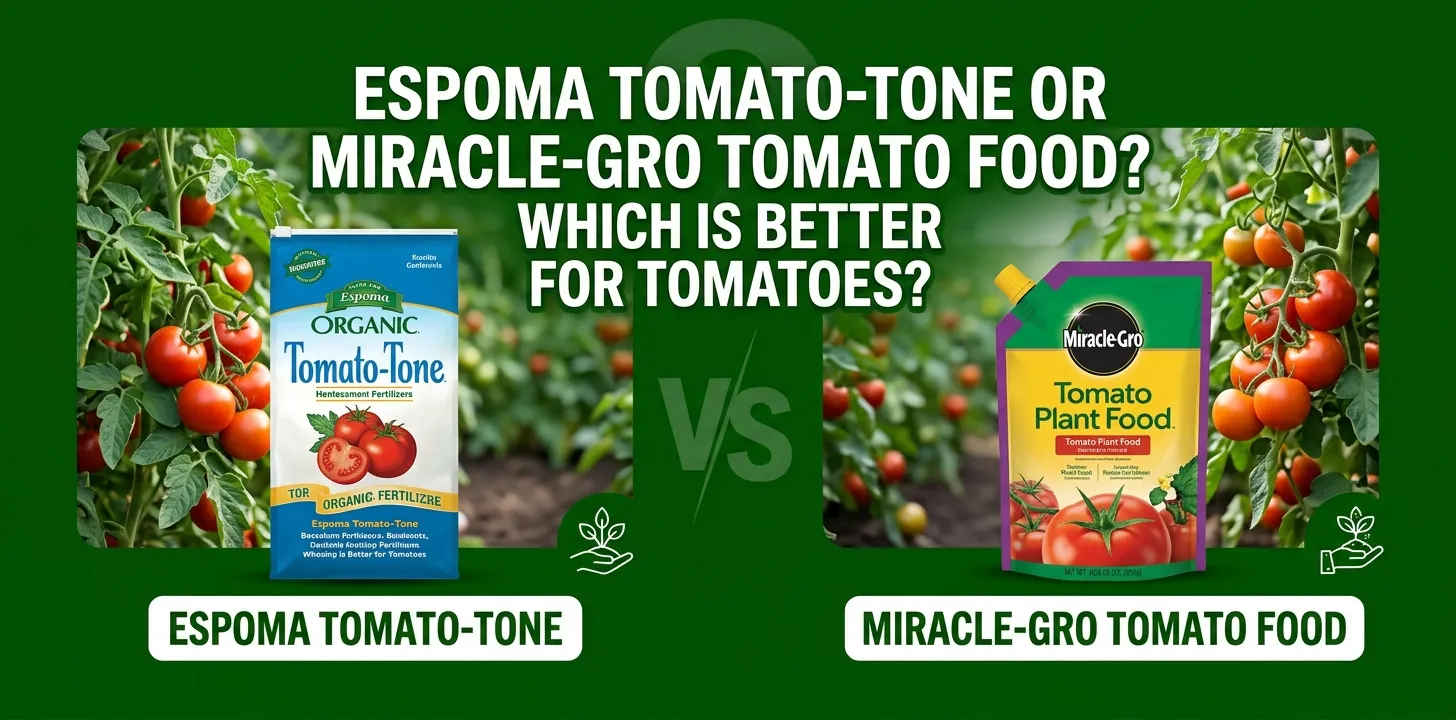
Espoma Tomato-Tone or Miracle-Gro Tomato Food? Which Is Better for Tomatoes?

If you want a simple choice, Espoma Tomato-Tone is the better pick for gardeners who want an organic, slow-release fertilizer with calcium and beneficial microbes. Miracle-Gro Water Soluble Tomato Plant Food is better when you want a fast-acting fertilizer that delivers nutrients through watering every 7–14 days. The right choice depends more on your feeding style and garden needs than on one fertilizer being universally better.
Espoma Tomato-Tone vs. Miracle-Gro Tomato Food at a Glance
These products take very different approaches to feeding tomatoes. Tomato-Tone is a granular organic fertilizer designed to release nutrients over time, while Miracle-Gro Water Soluble Tomato Plant Food dissolves in water and is intended to feed plants quickly.
| Feature | Espoma Tomato-Tone | Miracle-Gro Water Soluble Tomato Plant Food |
|---|---|---|
| Fertilizer type | Granular, slow-release | Water-soluble |
| N-P-K | 3-4-6 | 18-18-21 |
| Organic gardening | 100% natural and organic approved | Conventional water-soluble fertilizer |
| Feeding speed | Slow and steady | Fast-acting |
| Application | Apply around plants and water | Mix with water and apply |
| Typical frequency | About every 2 weeks per current directions | Every 7–14 days |
| Calcium | 8% calcium | Different nutrient formulation; check current label |
| Beneficial microbes | Yes, Bio-tone® microbes | Not the main feature |
| Containers | Yes | Yes |
| Best for | Organic, low-maintenance feeding | Fast, regular liquid feeding |
The N-P-K numbers show a major difference. Tomato-Tone is 3-4-6, while Miracle-Gro Water Soluble Tomato Plant Food is 18-18-21. A higher number does not automatically mean a fertilizer is better; the concentration and application method are different.
What Makes Espoma Tomato-Tone Different?
Espoma Tomato-Tone is specifically formulated for tomatoes and other fruiting crops such as peppers, squash, and melons. Its current formula is 3-4-6 and includes 8% calcium, magnesium, sulfur, humic acids, and beneficial microbes.
The biggest advantage is its slow-release feeding approach. Instead of dissolving completely in water for rapid feeding, much of its nitrogen is designed to become available over time. That makes it a good fit for gardeners who do not want to mix fertilizer every time they feed their plants.
Tomato-Tone is also listed by Espoma as 100% natural and organic approved. That matters if you are intentionally following an organic gardening approach.
Tomato-Tone and calcium
Tomato-Tone contains 8% calcium, which is one reason it is often considered attractive for tomato growers concerned about blossom-end rot. But adding calcium alone is not a guaranteed cure.
Blossom-end rot is closely connected to the plant’s ability to take up calcium, and inconsistent soil moisture, root problems, unsuitable soil conditions, and other factors can interfere with calcium uptake. Consistent watering and appropriate soil conditions remain important.
What Makes Miracle-Gro Tomato Food Different?
Miracle-Gro Water Soluble Tomato Plant Food is designed for gardeners who want a quick, water-based feeding system. The current US product has an 18-18-21 analysis and is recommended for tomatoes as well as other vegetables.
You mix the fertilizer with water and soak the soil around the plant. The manufacturer recommends feeding every 7–14 days while plants are actively growing.
That makes Miracle-Gro particularly convenient when a tomato plant needs a quick nutrient boost or when you already prefer liquid feeding.
The trade-off is that you have to measure, mix, and apply it regularly. It is a different routine from sprinkling a granular fertilizer around the plant and watering it in.
Which One Is Better for Organic Tomato Gardening?
Espoma Tomato-Tone is the clear choice for gardeners specifically looking for an organic tomato fertilizer. Espoma describes Tomato-Tone as 100% natural and organic approved, while its formula includes organic nutrient sources and beneficial microbes.
Miracle-Gro Water Soluble Tomato Plant Food is not the better choice if your main requirement is an organic fertilizer.
This does not mean Miracle-Gro cannot grow healthy tomatoes. It simply uses a different fertilizer approach.
Which One Works Faster?
Miracle-Gro generally has the advantage when you want fast nutrient availability. The manufacturer describes its water-soluble tomato food as feeding instantly and recommends applying it every 7–14 days.
Tomato-Tone is intended for slower, longer-lasting feeding. That can be useful when you want a more gradual nutrient supply rather than frequent liquid applications.
Think of the difference this way:
- Miracle-Gro: mix, water, feed.
- Tomato-Tone: apply granular fertilizer, water, and let it release nutrients over time.
Neither approach is automatically better for every garden.
Which Is Better for Container Tomatoes?
Both can work well in containers, but they suit different gardeners.
Choose Tomato-Tone if you want granular organic feeding and are comfortable applying it around the pot according to the label.
Choose Miracle-Gro if you like feeding while you water and do not mind mixing fertilizer regularly.
Espoma’s directions call for Tomato-Tone to be applied according to pot diameter. For example, the current directions specify 1.5 teaspoons for every 4 inches of pot diameter for established potted plants.
Miracle-Gro recommends mixing its water-soluble tomato food with water and soaking the soil around the base of outdoor plants every 7–14 days.
Container tomatoes can also dry out faster than plants in the ground, so fertilizer should not replace good watering habits.
Which Is Better for Raised Beds?
For a raised-bed gardener who wants an organic approach, Tomato-Tone has the stronger case.
Its granular application fits well with preparing soil and feeding established plants. Espoma recommends incorporating it into the soil when preparing tomato beds and applying additional fertilizer around established plants during the growing season.
Miracle-Gro makes more sense if you already use a liquid feeding routine and want a fertilizer that can be applied with a watering can or garden feeder.
For either product, the fertilizer is only one part of the equation. Good soil, adequate sunlight, consistent moisture, and appropriate tomato support still matter.
Which Is Easier to Use?
This depends on what you consider easy.
Tomato-Tone is easier for gardeners who dislike mixing fertilizer. You measure the granular product, place it around the plant as directed, and water thoroughly.
Miracle-Gro is easier for gardeners who already water with a can or garden feeder. The fertilizer dissolves in water and can be applied as part of your regular watering routine.
If you have only a few plants, either method is manageable. With a larger container collection, your preferred routine may become the deciding factor.
What About the N-P-K Difference?
The numbers can make this comparison confusing.
Tomato-Tone has an N-P-K ratio of 3-4-6, while Miracle-Gro Water Soluble Tomato Plant Food is 18-18-21.
That does not mean Miracle-Gro is automatically six times better because its nitrogen number is six times higher.
The products are formulated differently and are applied differently. Tomato-Tone also contains slow-release nitrogen and additional materials such as calcium, magnesium, sulfur, humic acids, and beneficial microbes.
The better question is not simply, “Which has the bigger N-P-K numbers?” It is, “Which nutrient delivery system fits my plants, soil, and gardening method?”
Two Practical Tomato-Growing Situations
You are growing six tomatoes in a backyard raised bed
Suppose you want an organic garden and do not want to mix fertilizer with water every week.
Tomato-Tone is the more natural fit. You can apply the granular fertilizer around the plants according to the label and maintain a regular feeding schedule.
You still need to monitor watering, plant growth, and soil conditions. More fertilizer is not necessarily better.
You are growing tomatoes in several large containers
Suppose you already water your container plants frequently and want to combine feeding with watering.
Miracle-Gro may be more convenient because you can mix the water-soluble fertilizer and apply it to the soil as part of your routine. The manufacturer recommends feeding every 7–14 days during active growth.
If you prefer organic gardening instead, Tomato-Tone remains the better match.
Should You Use Both Tomato-Tone and Miracle-Gro?
For most home gardeners, there is little reason to automatically use both.
Each product already provides a fertilizer program, and combining fertilizers can make it harder to track how much nutrition your plants are receiving. Follow the label directions for whichever product you choose rather than assuming that adding more fertilizer will produce more tomatoes.
If a soil test shows a specific nutrient problem, use that information to guide your fertilizer choice instead of stacking products blindly.
Which One Should You Buy?
The simplest decision is:
| If your priority is… | Better choice |
|---|---|
| Organic gardening | Espoma Tomato-Tone |
| Slow-release feeding | Espoma Tomato-Tone |
| Added calcium in the fertilizer | Espoma Tomato-Tone |
| Beneficial microbes | Espoma Tomato-Tone |
| Fast nutrient availability | Miracle-Gro |
| Feeding while watering | Miracle-Gro |
| Frequent liquid feeding | Miracle-Gro |
| Simple granular application | Espoma Tomato-Tone |
Choose Espoma Tomato-Tone if…
Pick Tomato-Tone if you want:
- An organic tomato fertilizer
- Granular, slow-release feeding
- A product specifically formulated for tomatoes
- Calcium included in the fertilizer
- Beneficial microbes
- A feeding routine that does not require mixing fertilizer with every application
Choose Miracle-Gro if…
Pick Miracle-Gro Water Soluble Tomato Plant Food if you want:
- Fast-acting water-soluble fertilizer
- A liquid feeding routine
- Regular feeding every 7–14 days
- A product that works for tomatoes and several other vegetables
- The option to use a watering can or Miracle-Gro Garden Feeder
The Bigger Factor: Don’t Overlook Watering
A good fertilizer cannot compensate for poor tomato care.
Tomatoes need adequate sunlight and consistent moisture. ScottsMiracle-Gro recommends 6–8 hours of sun each day and notes that inconsistent watering can contribute to problems such as blossom-end rot and cracked fruit.
This is especially important when using fertilizer. A plant that is stressed by irregular watering may not respond the way you expect, even if the fertilizer itself is suitable.
For container tomatoes, pay even more attention to moisture because containers can dry out faster.
Frequently Asked Questions
Is Tomato-Tone better than Miracle-Gro for tomatoes?
Tomato-Tone is better if you want organic, slow-release feeding with calcium and beneficial microbes. Miracle-Gro is better if you prefer fast, water-soluble feeding on a regular 7–14 day schedule.
Can I use Miracle-Gro tomato food on tomato plants in containers?
Yes. Miracle-Gro states that its Water Soluble Tomato Plant Food can be used on vegetable plants grown in containers as well as in the ground. Follow the product label for the correct dilution and application frequency.
Does Tomato-Tone prevent blossom-end rot?
Not by itself. Tomato-Tone supplies calcium, but blossom-end rot can also be related to inconsistent moisture, root problems, soil conditions, and other factors that affect calcium uptake. Keeping soil moisture consistent is an important part of prevention.
Final Verdict
For most gardeners choosing between these two specifically for an organic tomato garden, I’d pick Espoma Tomato-Tone. Its 3-4-6 slow-release formula, 8% calcium, organic ingredients, and beneficial microbes make it a strong fit for gardeners who want steady granular feeding.
Choose Miracle-Gro instead if fast, water-soluble feeding is more important to you. Its 18-18-21 formula is designed to work quickly and is applied every 7–14 days during active growth.
One practical tip: choose one fertilizer program and follow its label rather than combining products or increasing the dose. Good sunlight, consistent watering, healthy soil, and proper plant support will have just as much to do with your tomato harvest as the fertilizer you choose.