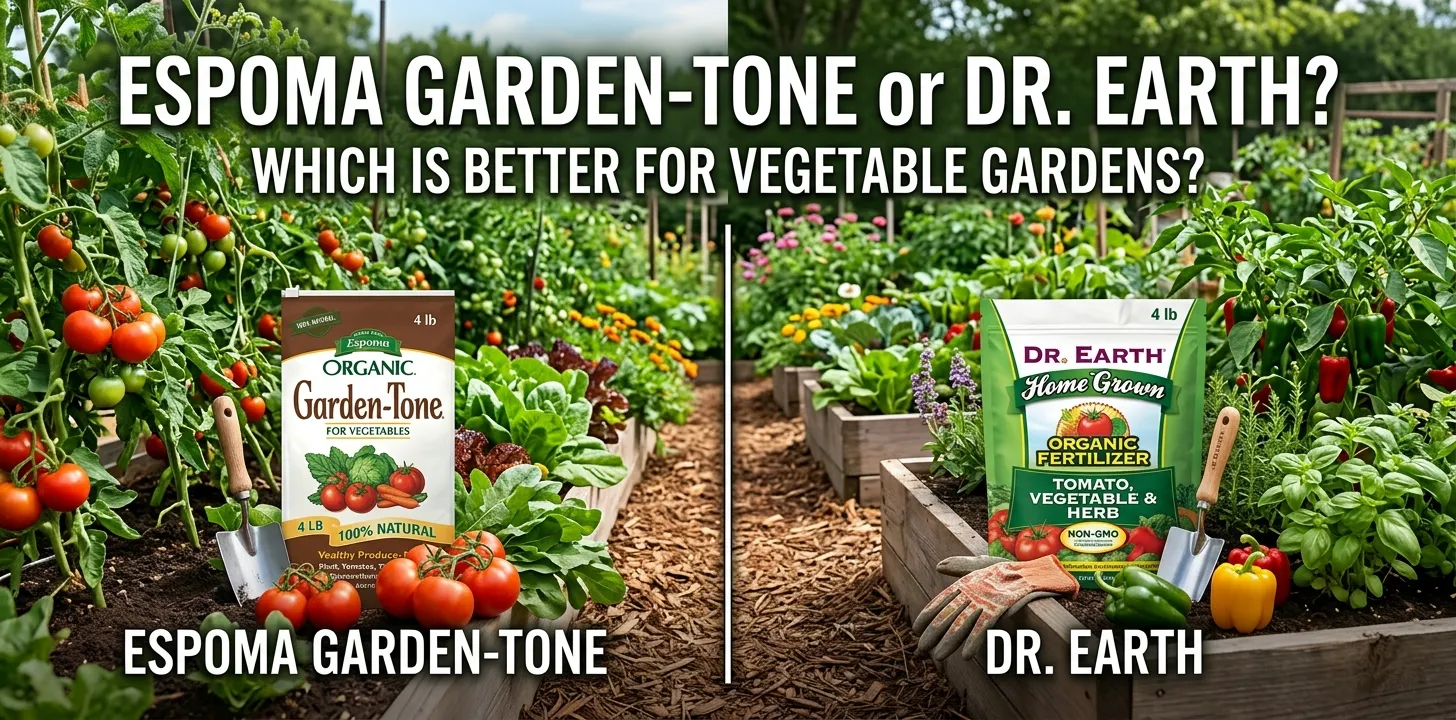
Espoma Garden-Tone or Dr. Earth? Which Is Better for Vegetable Gardens?

If you are choosing between Espoma Garden-Tone and Dr. Earth Home Grown for a vegetable garden, both are organic granular fertilizers designed for vegetables, herbs, and garden soil. Garden-Tone has a balanced 3-4-4 analysis and is a strong all-around choice for mixed vegetable beds. Dr. Earth Home Grown uses a 4-6-3 formula and adds beneficial microbes and mycorrhizae, making it attractive for gardeners who place extra value on soil biology.
For most home vegetable gardens, Espoma Garden-Tone is the better straightforward all-purpose pick, while Dr. Earth Home Grown is the better choice if you specifically want its microbial and mycorrhizal blend or prefer its higher nitrogen and phosphorus analysis.
Espoma Garden-Tone vs. Dr. Earth Home Grown at a Glance
The two products look similar at first because both are organic granular fertilizers made specifically for edible crops. The bigger differences are their nutrient analysis, added biological ingredients, and feeding approach.
| Feature | Espoma Garden-Tone | Dr. Earth Home Grown |
|---|---|---|
| Primary use | Vegetables and herbs | Vegetables, tomatoes, herbs |
| N-P-K | 3-4-4 | 4-6-3 |
| Form | Granular | Granular |
| Organic positioning | 100% natural & organic | Organic & natural |
| Beneficial microbes | Yes, Bio-tone microbes | Yes, TruBiotic microbes |
| Mycorrhizae | Not highlighted on current Garden-Tone product page | Yes |
| Calcium | 5% | 7.5% |
| Magnesium | 1% | 0.3% |
| Best fit | Mixed vegetable gardens | Vegetable gardens focused on soil biology and strong nutrient support |
| Feeding approach | Regular applications during growing season | Planting, transplanting, top dressing, or compost tea |
Espoma lists Garden-Tone as 3-4-4, with calcium and magnesium included in the guaranteed analysis. Dr. Earth lists Home Grown at 4-6-3, with calcium, sulfur, magnesium, iron, and manganese also included.
What Makes Espoma Garden-Tone Different?
Garden-Tone is designed as a general vegetable and herb fertilizer rather than a fertilizer aimed at one particular crop.
Espoma’s current directions cover a wide range of vegetables, including beans, cucumbers, eggplant, peppers, pumpkins, squash, sweet potatoes, tomatoes, broccoli, cabbage, lettuce, spinach, and root crops.
Its 3-4-4 N-P-K ratio provides a relatively balanced supply of the three primary fertilizer nutrients:
- Nitrogen (N): supports leafy growth.
- Phosphorus (P): plays a role in root development and reproductive growth.
- Potassium (K): supports overall plant function and crop development.
Garden-Tone also contains calcium, magnesium, sulfur, and several organic nutrient sources. Espoma says its formula includes ingredients such as feather meal, poultry manure, bone meal, alfalfa meal, greensand, humates, and sulfate-based mineral sources.
One useful feature for a mixed garden is that you do not need a separate fertilizer simply because you are growing several different types of vegetables. Garden-Tone is intended for a broad range of edible crops.
Garden-Tone’s feeding schedule
Espoma currently recommends mixing Garden-Tone into garden soil before planting. For established vegetables and tomatoes, its directions call for feeding monthly during the growing season, with the fertilizer kept away from the plant’s main stem and foliage.
That makes it easy to build into a simple gardening routine.
What Makes Dr. Earth Home Grown Different?
Dr. Earth Home Grown is also designed specifically for vegetable gardens, tomatoes, herbs, containers, and backyard soil.
Its 4-6-3 analysis gives it more nitrogen and phosphorus than Garden-Tone on the label, while Garden-Tone has slightly more potassium.
But the more notable difference is the biological component.
Dr. Earth says Home Grown contains TruBiotic beneficial soil microbes plus mycorrhizae. The company says these organisms help break down organic nutrients and make them available to plant roots.
The fertilizer also contains calcium, sulfur, magnesium, iron, and manganese according to the manufacturer’s current nutrient information.
Dr. Earth describes Home Grown as suitable for initial planting, transplanting, regular top dressing, and use as a compost tea. The company also states that the product is OMRI listed and references organic-input certifications and the National Organic Program.
Which Has the Better N-P-K Ratio?
There is no universally “better” N-P-K ratio because the right fertilizer depends on the crop and what your soil already contains.
Still, the difference is worth understanding:
Garden-Tone: 3-4-4
Dr. Earth Home Grown: 4-6-3
Dr. Earth therefore supplies a higher percentage of nitrogen and available phosphate on the fertilizer label, while Garden-Tone supplies a slightly higher percentage of potash.
That does not mean Dr. Earth will automatically produce larger vegetables. Fertilizer performance depends heavily on soil fertility, moisture, crop type, application rate, and growing conditions.
A soil test is much more useful than simply choosing the fertilizer with the higher numbers. If your soil already has plenty of phosphorus, for example, adding more phosphorus may not be helpful.
Which Is Better for Tomatoes?
For a garden growing mostly tomatoes, the choice becomes less straightforward.
Dr. Earth Home Grown is specifically labeled for tomatoes, vegetables, and herbs and has a 4-6-3 analysis. Garden-Tone is also labeled for tomatoes and vegetables, with a 3-4-4 analysis.
Both can work for tomatoes.
However, Garden-Tone is not necessarily the best Espoma product if tomatoes are your main crop. Espoma also sells Tomato-Tone, which has a different 3-4-6 analysis and is specifically intended for tomatoes and other fruiting crops.
So if you are comparing only the two products in this article, either can be used for tomatoes. But if your garden is primarily tomatoes, it is worth comparing tomato-specific fertilizers rather than assuming a general vegetable fertilizer is automatically ideal.
Which Is Better for Leafy Vegetables?
For crops such as lettuce, kale, spinach, and other leafy vegetables, nitrogen becomes especially important because these plants produce substantial leafy growth.
Dr. Earth’s 4-6-3 analysis contains more nitrogen than Garden-Tone’s 3-4-4 formula. That may look attractive on paper, but it still does not mean you should automatically choose the higher-nitrogen product.
If a soil test shows adequate or high phosphorus, repeatedly adding a fertilizer with relatively substantial phosphorus may not be desirable.
For a mixed garden where soil conditions are unknown, Garden-Tone’s balanced approach is a reasonable choice. For a specific garden with known nutrient needs, choose based on the soil test rather than the product label alone.
Which Is Better for Raised Beds?
Both products can make sense in raised beds.
Raised beds often contain a mix of topsoil, compost, and other amendments. Because the starting soil mix can vary widely, the fertilizer that works best depends on what is already present.
Choose Garden-Tone if:
- You want a simple general vegetable fertilizer.
- You grow many different crops in the same bed.
- You prefer a 3-4-4 analysis.
- You want a fertilizer with a straightforward monthly feeding schedule.
Consider Dr. Earth Home Grown if:
- You specifically want a fertilizer containing mycorrhizae and beneficial microbes.
- You want the 4-6-3 nutrient analysis.
- You are feeding vegetables, tomatoes, and herbs.
- You like the flexibility of using it at planting and as a top dressing.
Dr. Earth also markets Home Grown for container plantings and backyard soil, so it can be useful when your vegetable garden is not limited to traditional in-ground beds.
Which Is Better for Container Vegetables?
Container vegetables have a different challenge from in-ground gardens: there is a limited amount of growing media and a smaller root zone.
Both products can be used with container vegetables, but following the manufacturer’s directions is especially important.
Espoma provides specific container directions for Garden-Tone, including mixing instructions for new plants and application rates for established potted plants.
Dr. Earth specifically lists container plantings among the intended uses for Home Grown.
For a few patio tomatoes or peppers, either can work. The more important issue is avoiding excessive fertilizer. More fertilizer does not necessarily mean more vegetables, and overfeeding can create nutrient problems.
Which One Is Better for Soil Health?
This is one area where Dr. Earth has a notable point of difference.
Dr. Earth Home Grown contains TruBiotic beneficial soil microbes and mycorrhizae, according to the manufacturer.
Garden-Tone also contains beneficial microbes. Espoma’s fact sheet identifies Bacillus species in its non-plant-food ingredients and describes Garden-Tone as being enhanced with Bio-tone beneficial microbes.
So it would be inaccurate to describe Garden-Tone as simply “fertilizer with no biology.”
The distinction is that Dr. Earth specifically includes mycorrhizae in its current Home Grown formulation, while Espoma’s Garden-Tone information emphasizes its Bio-tone microbes.
For gardeners who specifically want a fertilizer that combines organic nutrients with mycorrhizal inoculation, Dr. Earth has the stronger feature set on paper.
Which Is Easier for Beginners?
For a beginner with a typical mixed vegetable garden, Espoma Garden-Tone gets the edge for simplicity.
The reason is not that Dr. Earth is difficult. Both are granular fertilizers, and both provide manufacturer directions.
Garden-Tone has a very clear use case: feed vegetables and herbs, apply after planting, and continue feeding according to the recommended schedule. Espoma also provides crop and application guidance directly on its product page.
A beginner who wants to grow tomatoes, peppers, beans, cucumbers, lettuce, and herbs in one garden can use one product without having to think too much about different formulas.
Which One Should You Choose?
The easiest way to decide is to match the fertilizer to your priorities.
| If your priority is… | Better fit |
|---|---|
| Simple all-purpose vegetable feeding | Espoma Garden-Tone |
| Mixed vegetable garden | Espoma Garden-Tone |
| 3-4-4 balanced formula | Espoma Garden-Tone |
| Mycorrhizae | Dr. Earth Home Grown |
| Higher nitrogen on the label | Dr. Earth Home Grown |
| Higher phosphorus on the label | Dr. Earth Home Grown |
| Higher potassium on the label | Espoma Garden-Tone |
| Vegetables + tomatoes + herbs | Either |
| Container vegetables | Either |
| Gardeners focused on added soil biology | Dr. Earth Home Grown |
The important point is that neither fertilizer wins in every garden.
Your soil test, crop mix, growing method, and application habits matter more than a small difference in N-P-K numbers.
How to Use Either Fertilizer Without Overdoing It
Organic granular fertilizers are not a substitute for good soil preparation.
Before feeding a vegetable garden, consider testing the soil. This gives you a better idea of whether your garden actually needs additional nitrogen, phosphorus, potassium, or other nutrients.
When applying either product:
- Read the current package directions before use.
- Use the recommended amount rather than adding extra “for better growth.”
- Keep granular fertilizer away from direct contact with stems and foliage.
- Water after applying it when the label directs you to do so.
- Reapply according to the product’s instructions.
- Adjust your fertilizer plan when a soil test shows a nutrient imbalance.
Espoma specifically instructs gardeners to keep Garden-Tone away from the main stem and foliage and to water thoroughly after feeding.
A practical example for a mixed vegetable bed
Suppose you have a raised bed containing tomatoes, peppers, lettuce, and beans.
If your soil test does not show a major nutrient problem and you simply want one organic fertilizer for the whole bed, Garden-Tone is a sensible choice because it is designed for a broad range of vegetables.
If you are especially interested in adding a product that contains beneficial microbes and mycorrhizae, Dr. Earth Home Grown may be more appealing.
The key is to use one according to its label rather than combining multiple fertilizers just because each one sounds useful.
A practical example for a tomato-heavy garden
If most of your garden is tomatoes, you have a different decision.
You could use either Garden-Tone or Dr. Earth Home Grown because both are intended for tomatoes. But it may make more sense to compare those products with a tomato-specific fertilizer such as Espoma Tomato-Tone before buying.
That keeps the decision focused on what your plants actually need rather than simply choosing between two popular brands.
Frequently Asked Questions
Is Espoma Garden-Tone good for all vegetables?
Yes. Garden-Tone is formulated for a wide range of vegetables and herbs, including leafy greens, root crops, beans, peppers, cucumbers, squash, and tomatoes. Espoma recommends using it before planting and continuing feeding during the growing season according to its current directions.
Can I use Dr. Earth Home Grown instead of Garden-Tone?
Yes. Both are organic granular fertilizers designed for vegetable gardens. The main differences are their N-P-K ratios and formulation, including Dr. Earth’s inclusion of beneficial microbes and mycorrhizae.
Which is better for a beginner vegetable gardener?
For a beginner growing several types of vegetables, Garden-Tone is the simpler overall choice because it is a broad vegetable-and-herb fertilizer with straightforward application directions. Dr. Earth Home Grown is also beginner-friendly, especially if you want a product that includes mycorrhizae and beneficial microbes.
The Bottom Line
Espoma Garden-Tone is the better overall choice for most mixed vegetable gardens. Its 3-4-4 formula is designed specifically for vegetables and herbs, and its straightforward feeding directions make it a practical option for gardeners who want one general-purpose organic fertilizer.
Dr. Earth Home Grown is the better alternative when soil biology is a major priority. Its 4-6-3 formula includes beneficial microbes and mycorrhizae, and it is specifically formulated for tomatoes, vegetables, herbs, containers, and backyard soil.
The expert tip is simple: test your soil before deciding that a higher N-P-K number is better. A fertilizer should correct or supply what your garden needs, not simply add more nutrients.