Jobes Organics or Espoma? Which Is Better for Organic Tomatoes?

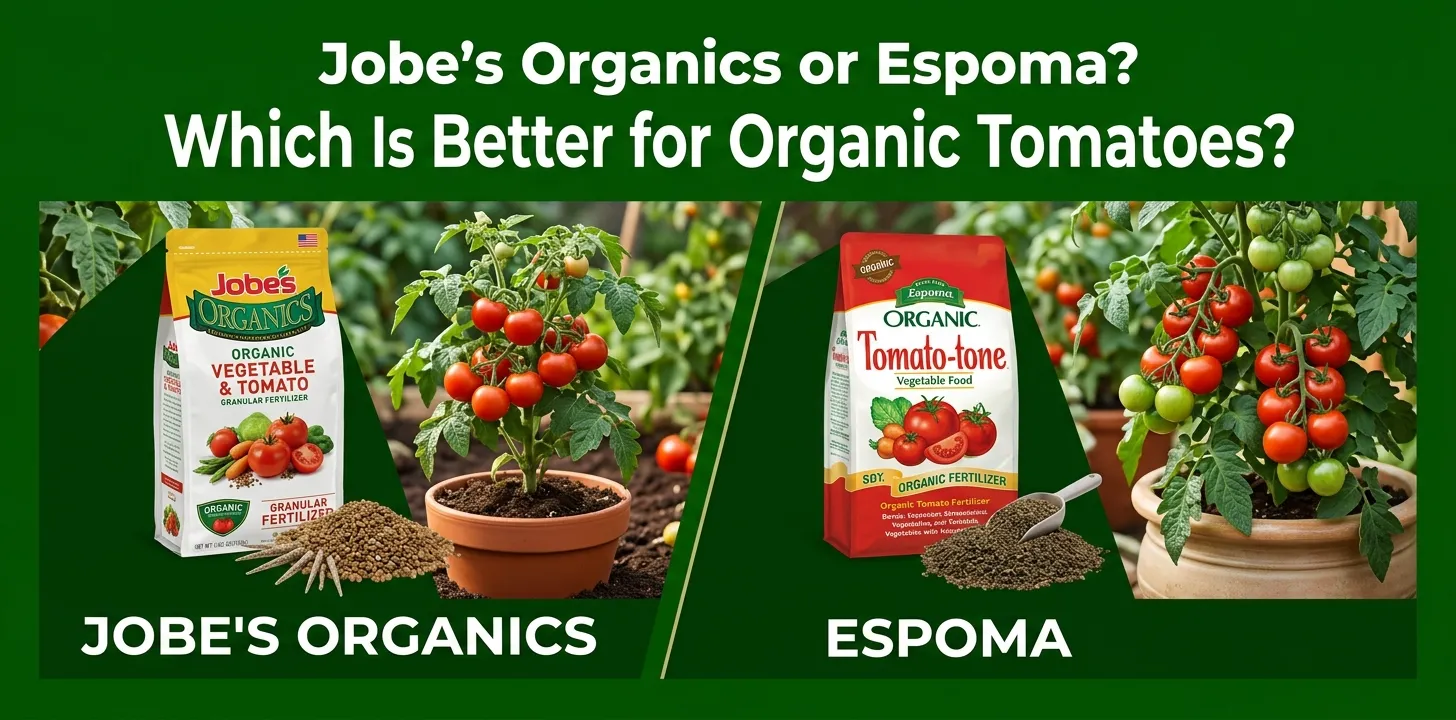
If you are choosing between Jobe’s Organics and Espoma for tomatoes, Espoma Tomato-tone is the better overall choice for most organic tomato gardeners, especially if your priority is a tomato-specific, slow-release fertilizer with a clearly stated calcium level. Jobe’s Organics Vegetable & Tomato is a strong lower-cost alternative, particularly for gardeners who value its microbial blend and slightly higher phosphorus content.
Jobe’s Organics vs. Espoma Tomato Fertilizer at a Glance
The comparison is most useful when you compare Jobe’s Organics Vegetable & Tomato Granular with Espoma Tomato-tone, since both are granular organic fertilizers designed for tomatoes and other edible garden crops.
| Feature | Jobe’s Organics Vegetable & Tomato | Espoma Tomato-tone |
|---|---|---|
| NPK | 2-5-3 | 3-4-6 |
| Form | Granular | Granular |
| Feeding style | Slow-release | Slow-release |
| Application | Every 4–6 weeks | At planting and about twice monthly during the main growing season |
| Microorganisms | Biozome blend | Beneficial microbes |
| Calcium | Supplied through ingredients such as bone meal and processed manure | 8% calcium |
| Best fit | Budget-conscious gardeners and soil-building | Tomato-focused feeding and long-term fruit production |
| Organic positioning | Organic | 100% natural and organic approved |
Jobe’s lists a 2-5-3 analysis and recommends reapplying every four to six weeks. Espoma Tomato-tone is 3-4-6 and specifically highlights its 8% calcium and slow-release feeding.
Why Espoma Tomato-tone Gets the Edge for Tomatoes
The biggest reason to choose Espoma is that Tomato-tone is built specifically around the needs of fruiting plants.
Its 3-4-6 NPK gives tomatoes relatively less nitrogen than phosphorus and potassium. The product also provides 8% calcium and includes beneficial microbes. Espoma recommends using it when preparing soil, after plants become established, and during the main growing period.
That makes it a particularly straightforward option for gardeners who do not want to build a fertilizer program from several different products.
The 8% calcium matters—but it is not a cure-all
Espoma prominently lists 8% calcium in Tomato-tone. Calcium is important for normal tomato growth, and adequate calcium availability is associated with reducing the risk of blossom-end rot.
But fertilizer alone does not guarantee that blossom-end rot will disappear. Water stress and inconsistent moisture can also contribute to the problem. So adding more fertilizer is not always the right answer when the bottoms of tomatoes begin to develop dark, sunken areas.
The better approach is to keep soil moisture reasonably consistent and avoid excessive fertilizer applications.
Where Jobe’s Organics Makes More Sense
Jobe’s Organics Vegetable & Tomato Granular has a 2-5-3 analysis, along with its Biozome blend of beneficial bacteria, mycorrhizal fungi, and archaea. The manufacturer says the product is intended for tomatoes and vegetables and recommends applying it every four to six weeks.
Its ingredient list includes bone meal, processed manure, potassium, and the Biozome microorganism blend.
That combination can appeal to gardeners who care about feeding the plant while also adding organic material and microbial activity to the growing environment.
Jobe’s is also listed by OMRI for certified organic production for its Vegetable & Tomato Granular Plant Food 2-5-3. OMRI notes that an OMRI listing does not itself mean the product is certified organic or constitute an endorsement, so gardeners following a certified-organic program should still check their certification requirements.
NPK: Is 2-5-3 or 3-4-6 Better for Tomatoes?
Neither NPK number is automatically “better” in every garden.
Jobe’s provides more phosphorus relative to nitrogen and potassium, while Tomato-tone puts its highest listed macronutrient percentage on potassium.
| Nutrient | Jobe’s | Espoma |
|---|---|---|
| Nitrogen | 2% | 3% |
| Phosphorus | 5% | 4% |
| Potassium | 3% | 6% |
For a productive tomato plant, you generally want enough nitrogen for healthy leaves and stems, but excessive nitrogen can encourage lots of leafy growth at the expense of fruit production.
That is one reason a tomato-specific fertilizer can be preferable to a high-nitrogen lawn or general-purpose fertilizer.
However, NPK should not be viewed in isolation. Existing soil fertility, compost, previous fertilizer applications, container size, and the plant’s growth stage all affect what your tomatoes need.
Which Is Better for Raised Beds?
Espoma Tomato-tone is my pick for most raised-bed tomato gardens.
Raised beds often contain a carefully prepared soil mix, so a predictable tomato-specific fertilizer can make feeding simpler. Tomato-tone’s 3-4-6 analysis, calcium content, and slow-release format make it a practical choice for gardeners who want one primary granular fertilizer.
Jobe’s is still a good option if you prefer its ingredient mix or already use Jobe’s products as part of your soil-building routine.
One important point: do not automatically add fertilizer simply because a raised bed contains vegetables. A soil test can tell you whether additional nutrients are actually needed.
Which Is Better for Container Tomatoes?
Espoma Tomato-tone has an advantage if you want a simple granular feeding routine, while Jobe’s can work well if you prefer its formula.
Container tomatoes are different from plants growing in a large garden bed because the root zone is limited and nutrients can be depleted more quickly.
Espoma provides specific container directions, including applying Tomato-tone based on pot diameter.
For containers, also pay close attention to watering. Fertilizer cannot compensate for a tomato plant that repeatedly swings between very dry and excessively wet soil.
Which Is Better for Organic Gardening?
Both brands offer organic-oriented tomato fertilizers, but check the exact product and label rather than assuming every fertilizer from either brand has identical certification or ingredients.
Jobe’s Vegetable & Tomato Granular is listed by OMRI, while Espoma describes Tomato-tone as 100% natural and organic approved.
If you are growing under USDA-certified organic rules, follow your certifier’s requirements rather than relying only on the word “organic” on a package.
Which One Is Better for Beginners?
Espoma Tomato-tone is slightly easier for beginners who want a tomato-specific fertilizer with clear application directions.
Its manufacturer provides directions for garden beds, individual plants, and containers. That reduces the guesswork for someone planting tomatoes for the first time.
Jobe’s is also beginner-friendly, especially because its granular formula does not require mixing a concentrate with water. Its four- to six-week application interval can also be convenient.
A beginner’s biggest mistake, though, is usually not choosing the “wrong” brand. It is overfeeding.
More fertilizer does not automatically mean more tomatoes.
Two Practical Tomato-Growing Examples
Example 1: A raised-bed gardener planting six tomatoes
Suppose you have a new raised bed with six tomato plants and reasonably fertile soil.
Espoma Tomato-tone is a simple choice because you can use its planting and established-plant directions without having to create a complicated feeding schedule.
The key is to follow the label rather than adding extra fertilizer whenever plants appear to grow slowly.
Example 2: A gardener already using Jobe’s products
Suppose your garden already contains organic amendments and you prefer Jobe’s Biozome approach.
Jobe’s Vegetable & Tomato Granular can be a reasonable choice. The product is specifically formulated for tomatoes and vegetables, and the manufacturer recommends feeding every four to six weeks.
In this situation, changing brands may offer little benefit if your plants are already growing well.
Jobe’s Organics or Espoma: Which Should You Buy?
For most home tomato gardeners, I would choose Espoma Tomato-tone.
Choose Espoma Tomato-tone if you want:
- A fertilizer specifically marketed for tomatoes
- 3-4-6 NPK
- 8% stated calcium
- Slow-release granular feeding
- Clear directions for beds and containers
- A simple all-season tomato-feeding option
Choose Jobe’s Organics Vegetable & Tomato if you want:
- A 2-5-3 organic granular fertilizer
- Jobe’s Biozome microbial blend
- Bone meal and processed manure in the ingredient mix
- A four- to six-week feeding schedule
- A product listed by OMRI for certified organic production
What About Jobe’s Water-Soluble Tomato Fertilizer?
There is an important distinction here.
Jobe’s also sells a Water-Soluble Vegetable and Tomato Fertilizer with a 3-1-2 analysis. The company describes it as fast-acting and recommends application every 7–28 days depending on the plant.
That product serves a different purpose from the granular 2-5-3 fertilizer.
If your tomato needs nutrients quickly, a water-soluble product may be more useful than a slow-release granular fertilizer. But for a basic season-long feeding plan, granular fertilizer is often simpler.
Common Mistakes to Avoid
The fertilizer brand is only one part of successful tomato growing.
Avoid these common mistakes:
- Using too much fertilizer. Follow the package directions.
- Choosing a high-nitrogen fertilizer just to make plants look greener. Excessive leafy growth is not the same as a heavy tomato harvest.
- Ignoring soil fertility. A soil test can prevent unnecessary nutrient additions.
- Blaming every blossom-end-rot problem on calcium deficiency. Moisture management matters too.
- Changing fertilizers too often. Give the plant and soil time to respond.
- Applying fertilizer directly against the stem. Follow the product’s application instructions and keep granular fertilizer properly distributed around the plant. Espoma specifically recommends keeping Tomato-tone at least 3 inches from the stem.
FAQ
Is Jobe’s Organics good for tomato plants?
Yes. Jobe’s Organics Vegetable & Tomato Granular is specifically formulated for tomatoes and vegetables and has a 2-5-3 analysis. It also contains Jobe’s Biozome microorganism blend and is listed by OMRI for certified organic production.
Is Espoma Tomato-tone better than Jobe’s for tomatoes?
For most gardeners, Espoma Tomato-tone has the edge because it is a tomato-focused 3-4-6 fertilizer with 8% calcium and beneficial microbes. Jobe’s remains a good alternative, particularly if you prefer its ingredients and Biozome blend.
Can I use both Jobe’s and Espoma on the same tomato plants?
There is usually little reason to use both at the same time. Both provide plant nutrients, so combining them without considering the soil and label rates can result in unnecessary fertilizer. Pick one primary fertilizer and follow its directions unless a soil test or specific growing problem gives you a reason to do something different.
The Bottom Line
Espoma Tomato-tone is the better overall pick for organic tomatoes, mainly because its 3-4-6 formula, 8% calcium, slow-release feeding, and tomato-specific directions make it a well-rounded choice for home gardeners.
Jobe’s Organics Vegetable & Tomato is the better alternative if you prefer its microbial blend, ingredient profile, or four-to-six-week feeding schedule.
My practical tip: before adding more fertilizer, look at the whole growing setup—soil fertility, sunlight, watering, and plant growth. A good fertilizer works best when those basics are already in place.