
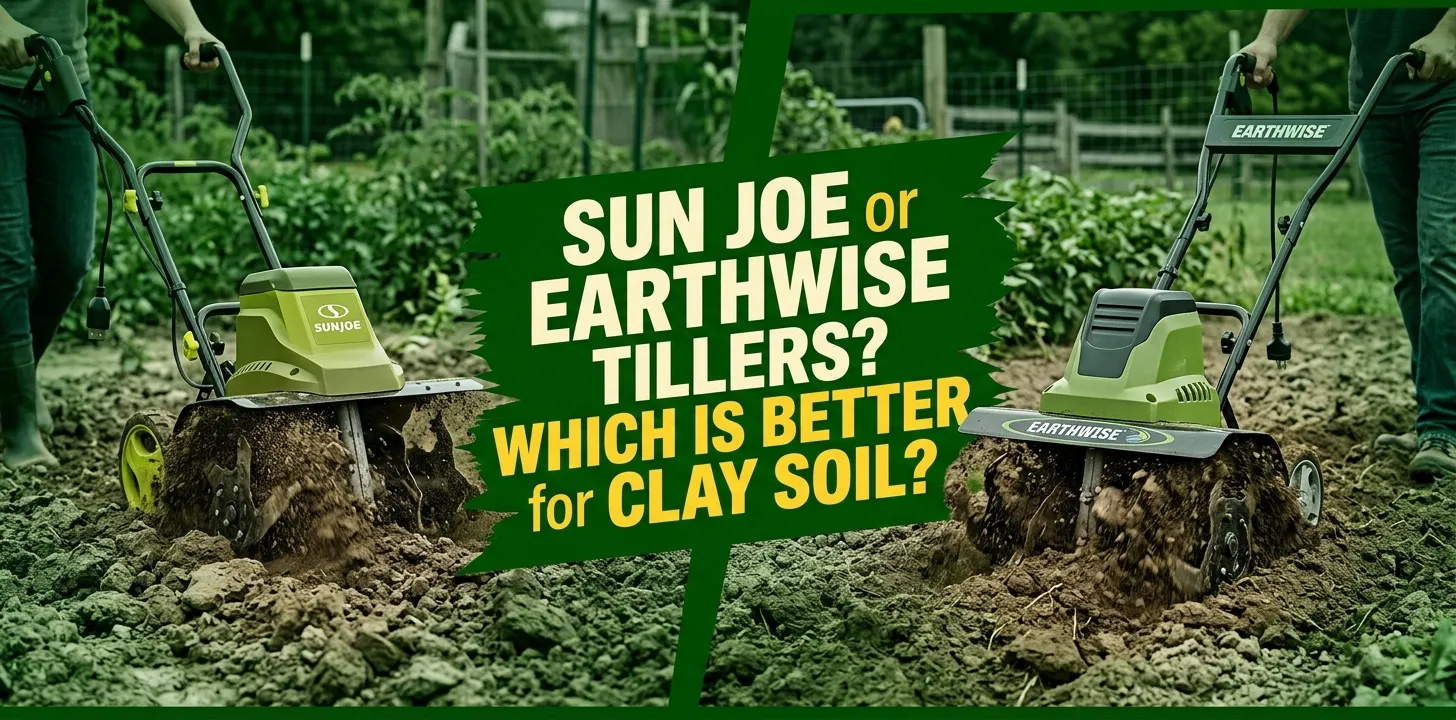
Sun Joe or Earthwise Tillers? Which Is Better for Clay Soil?

If you are choosing between Sun Joe and Earthwise for clay soil, Sun Joe is usually the stronger pick when breaking up compacted ground is the main goal, especially with a 12- to 13.5-amp, 16-inch model. Earthwise can also be a good choice, particularly for maintaining smaller garden beds. The bigger issue is soil moisture: very wet clay can clog or pack onto tines, while bone-dry clay can be extremely hard to penetrate.
Sun Joe vs. Earthwise for Clay Soil
For this comparison, the most useful models are the larger corded electric machines rather than small handheld cultivators. Current product comparisons list both Sun Joe and Earthwise 16-inch models in a similar power class, while the smaller Earthwise machines are intended more for lighter cultivation.
| Factor | Sun Joe | Earthwise | Better for clay |
|---|---|---|---|
| Breaking compacted soil | Strong | Strong on comparable models | Sun Joe, slight edge |
| Motor options | Up to 13.5 amps in TJ604E | 12.5-amp class available | Sun Joe |
| Working width | Up to 16 inches | Up to 16 inches | Tie |
| Tilling depth | Up to 8 inches on larger models | About 8 inches on larger models | Tie |
| Small-bed maneuverability | Good | Good | Earthwise on smaller models |
| Routine cultivation | Very good | Very good | Tie |
| Very hard, untouched clay | Limited by electric design | Limited by electric design | Neither ideal |
| Best overall for clay | Sun Joe | Good alternative | Sun Joe |
The Sun Joe TJ603E, for example, uses a 12-amp motor, six steel blades, and has a maximum cultivating width of 16 inches and depth of 8 inches.
Sun Joe’s TJ604E steps up to a 13.5-amp motor while retaining a 16-inch working width and six steel tines.
That extra motor capacity is useful when the soil is dense and the machine needs to keep the tines turning under load.
Why clay soil is harder to till
Clay particles are very small and pack tightly together. When clay is compacted, a lightweight electric tiller may have trouble getting the tines into the ground.
There is also a timing problem:
- Too wet: Clay can become sticky and smear together.
- Too dry: Hard clay can become extremely difficult to penetrate.
- Slightly moist: Usually a much better working condition.
This means buying a more powerful tiller does not solve every clay-soil problem. Soil condition and tilling technique matter almost as much as motor power.
Why Sun Joe Gets the Edge
The main reason I would choose Sun Joe for a clay-heavy garden is the combination of motor power, working width, and steel tines.
The TJ603E has a 12-amp motor and six steel tilling blades, while the TJ604E increases motor output to 13.5 amps.
That makes the larger Sun Joe models better suited to demanding soil preparation than small cultivators.
A current 2026 comparison from Bob Vila also rates both a 12-amp Sun Joe 16-inch model and a 120V 16-inch Earthwise highly for performance, showing that this is a close comparison rather than a situation where Earthwise is incapable of handling difficult soil.
The advantage becomes more noticeable when you are trying to prepare an area that has not been worked recently.
Sun Joe is especially useful for new garden beds
Imagine you have converted part of a lawn into a 100- to 200-square-foot vegetable garden. The soil is compacted and contains a lot of clay.
You need enough power to get the tines into the upper layer and gradually break it apart. A larger Sun Joe is better suited to this kind of job than a lightweight cultivator.
But don’t expect any small electric tiller to behave like a heavy gas-powered rototiller.
For deeply compacted clay or a large area of untouched ground, renting a heavier tiller can make more sense. Gardeners dealing with hard clay commonly report that electric tillers can struggle when the soil becomes extremely hard.
When Earthwise Makes More Sense
Earthwise should not be dismissed simply because Sun Joe has a small advantage for heavy clay.
Earthwise offers both smaller cultivators and larger 16-inch corded tillers. A current comparison lists an Earthwise 16-inch model with six tines, an 8-inch maximum depth, and a 28.9-pound weight.
That can make it a sensible choice if your soil is already partly prepared.
For example, suppose you have a vegetable bed that was tilled last year. You add compost in spring and only need to loosen the top several inches before planting.
You don’t need maximum ground-breaking ability. A capable Earthwise can handle routine cultivation without requiring you to buy a machine primarily designed for breaking virgin ground.
Earthwise is more attractive for lighter-duty garden work
Earthwise’s smaller models are particularly different from the larger Sun Joe machines.
An 8.5-amp Earthwise cultivator, for example, belongs in a lighter-duty category. It makes more sense for existing beds, shallow cultivation, and smaller spaces than for breaking hard, untouched clay.
So when someone asks, “Sun Joe or Earthwise?” the model matters almost as much as the brand.
A 13.5-amp Sun Joe versus an 8.5-amp Earthwise is not a fair brand-to-brand comparison.
You should compare motor class, tine design, width, depth, weight, and intended use.
Which Sun Joe Model Is Better for Clay?
If clay soil is your main concern, the Sun Joe TJ604E is the more compelling option among the commonly compared Sun Joe models because of its 13.5-amp motor.
The TJ603E is still a capable choice. Its 12-amp motor, six steel blades, 16-inch width, and 8-inch maximum depth give it a useful combination of power and coverage.
The TJ604E increases motor power to 13.5 amps while maintaining the 16-inch working width.
For someone starting a new garden in dense clay, I would favor the higher-powered option when the price difference makes sense.
How to Till Clay Soil Without Making the Job Worse
The machine is only part of the equation.
Pick the right soil moisture
Don’t till clay when it is soaking wet.
When wet clay is worked aggressively, it can smear and form dense clods. Instead, wait until the soil has dried enough that it crumbles rather than sticking heavily to your tools.
At the same time, extremely dry clay can be almost rock-hard.
A practical test is to squeeze a handful of soil. If it forms a sticky ball that does not break apart, wait. If it is so dry and hard that you can barely penetrate it, adding some moisture and waiting for better conditions may help.
Start shallow
Don’t immediately try to reach the maximum 8-inch depth.
Start with a shallow pass. Let the tines break the surface, then make another pass.
This reduces the load on the motor and gives the machine a better chance of gradually working through compacted soil.
Work in multiple passes
Dense clay often responds better to several passes than one deep pass.
A reasonable approach is:
- Clear rocks, thick roots, and debris.
- Make a shallow pass.
- Allow the machine to work through the soil without forcing it.
- Make another pass after the first layer has loosened.
- Gradually increase depth.
- Mix in appropriate organic matter when preparing the bed.
The goal is to loosen the soil rather than simply pulverize it into hard clods.
Don’t force the tiller forward
If the tines are bouncing, stalling, or struggling to penetrate, pushing harder isn’t necessarily the answer.
Give the machine time to work. In difficult soil, slowing down and taking shallower passes can produce better results than trying to force the tiller through the ground.
What About Wet Clay?
This is one area where neither Sun Joe nor Earthwise should be treated as a magic solution.
Wet clay can stick to rotating tines and turn into heavy clumps. It can also become compacted again after you walk or drive equipment over it.
If the soil is noticeably sticky, postponing the job can be better than choosing a more powerful electric tiller.
This is especially important when preparing a vegetable garden because repeatedly working wet clay can leave the soil structure worse than when you started.
Sun Joe or Earthwise for Different Clay-Soil Jobs?
| Your situation | Better choice |
|---|---|
| New garden in compacted clay | Sun Joe 13.5-amp class |
| Existing vegetable bed | Sun Joe or Earthwise |
| Small bed with already-loose soil | Earthwise can be enough |
| Large area of hard clay | Heavy-duty/rental tiller |
| Mixing compost into established soil | Either |
| Very wet clay | Wait for better soil conditions |
| Very dry, hard clay | Neither small electric model is ideal |
| Tight garden area | Smaller Earthwise model may be easier |
| Maximum electric tilling power | Sun Joe TJ604E |
Is an Electric Tiller Enough for Heavy Clay?
For a small backyard garden, often yes—but there is an important limit.
A powerful corded electric tiller can handle clay soil that has already been somewhat worked or that is being prepared in manageable garden beds. Current 2026 buying guides continue to rate larger Sun Joe and Earthwise electric models strongly for tilling performance.
But if you’re trying to break untouched, extremely compacted clay over a large area, a heavier gas-powered tiller may be a better tool.
This distinction matters because “clay soil” can mean anything from moderately heavy garden soil to ground that has been compacted for years.
For the latter, renting a heavier machine for the initial job and using a smaller electric tiller for yearly maintenance can be a more practical setup.
Which Is Better for Clay Soil: Sun Joe or Earthwise?
Sun Joe wins for clay soil overall, especially if you choose a larger 12- or 13.5-amp, 16-inch model. Its combination of motor power, six steel tines, and an 8-inch maximum tilling depth gives it the capability needed for demanding garden preparation.
Earthwise is still a good option when the clay is already loosened, the garden is small, or your main job is seasonal cultivation rather than breaking new ground.
The biggest mistake is choosing based only on the brand name. Compare the specific models.
If your garden has dense clay and you are starting a new bed, I’d lean toward the Sun Joe TJ604E. If you’re maintaining an established bed and don’t need as much power, an appropriately sized Earthwise can be a sensible alternative.
Frequently Asked Questions
Can a Sun Joe tiller break up hard clay soil?
A larger Sun Joe electric tiller can work through moderately compacted clay, especially when the soil has the right moisture level and you use several shallow passes. Extremely hard or untouched clay over a large area may require a heavier-duty tiller.
Is Earthwise good for clay soil?
Yes, particularly the larger Earthwise models with stronger motors and wider working widths. Smaller Earthwise cultivators are better suited to lighter cultivation and already-loosened beds than breaking deeply compacted clay.
Should I till clay soil when it is wet?
Generally, no. Wet clay can become sticky and compact easily when worked, so waiting until it is moist but crumbly is usually a better approach. This can matter more than choosing between two similar electric tillers.
Final Takeaway
For gardeners deciding between Sun Joe and Earthwise specifically for clay soil, Sun Joe has the edge when breaking compacted ground is the priority. Earthwise becomes more appealing for lighter cultivation and established beds.
Before you buy, check your actual soil condition, garden size, and whether you’re preparing new ground or maintaining an existing bed. For a small garden with dense clay, use the strongest suitable electric model and work the soil in shallow passes rather than trying to force it to full depth in one run.
