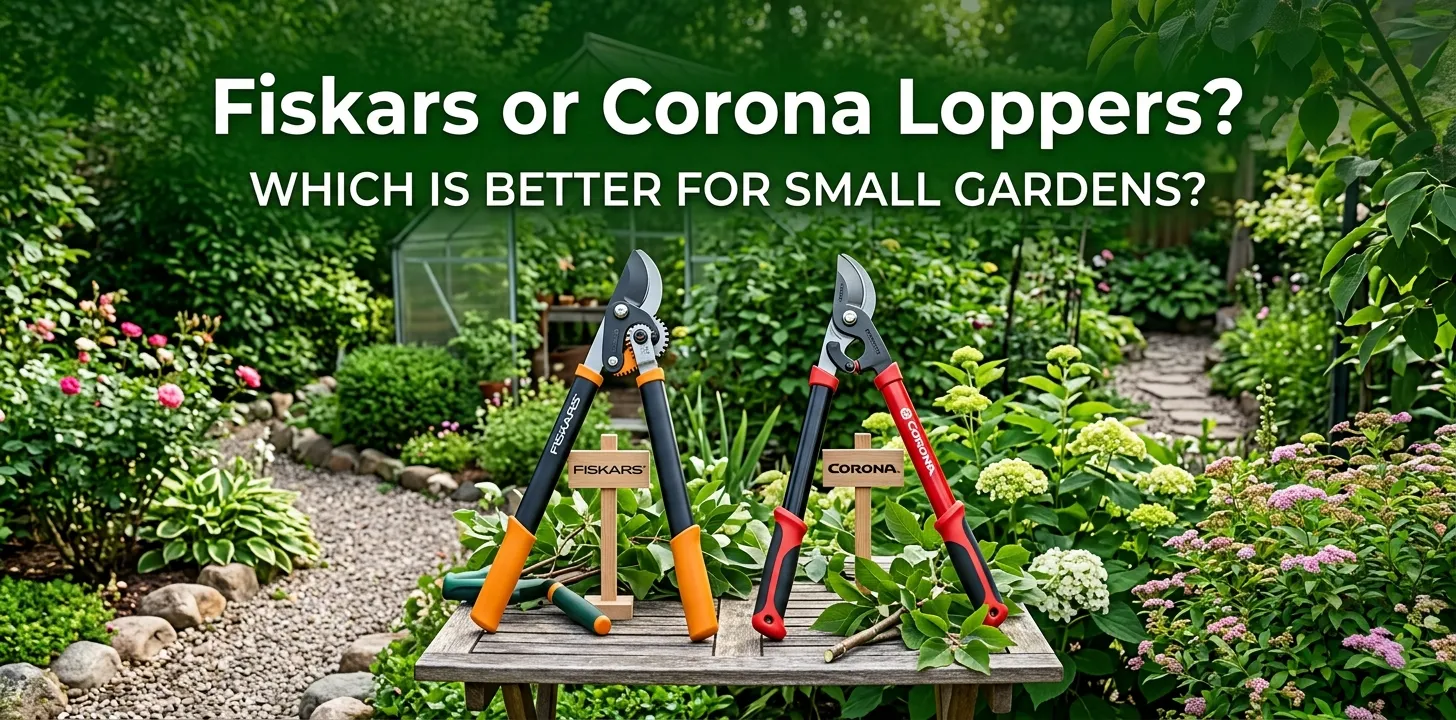
Fiskars or Corona Loppers? Which Is Better for Small Gardens?

For a small garden, Fiskars loppers are usually the better choice when you want a lightweight, easy-to-handle tool for routine pruning. Fiskars offers shorter PowerGear models designed for smaller branches, while Corona has strong, durable options that can make more sense when you expect heavier pruning. For tight garden spaces, size, weight, and maneuverability matter more than maximum cutting capacity.
Fiskars vs. Corona: The Short Answer
If your garden mainly has rose canes, small fruit-tree branches, shrubs, and other manageable growth, I would lean toward Fiskars. Its shorter PowerGear2 25-inch lopper is designed to provide extra leverage while remaining more compact than a 32-inch model.
Corona becomes more attractive if your “small garden” still includes thicker woody branches or you want a heavier-duty tool that can handle demanding pruning. Independent testing has rated Corona’s X Series highly overall, while Fiskars’ PowerGear models have also performed well for larger cuts.
| Factor | Fiskars | Corona |
|---|---|---|
| Small gardens | Excellent | Very good |
| Tight spaces | Better with shorter models | Depends on model |
| Lightweight options | Strong advantage | Varies |
| Cutting power | Excellent | Excellent |
| Thick woody branches | Excellent | Excellent |
| Ergonomics | Very good | Very good |
| Best for routine pruning | Fiskars | Corona |
| Best for heavier pruning | Fiskars PowerGear | Corona X Series |
| Brand choice for a small garden | Fiskars | Good alternative |
Why Fiskars Works Well in a Small Garden
A small garden changes what you should look for in loppers.
You usually don’t need the longest handles or the largest cutting capacity. Instead, you want something that can move easily between shrubs, flower beds, fences, and trees without feeling bulky.
Fiskars has several lopper sizes. Its current PowerGear range includes a 25-inch bypass lopper rated for branches up to 1¾ inches and a 32-inch version rated for branches up to 2 inches. Both use a geared mechanism designed to increase leverage during the cut.
That makes the shorter Fiskars particularly interesting for compact yards.
The 25-inch size is the important part
A 25-inch lopper gives you more reach and leverage than hand pruners without becoming as cumbersome as a very long lopper.
That’s useful when you’re working around:
- Rose bushes
- Small fruit trees
- Hydrangeas and other shrubs
- Young ornamental trees
- Berry bushes
- Small hedges
- Dead or damaged branches
The Fiskars PowerGear2 25-inch model also uses a hardened bypass-style steel blade with a low-friction coating and ergonomic Softgrip handles.
For a gardener who only needs loppers a few times each season, that combination makes a lot of sense.
Where Corona Has the Edge
Corona should not be dismissed just because the garden is small.
The brand makes loppers aimed at both everyday pruning and heavier cutting. Its X Series is especially worth considering if your garden has mature shrubs, thicker fruit-tree branches, or woody growth that needs more force.
Recent independent testing named the Corona X Series Pro the best overall lopper in Outdoor Life’s 2026 roundup.
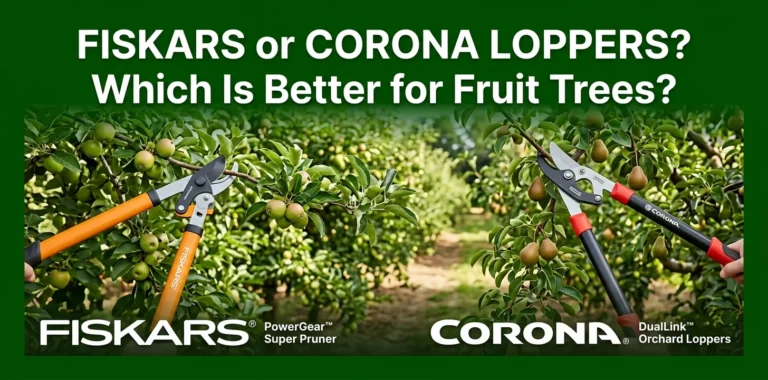
Corona also offers compound-action designs. For example, its ComfortGEL DualLink lopper uses a power-compounding link system and has a two-zone blade intended for both larger cuts and more precise smaller cuts.
The trade-off is that some of these heavier designs can be less convenient in a cramped garden.
A small yard does not automatically mean you need a small lopper—but it does mean maneuverability becomes more important.
Which Is Easier to Use in Tight Spaces?
Fiskars gets the advantage if you choose a shorter model.
Long handles can provide excellent leverage, but they also need more room to open and close. That can become annoying when you’re reaching between dense branches or working beside a fence.
A shorter lopper lets you make more controlled cuts without constantly bumping into nearby plants.
This is one reason I would not automatically recommend a 32-inch lopper just because it has greater cutting capacity.
For a small garden, buying more tool than you need can make pruning less comfortable.
Which Brand Is Better for Thick Branches?
For genuinely thick branches, both brands have capable options.
Fiskars’ PowerGear2 32-inch model is rated for branches up to 2 inches thick, while its 25-inch model is rated for up to 1¾ inches.
Corona also has heavy-duty loppers designed around leverage and larger cuts. Its ComfortGEL DualLink model, for example, is rated for cuts up to 4.5 cm (about 1.8 inches).
The important point is that maximum capacity should not be your only buying criterion.
If most of your garden branches are under an inch thick, a large heavy-duty lopper may add weight without giving you a meaningful advantage.
And when a branch is beyond what your lopper is designed to cut, a pruning saw is usually the more appropriate tool rather than forcing the lopper.
Fiskars or Corona for Rose Bushes?
For rose bushes, I would choose Fiskars for most small gardens.
Rose canes vary in thickness, but pruning often involves many relatively small cuts rather than occasional very large branches. A compact bypass lopper can give you useful reach while remaining easier to position among the canes.
For very small rose stems, however, hand pruners may be a better choice than loppers. Loppers are most useful when the stem is too large or awkward for comfortable hand-pruner work.
The same principle applies to many ornamental shrubs: use the smallest suitable tool rather than reaching for a large lopper for every cut.
Fiskars or Corona for Small Fruit Trees?
This choice is closer.
Choose Fiskars if the tree is young or the branches are mostly small to medium-sized. Choose Corona if the garden contains older, woody growth and you regularly need more cutting force.
For example, imagine a small backyard with one young apple tree and several shrubs. A shorter Fiskars lopper would probably be the more practical choice because you can move it around the canopy more easily.
Now imagine a compact yard with an older peach or apple tree that has developed several thick woody branches. In that case, a stronger Corona or heavy-duty Fiskars model may make more sense.
The tree—not simply the size of the yard—should determine the lopper’s capacity.
Which One Should a Beginner Buy?
For a beginner with a small garden, Fiskars is the easier recommendation.
The reason isn’t that every Fiskars lopper is better than every Corona lopper. Both brands sell several designs, and their characteristics differ by model.
The simpler decision is:
- Choose a bypass lopper for most live branches.
- Pick a shorter model if your garden is cramped.
- Make sure its rated cutting capacity covers the branches you actually prune.
- Prioritize manageable weight over maximum capacity.
- Move to a heavier model only if your garden regularly demands it.
Fiskars’ PowerGear mechanism is particularly useful when you want more leverage without simply buying an extremely long lopper.
When Corona Is the Better Choice
Corona may be the better buy if:
- You regularly prune thick woody branches.
- You prefer a more substantial, heavy-duty tool.
- You want a compound-action lopper.
- You care more about cutting force than compact handling.
- Your garden contains mature trees or large woody shrubs.
- You are comfortable with a somewhat heavier tool.
A recent Gardeners’ World test of Corona’s ComfortGEL DualLink highlighted its power-compounding design, large cutting capacity, comfort features, and lifetime warranty, while also noting that the heavier design can be harder to maneuver in tight spaces.
That last point matters for small gardens.
When Fiskars Is the Better Choice
Fiskars makes more sense when:
- Your garden is physically small.
- You work around dense shrubs or flower beds.
- Most branches are small to medium-sized.
- You want a lighter-feeling tool.
- You value leverage without excessive handle length.
- You want one lopper for routine pruning.
- You don’t want a bulky tool sitting around the shed.
Fiskars’ current catalog includes compact loppers as well as larger models, so you can match the tool to the scale of your plants instead of buying the biggest option.
A Common Mistake: Buying Based Only on Cutting Capacity
Suppose one lopper can cut 2 inches and another can cut 1¾ inches.
It is tempting to assume the 2-inch model is automatically better.
For a small garden, that’s not necessarily true.
If 90% of your pruning involves branches around ½ to 1 inch thick, the larger capacity may not help much. A lighter, shorter lopper that you can position easily could make the job faster and more comfortable.
Think about the branches you actually have, not the largest branch you might encounter someday.
Two Small-Garden Examples
Example 1: Suburban backyard
You have two rose bushes, a young citrus tree, a few ornamental shrubs, and a small hedge. Most branches are under about 1 inch thick.
Best fit: Fiskars. A shorter bypass lopper gives you enough leverage without being unnecessarily large.
Example 2: Small yard with mature trees
Your property is small, but it contains an established fruit tree with several thick woody branches. You also prune large shrubs several times a year.
Best fit: Corona or a heavier Fiskars PowerGear model. Here, cutting power matters more than simply choosing the smallest lopper.
The Best Pick Depends More on the Model Than the Logo
“Fiskars vs. Corona” is useful as a starting point, but it isn’t the whole decision.
Both brands make different types of loppers. A compact Fiskars bypass lopper and a heavy-duty Corona compound lopper are designed for different jobs.
For a small garden, compare these five things before buying:
| What to check | Why it matters |
|---|---|
| Overall length | Determines maneuverability and leverage |
| Weight | Affects comfort during repeated cuts |
| Blade type | Bypass is generally suited to live wood |
| Cutting capacity | Should match your typical branches |
| Handle design | Affects grip and control |
This approach is more useful than choosing a brand based only on reputation.
Fiskars or Corona Loppers: Which Should You Choose?
For most small gardens, I’d choose Fiskars, particularly a shorter bypass model such as the PowerGear2 25-inch. It offers a good balance of leverage, cutting ability, and manageable size.
Choose Corona instead when your small garden has unusually thick or mature woody growth and you want a more heavy-duty lopper.
The simplest rule is:
- Small branches + tight garden = Fiskars
- Routine pruning + lighter handling = Fiskars
- Thicker woody branches = Corona or heavy-duty Fiskars
- Heavy pruning = Compare the specific Corona and Fiskars models
- Very small stems = Use hand pruners instead
FAQ
Are Fiskars loppers good for small gardens?
Yes. Fiskars offers shorter loppers that provide useful cutting power without the reach and bulk of its longest models. The PowerGear2 25-inch model is rated for branches up to 1¾ inches and is a strong fit for many small-yard pruning jobs.
Are Corona loppers better than Fiskars?
Not across the board. Corona has excellent heavy-duty options, while Fiskars offers strong leverage and compact choices; the better brand depends on branch size, available space, weight, and the specific model you choose.
Should I buy 25-inch or 32-inch loppers for a small garden?
A 25-inch model is usually the more practical starting point for a small garden because it is easier to maneuver. A 32-inch lopper becomes worthwhile when you regularly need extra leverage or greater cutting capacity.
Final Recommendation
For a typical small U.S. garden, Fiskars is my first choice because compact pruning jobs benefit from easy handling as much as raw cutting power. Start with a shorter bypass model that comfortably covers the branch sizes you actually encounter.
One practical tip: measure the largest branches you regularly prune before buying. If most are well below the lopper’s maximum capacity, choose the lighter, easier-to-control option rather than paying for size you rarely need.