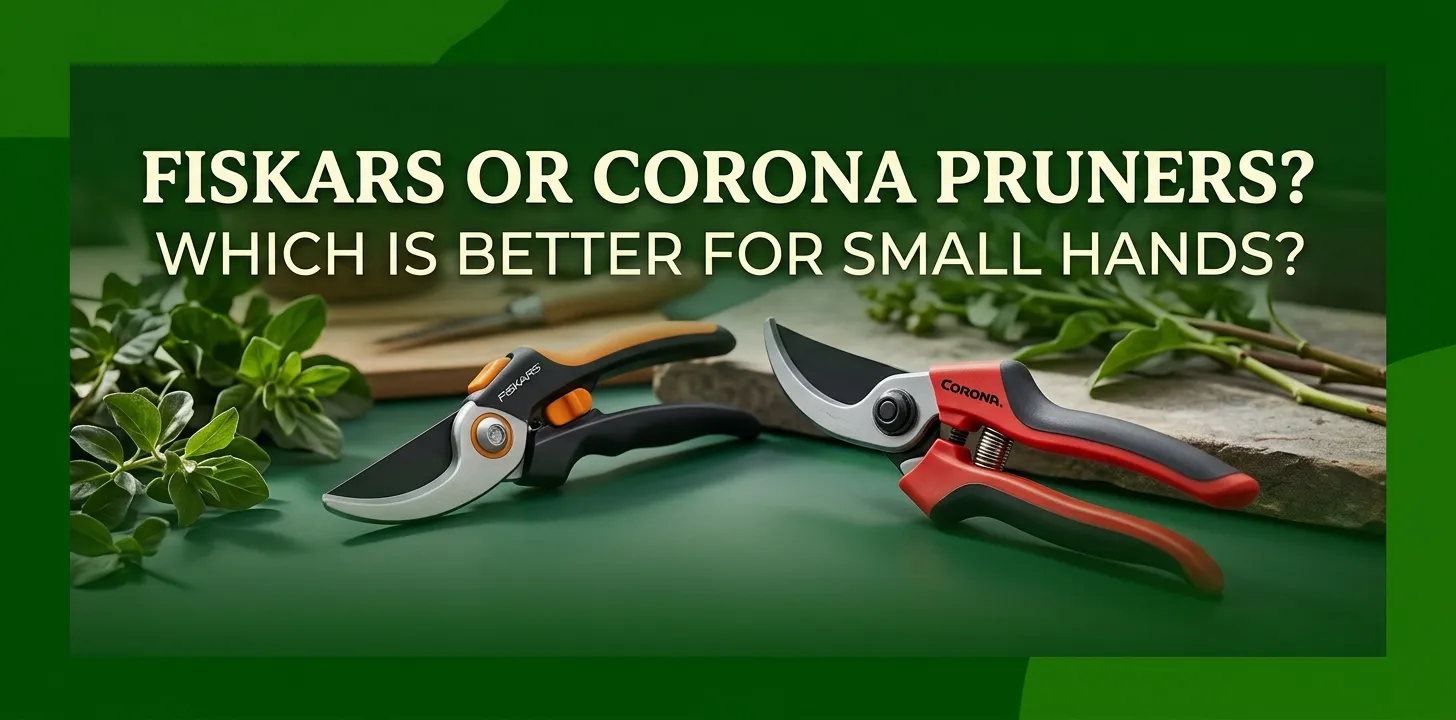
Fiskars or Corona Pruners? Which Is Better for Small Hands?

For gardeners with small hands, Fiskars is usually the better choice, especially when the model has an adjustable or narrower handle design. Fiskars offers pruners specifically designed to reduce handle spread and hand fatigue, while some Corona models can feel wide when fully opened. However, Corona has smaller-hand options, so the best choice depends on handle size, cutting needs, and how much leverage you want.
Why hand size matters more than brand
A pruner can have a sharp blade and strong construction but still feel uncomfortable if the handles are too far apart. This matters most when you make many cuts during one gardening session.
For smaller hands, pay attention to:
- Handle opening width
- Grip shape
- Overall weight
- Spring resistance
- Required hand strength
- Lock position
- Blade capacity
- Whether the handles stay comfortable after repeated cuts
A pruner that feels fine for five cuts may become tiring after 50 cuts. Independent testing has also found that comfort varies with hand size, and some Fiskars models performed particularly well for smaller hands.
Fiskars vs. Corona for small hands
Both brands make bypass pruners for cutting live stems and branches, but they approach ergonomics differently.
| Factor | Fiskars | Corona |
|---|---|---|
| Small-hand comfort | Generally better selection | Depends heavily on model |
| Adjustable handle options | Yes, on some models | Available on selected ergonomic models |
| Lightweight options | Strong selection | Several lightweight options |
| Leverage | Excellent on PowerGear models | Good, depending on model |
| Simple traditional design | Available | Strong selection |
| Small-hand-specific choices | Several options | Some smaller models |
| Best reason to choose | Ergonomics and reduced effort | Traditional feel and durable designs |
| Best overall for small hands | Fiskars | Good alternative |
The key point is that you should compare individual models, not just Fiskars against Corona as brands.
Fiskars has an advantage in handle ergonomics
One of Fiskars’ strongest advantages for smaller hands is its focus on handle shape and opening.
For example, the Fiskars SmartFit bypass pruner uses an adjustable mechanism that lets the user change how widely the handles open. Fiskars says the design is intended to accommodate different hand sizes, while its ergonomic handle and SoftGrip details are designed for comfort.
That feature can make a noticeable difference for someone who struggles to fully close a large pair of pruners.
Fiskars also makes models specifically described as suitable for smaller hands. Its P57 bypass pruner, for example, is designed for small and medium-sized hands and uses a PowerLever mechanism to reduce cutting effort.
This gives Fiskars an important advantage: you have more ways to match the tool to your hand rather than simply adapting your hand to the tool.
Where Fiskars PowerGear makes sense
The Fiskars PowerGear2 is worth considering if your small hands also have trouble generating cutting force.
Its gear mechanism is designed to increase leverage during the cut, while the contoured rolling handle follows the natural movement of the hand. Fiskars rates this model for branches up to 3/4 inch thick.
That does not automatically make it the most comfortable pruner for everyone.
Some gardeners prefer a conventional fixed handle because a geared or rolling handle can feel different from a traditional pruner. Independent testing has also found that rotating-handle designs can be a matter of personal preference rather than an automatic comfort upgrade.
So if you have small hands, try the handle design before choosing it solely because it offers more leverage.
Corona can still be a good choice for smaller hands
Corona should not be ruled out simply because the question is about small hands.
The company makes several hand pruners, including ergonomic and ClassicCUT models. Its current lineup includes an Ergonomic Bypass Pruner rated for 5/8-inch cuts and a ClassicCUT Bypass Pruner rated for 3/4-inch cuts.
Corona also has smaller-hand models in professional tool catalogs. One Corona stationary bypass model is specifically listed for small hands with a 1/2-inch cutting capacity.
The catch is that Corona’s model-to-model differences matter a lot.
Some larger Corona pruners can feel wide when the handles are opened. Testing reported that one Corona model was awkward for small-to-medium hands because of its wide handle span.
So if your hands are genuinely small, don’t assume that a larger Corona pruner will become comfortable just because the blade is good.
Which is easier to squeeze?
For small hands, squeezing force is only half the issue. Handle spread is just as important.
Imagine two gardeners trimming the same rose bush.
The first gardener has small hands and uses a pruner with a wide handle opening. Each cut requires the hand to stretch farther before the handles come together. Even if the blade is sharp, repeated cutting can become tiring.
The second gardener uses a pruner with a smaller or adjustable handle opening. The hand stays in a more natural position, so repeated cuts may feel easier.
This is where Fiskars has a strong case. Its SmartFit system lets the user adjust the handle opening, while PowerGear models are designed to increase leverage.
Which is better for rose pruning?
For roses and other living stems, a bypass pruner is generally the appropriate style because the blades pass each other like scissors and are designed for clean cuts on fresh growth. Fiskars describes its bypass pruners as intended for green, living growth.
For a gardener with small hands, I would lean toward Fiskars if comfortable handle closure is the main concern.
Corona remains a good option if you prefer a traditional fixed-handle feel and find a model that fits your hand well.
The important thing is not simply choosing the brand. It is choosing a bypass pruner that you can fully close without stretching your fingers or forcing your grip.
What about thick stems?
Small hands do not necessarily mean you need a small cutting capacity.
If you regularly prune thicker woody stems, leverage becomes more important. Fiskars PowerGear2 is designed to provide additional mechanical advantage and is rated for branches up to 3/4 inch thick.
Corona also makes larger-capacity bypass pruners. Its current professional lineup includes models with capacities ranging from 5/8 inch to 1 inch and beyond, depending on the design.
But there is a trade-off:
More cutting capacity often means a larger tool.
For someone with small hands, the biggest pruner is not necessarily the best pruner. If most of your work involves thin rose stems, flowers, herbs, and young branches, a smaller, easier-to-control model may be more useful than a heavy-duty option.
Fiskars or Corona: which should you buy?
For most people with small hands, I would choose Fiskars, but with an important condition: select a model designed around hand comfort rather than simply buying the most popular Fiskars pruner.
Fiskars is particularly attractive when you want:
- A narrower or adjustable handle opening
- Lower hand fatigue
- Extra leverage
- A lightweight design
- Comfortable grip materials
- A pruner for repeated everyday garden work
Corona becomes more attractive when you prefer:
- A traditional fixed-handle design
- A straightforward bypass pruner
- A professional-style tool
- A specific smaller-hand Corona model
- A particular Corona blade and handle combination
The brand comparison becomes much closer once you compare similarly sized models.
The biggest mistake small-handed gardeners make
The common mistake is choosing a pruner based only on maximum cutting capacity.
A 1-inch-capacity pruner may sound better than a 5/8-inch model, but that extra capacity does not help if the handles are too large for your hand.
For routine pruning, match the tool to the work you actually do.
If you mostly trim flowers, herbs, young stems, and small branches, prioritize fit and control.
If you regularly cut thicker woody branches, prioritize leverage and cutting capacity, while still making sure you can comfortably operate the handles.
Another mistake is assuming that a rotating or geared handle will automatically be more comfortable. Testing has shown that handle preferences can vary significantly between users.
Two practical buying examples
Example 1: Small hands and rose bushes
Suppose you maintain several rose bushes and spend 20–30 minutes deadheading and removing small green stems. You probably do not need the largest Corona or Fiskars pruner available.
A lightweight Fiskars model with a handle designed for smaller hands would make more sense because repeated comfortable cuts matter more than maximum capacity.
Example 2: Small hands but frequent woody pruning
Now suppose you have small hands but regularly cut thicker branches on shrubs. In that situation, a Fiskars PowerGear-style pruner could make more sense because the leverage system is designed to make difficult portions of the cut easier.
A smaller Corona model could also work if its handle fits your hand better and its cutting capacity covers your typical jobs.
Final verdict: Fiskars or Corona for small hands?
Fiskars wins for most small-handed gardeners because it offers more ergonomic options specifically suited to different hand sizes. Its SmartFit and smaller-hand designs are especially useful when handle spread is your biggest problem.
Corona is still a strong alternative, particularly if you prefer a traditional pruner or find a smaller Corona model that fits your hand naturally.
The best practical tip is simple: don’t choose based on blade capacity alone. Open the pruner, check whether you can comfortably reach both handles, and think about how it will feel after dozens of cuts—not just the first few.
Frequently Asked Questions
Are Fiskars pruners good for people with small hands?
Yes. Fiskars offers several designs aimed at improving comfort for smaller hands, including models with adjustable handle openings and models specifically described as suitable for small or medium-sized hands.
Are Corona pruners too large for small hands?
Not all of them. Corona makes smaller and ergonomic models, but some larger designs can have a wide handle span that is less comfortable for small-to-medium hands. Choosing the specific model matters more than choosing the brand alone.
Which is better for small hands, Fiskars PowerGear or a traditional Corona pruner?
Fiskars PowerGear is the better choice if you want extra leverage and a contoured handle, especially for tougher stems. A traditional Corona may be preferable if you want a simpler fixed-handle feel, provided its handle size fits your hand comfortably.
Conclusion
For gardeners with small hands, Fiskars is the better overall choice because several of its pruners focus on comfortable handle size, adjustable opening, and easier cutting. Corona is still a solid option, especially if you prefer a traditional design or find a smaller Corona model that fits your hand well.
Before buying, focus less on the brand and more on handle fit, cutting capacity, weight, and hand comfort. If you can comfortably close the handles without stretching your fingers, you are much more likely to enjoy using the pruner for longer gardening sessions.