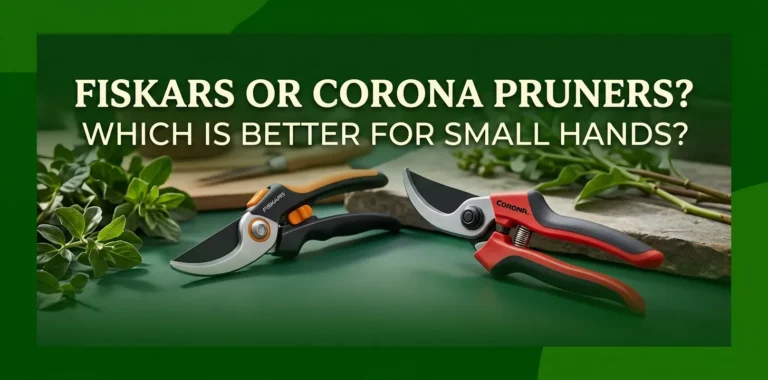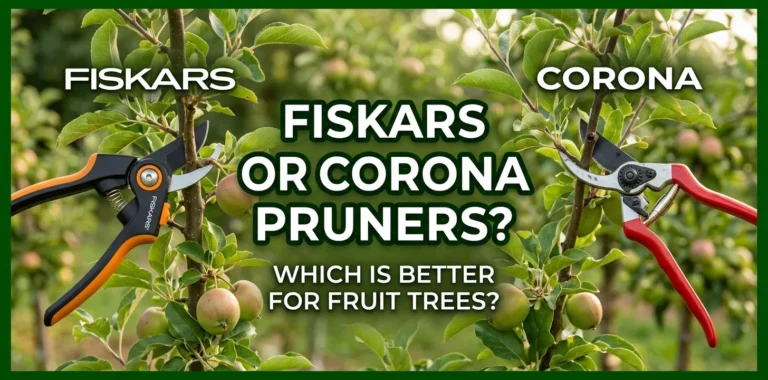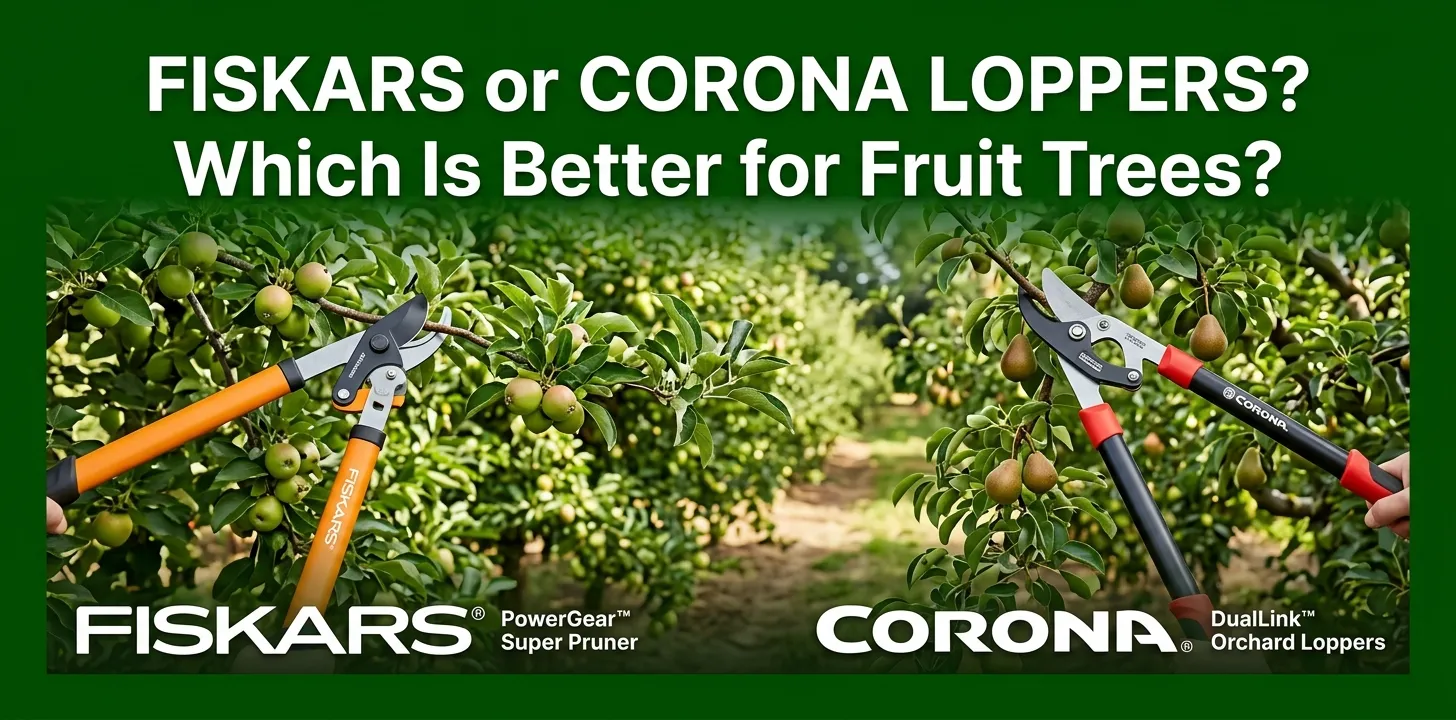
Fiskars or Corona Loppers? Which Is Better for Fruit Trees?

For fruit trees, Corona is the better choice for most pruning jobs, especially if you choose one of its bypass orchard loppers. Corona offers dedicated DualARC Orchard models with forged, resharpenable blades and a sap-cleaning groove. Fiskars is still an excellent option when low effort, lighter handling, or geared cutting power matters more than blade serviceability.
The important detail is that the brand matters less than the type of lopper and the branch you are cutting. For healthy, living fruit-tree branches, a sharp bypass lopper is usually the right tool. The USDA Forest Service specifically recommends bypass-type loppers for pruning because the blades pass each other like scissors rather than crushing the branch.
Fiskars vs. Corona for Fruit Trees
If your main job is pruning apple, pear, peach, plum, cherry, or similar fruit trees, Corona has a small advantage because its current lineup includes loppers designed specifically for orchard work.
| Feature | Fiskars | Corona |
|---|---|---|
| Best strength | Easy cutting and leverage | Precision and orchard-focused designs |
| Best type for live branches | PowerGear2 bypass | DualARC or other bypass |
| Cutting capacity | Up to 2 inches on PowerGear2 32″ | Up to 2¼ inches on DualARC Orchard |
| Blade | Hardened steel, low-friction coating | Forged steel, resharpenable/replaceable |
| Sap management | Low-friction coating helps reduce sticking | Self-cleaning sap groove on select models |
| Handle options | Ergonomic, geared designs | Aluminum or other handle options |
| Good for repeated orchard pruning | Yes | Yes, especially Orchard models |
| Best for | Less cutting effort | Long-term, precise pruning work |
Fiskars’ PowerGear2 32-inch bypass lopper is rated for branches up to 2 inches and uses a geared cam system designed to increase cutting power through the thickest part of the branch.
Corona’s DualARC Orchard lopper is rated for branches up to 2¼ inches and uses a forged bypass blade that can be resharpened and replaced. Its blade also has a self-cleaning groove intended to reduce sap buildup.
Why bypass matters for fruit trees
Fruit-tree pruning is different from cutting dry brush.
When removing a healthy living branch, you generally want a clean cut with minimal crushing. A bypass lopper works much like scissors: one blade passes the other to make the cut. The USDA Forest Service lists bypass loppers among the preferred pruning tools and advises making the final cut just outside the branch collar rather than cutting into it.
That makes a bypass Fiskars or bypass Corona a better fit for most fruit-tree pruning than an anvil lopper.
Why Corona Gets the Edge for Fruit Trees
Corona’s biggest advantage here is not simply that it makes strong loppers. It is that the company currently offers a dedicated DualARC Orchard Lopper line.
The 26-, 32-, and 36-inch Orchard models have a 2¼-inch stated cutting capacity. The 36-inch version uses a forged DualARC bypass blade, a self-cleaning groove, lightweight aluminum handles, and an integrated shock-absorbing bumper. Corona also lists a lifetime warranty for the model.
That combination makes sense for someone who spends a lot of time pruning fruit trees.
The replaceable and resharpenable blade is another useful feature. If you maintain an orchard and make many cuts each season, being able to sharpen or replace the cutting components can matter more than simply having a very strong cutting mechanism.
Where Fiskars is better
Fiskars has a strong argument when cutting effort is your main concern.
The PowerGear2 system uses modified gears and a cam mechanism to increase leverage where the branch is thickest. Its 32-inch model is designed for branches up to 2 inches and has a hardened bypass blade with a low-friction coating.
That can be especially useful if you have several mature trees to prune or simply find thick branches difficult to cut by hand.
An independent 2026 lopper test from Outdoor Life also selected the Fiskars PowerGear 2 L5532 as its pick for big branches, while naming the Corona X Series Pro its overall pick.
So Fiskars should not be viewed as a second-rate choice. It is particularly attractive when leverage and easier cutting are your priorities.
Which One Is Better for Different Fruit-Tree Jobs?
The right choice changes depending on what you are actually cutting.
For young fruit trees
Fiskars is often the better fit.
Young trees usually have relatively smaller branches, so you do not need the biggest 32- or 36-inch lopper. A shorter bypass lopper can give you better control and make it easier to work around closely spaced branches.
For small cuts, a quality hand pruner may actually be better than a lopper.
For mature apple and pear trees
Corona gets the edge for regular orchard pruning.
Mature apple and pear trees can develop plenty of woody branches that require more reach and cutting power. Corona’s Orchard models are designed around this type of work and offer 2¼-inch capacity on the current DualARC line.
For example, if you are removing several healthy branches around the outer canopy, a long-handled bypass lopper can give you enough leverage without immediately reaching for a saw.
For peach and plum trees
Choose a precise bypass lopper rather than simply choosing the strongest lopper.
Stone-fruit trees can have many branches close together, so maneuverability matters. A very long lopper can become awkward in a crowded canopy.
A 20- to 26-inch bypass model may be easier to position than a 36-inch model when making selective cuts.
For thick or dead branches
This is where you should stop thinking only about Fiskars vs. Corona.
If a branch is beyond the practical capacity of your lopper, use a pruning saw instead of forcing the lopper. Loppers are not a substitute for a saw on large limbs.
Also, the distinction between live and dead wood matters. Bypass loppers are especially appropriate for living branches, while other cutting designs can be more suitable for hard, dead material. For large branches, the USDA recommends using an appropriate saw and a three-step cutting method to reduce the risk of bark tearing.
Fiskars PowerGear2 vs. Corona DualARC Orchard
If you are choosing between the two brands specifically for fruit trees, these are two useful product families to compare.
| Fiskars PowerGear2 | Corona DualARC Orchard | |
|---|---|---|
| Cutting style | Bypass | Bypass |
| Maximum listed capacity | Up to 2″ on 32″ model | Up to 2¼” |
| Main advantage | Geared cutting leverage | Orchard-focused forged blade |
| Blade maintenance | Low-friction coated blade | Resharpenable and replaceable |
| Sap control | Low-friction coating | Self-cleaning sap groove |
| Handle choices | 25″ and 32″ models | 26″, 32″, and 36″ models |
| Best match | Easier cutting | Repeated orchard pruning |
Fiskars’ 25-inch PowerGear2 model is rated for branches up to 1¾ inches, while the 32-inch model reaches 2 inches.
Corona currently lists its DualARC Orchard models in 26-, 32-, and 36-inch versions, all with a 2¼-inch stated cutting capacity.
The Length You Choose Matters More Than You Might Expect
Longer handles provide more leverage, but they also make the tool harder to control in a dense tree.
For most homeowners:
- 20–26 inches: easier to maneuver and good for smaller trees
- 26–32 inches: a useful middle ground for mature fruit trees
- 36 inches: excellent reach and leverage, but can feel awkward in crowded branches
A 36-inch lopper is not automatically better than a 26-inch model. If you cannot position the cutting head cleanly, extra length does not help.
This is one reason the Corona Orchard range is useful: you can choose among several lengths instead of treating one lopper as the answer for every tree.
Two Real-World Examples
Example 1: A homeowner with three young apple trees
Suppose your trees are still fairly small and most branches are under about 1½ inches. You will probably benefit more from a shorter, easy-to-control bypass lopper than a large orchard lopper. A Fiskars PowerGear2 in an appropriate size would make sense if reducing hand effort is your priority.
Example 2: A homeowner maintaining several mature fruit trees
If you regularly remove 1½- to 2-inch living branches from mature apple, pear, or similar trees, a Corona DualARC Orchard model becomes more attractive. The forged, resharpenable blade and sap groove are useful features for repeated pruning, while the longer models provide additional reach.
What About the Cutting Capacity?
Do not treat the manufacturer’s maximum cutting diameter as a target.
A lopper may be rated to cut a certain diameter under suitable conditions, but branch hardness, wood condition, tool sharpness, and your position all affect how easy that cut will be.
For fruit trees, cleanly cutting a smaller branch is often better than forcing a lopper through a branch near its maximum capacity.
If you have to strain heavily, twist the handles, or repeatedly reposition the tool, move up to a pruning saw.
How to Make a Better Fruit-Tree Cut
A good lopper cannot compensate for poor pruning technique.
For a branch that is within the tool’s practical capacity:
- Identify the branch you want to remove.
- Position the bypass blades so the cut is clean and controlled.
- Avoid damaging nearby shoots or branches.
- Make the final cut just outside the branch collar.
- Do not leave an unnecessarily long stub.
- Clean the blades between trees when disease spread is a concern.
For larger branches that require a saw, the USDA Forest Service recommends a three-step approach: an initial underside cut, a second cut to remove most of the branch, and a final cut outside the branch bark ridge and branch collar.
Common Mistakes When Choosing Loppers for Fruit Trees
Buying an anvil lopper for all pruning
For living fruit-tree branches, a bypass design is generally the better choice. The USDA specifically recommends bypass-type pruning tools for this work.
Choosing the longest lopper available
Extra reach is useful, but a long tool can be difficult to maneuver between branches. Choose the shortest length that gives you the leverage and reach you actually need.
Using maximum capacity as your normal cutting size
If your lopper says it can cut 2 inches, that does not mean every 2-inch branch should be cut with it. Large or hard branches may be better handled with a pruning saw.
Ignoring blade maintenance
Sap and dirt can make pruning harder. Corona’s Orchard loppers specifically address sap buildup with a self-cleaning groove, while Fiskars uses a low-friction blade coating on PowerGear2 models.
Cutting too close to the trunk
A powerful lopper makes it tempting to cut flush against the trunk. Do not do that. The final pruning cut should respect the branch collar rather than cutting into it.
So, Fiskars or Corona Loppers for Fruit Trees?
Choose Corona if fruit-tree pruning is the main reason you are buying the lopper. Its current DualARC Orchard models are specifically positioned for orchard work, offer a forged bypass blade, 2¼-inch capacity, sap management, and replaceable/resharpenable blades.
Choose Fiskars if you care most about reducing cutting effort. The PowerGear2 mechanism gives you extra leverage, and its 25- and 32-inch bypass models cover common homeowner pruning jobs.
For most backyard fruit-tree owners, I would pick a Corona DualARC Orchard bypass lopper in the length that fits the tree, then keep a sharp pruning saw available for branches that are too large for the lopper.
Frequently Asked Questions
Are Fiskars loppers good for fruit trees?
Yes. Fiskars PowerGear2 bypass loppers are suitable for living branches and offer geared leverage that can make thick cuts easier. The 32-inch model is rated for branches up to 2 inches.
Are Corona Orchard loppers worth it for a home fruit tree?
They can be, especially if you prune several trees every year. The DualARC Orchard models combine forged, resharpenable blades, a sap-cleaning groove, long aluminum handles, and a lifetime warranty, although a smaller lopper may make more sense for a single young tree.
Should I use loppers or a saw on thick fruit-tree branches?
Use loppers for branches that are comfortably within their working capacity and a pruning saw for larger limbs. Do not force a lopper through a branch simply because its advertised maximum diameter appears large enough.
Final Verdict
For fruit-tree pruning specifically, Corona has the advantage, mainly because its DualARC Orchard line is purpose-built around orchard-style cutting and offers a serviceable forged bypass blade.
Fiskars remains the better choice for gardeners who value easy cutting and mechanical leverage. The practical expert tip is simple: choose a bypass lopper that you can control comfortably, keep the blade sharp, and switch to a pruning saw before a branch becomes too large to cut cleanly.