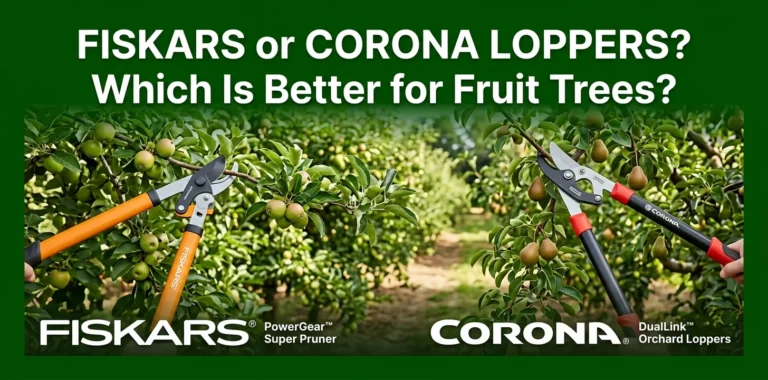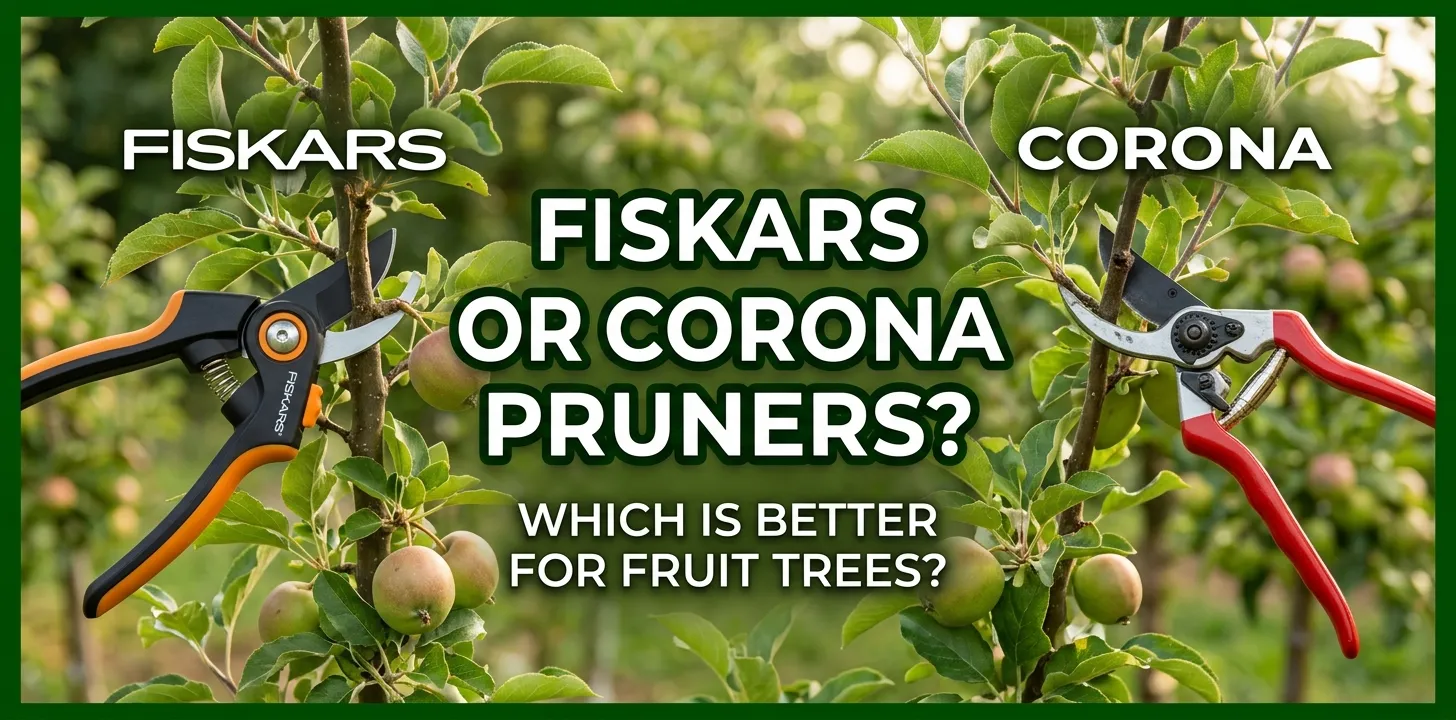
Fiskars or Corona Pruners? Which Is Better for Fruit Trees?

For fruit trees, Corona is usually the better choice for frequent, precise pruning, especially when you value a traditional bypass pruner with a solid feel and replaceable or serviceable parts. Fiskars is often the better pick for easier cutting and lower hand strain, particularly with its geared PowerGear models. The right choice depends on branch size, hand comfort, and how often you prune.
Fiskars vs. Corona for Fruit Tree Pruning
Both brands make bypass-style hand pruners that can work well on young shoots and small branches. The bigger difference is how each tool approaches the job.
Fiskars puts more emphasis on cutting leverage and ergonomic designs. Its PowerGear2 Pruner, for example, uses a geared mechanism to increase cutting power and is rated for branches up to ¾ inch thick. It also has a low-friction coated blade and a contoured rolling handle.
Corona has a long-standing reputation among gardeners for traditional pruning tools, with models designed around sturdy construction, comfortable grips, and clean bypass cuts. Independent testing has also found Corona pruners among the comfortable choices for regular pruning work.
For fruit trees, however, the brand name matters less than choosing the correct bypass pruner for the branch size you’re actually cutting.
| Factor | Fiskars | Corona |
|---|---|---|
| Cutting power | Excellent on geared models | Excellent |
| Clean cuts | Very good | Very good |
| Hand comfort | Excellent on ergonomic models | Very good to excellent |
| Small branches | Excellent | Excellent |
| Tougher small branches | Excellent with PowerGear | Excellent |
| Frequent fruit-tree pruning | Very good | Excellent |
| Ease of use | Excellent | Very good |
| Best reason to choose | Leverage and reduced effort | Traditional durability and pruning feel |
Why Bypass Pruners Work Well on Fruit Trees
Fruit trees need clean, controlled cuts rather than crushing or tearing branches.
A bypass pruner works like scissors. The sharpened blade passes alongside a thicker counter blade, making it well suited to live, relatively small branches and shoots.
Fiskars describes its standard pruning shears as suitable for stems and branches up to about 1 inch, depending on the model, while its PowerGear2 model is rated for branches up to ¾ inch.
For fruit trees, that makes bypass pruners useful for jobs such as:
- Removing small water sprouts
- Cutting young shoots
- Removing small dead twigs
- Thinning crowded growth
- Shaping young branches
- Removing small branches growing in the wrong direction
The important point is not to force a hand pruner beyond its intended capacity. Larger branches are better handled with loppers or a pruning saw.
Where Fiskars Has the Edge
Fiskars makes a strong case for fruit-tree owners who want cutting power without having to squeeze ordinary pruners as hard.
Better leverage for tough cuts
The PowerGear2 mechanism is designed to increase leverage during the cut. Fiskars specifically says its gearing and cam mechanism provide more power around the middle of the cut, where the branch becomes harder to sever.
That can be useful when pruning a mature apple, pear, peach, or similar tree with plenty of small but fairly firm branches.
If your hands tire easily during a long pruning session, this is one of the biggest reasons to consider Fiskars.
Comfortable for repeated pruning
The contoured handle on the PowerGear2 is designed around the natural movement of the hand. Fiskars also offers different pruning designs, so you are not limited to one handle style.
This matters more than it may seem.
A fruit tree can require dozens or even hundreds of small cuts during a major pruning session. A pruner that feels comfortable after five cuts may feel very different after 100.
Good choice for gardeners who want more cutting assistance
A geared Fiskars model makes particular sense if you frequently encounter branches that are close to the upper end of a hand pruner’s capacity.
For example, imagine you are pruning an established peach tree and repeatedly encounter firm branches around ½ to ¾ inch thick. A geared Fiskars can make those cuts easier than a basic, non-geared pruner.
Where Corona Has the Edge
Corona is especially appealing if you prefer a more traditional pruning tool and want a sturdy pruner for regular garden and orchard work.
Strong reputation for pruning tools
Corona has been making garden cutting tools for decades, and its pruners are widely used for pruning and horticultural work. Independent testing has included Corona models among comfortable hand pruners, particularly for users with medium or larger hands.
For someone who does not need a geared mechanism, a conventional Corona bypass pruner can be a straightforward choice.
Good control for detailed cuts
Fruit-tree pruning is not just about cutting through wood.
You often need to position the blade carefully around a shoot or branch so you can make the cut where you want it. A traditional bypass design gives you direct control over the blade.
That can be helpful when thinning crowded growth or removing a shoot close to a larger branch.
A good fit for frequent orchard-style pruning
If you regularly prune several fruit trees, you may prefer a tool that feels solid and predictable rather than one focused primarily on mechanical leverage.
Corona is worth considering if that is your preference.
Which Is Better for Different Fruit Trees?
The best choice can change depending on what you are pruning.
| Fruit tree situation | Better choice | Why |
|---|---|---|
| Young apple tree | Fiskars or Corona | Both work well for small shoots |
| Young pear tree | Fiskars or Corona | Clean bypass cuts are the priority |
| Peach tree | Fiskars | Extra leverage can help with firm branches |
| Plum tree | Fiskars or Corona | Choose based on branch size and comfort |
| Citrus tree | Corona | Precise control is useful for smaller shoots |
| Mature fruit tree | Corona + larger tools | Hand pruners alone are not enough |
| Many trees to prune | Fiskars | Reduced effort can be helpful |
| Occasional pruning | Corona | A traditional pruner is simple and practical |
| Smaller hands | Fiskars | Some Fiskars designs emphasize ergonomic leverage |
| Larger hands | Corona or Fiskars | Both can work; handle fit matters |
These are not hard rules. The specific model can matter more than the brand.
Fiskars or Corona for Young Fruit Trees?
For young fruit trees, I would give a slight edge to Fiskars for ease of cutting, but either brand can work well.
Young trees usually have relatively small branches, so cutting capacity is rarely the main issue. Control, blade sharpness, and comfort matter more.
If you are training a newly planted apple or pear tree, you may make many small cuts rather than a few heavy cuts. In that situation, a comfortable pruner that opens and closes easily can make the job less tiring.
A basic Fiskars bypass model or a suitable Corona bypass pruner can both handle this type of work.
Fiskars or Corona for Mature Fruit Trees?
For mature fruit trees, the answer becomes less about Fiskars vs. Corona and more about using the right tool for each branch.
A hand pruner should handle smaller branches.
Loppers should take over when branches become too large for comfortable hand-pruner use. For still larger limbs, a pruning saw is usually more appropriate.
Fiskars itself separates its garden cutting tools into pruning shears, loppers, and tree pruners, with its pruning shears intended for smaller stems and branches and its loppers designed for larger branches.
So buying the strongest hand pruner available is not necessarily the best solution.
Which One Makes Cleaner Cuts?
Both can make clean cuts when the blade is sharp and the tool is used within its intended capacity.
The quality of the cut depends on several factors:
- Blade sharpness
- Bypass design
- Branch size
- Wood condition
- Blade alignment
- Where you place the cut
- Whether you force the tool beyond its capacity
Fiskars uses hardened steel blades and low-friction coatings on several of its pruning models. Its standard pruner also includes a sap groove intended to help prevent sticking.
But even a premium pruner can produce a poor cut if you try to cut wood that is too thick.
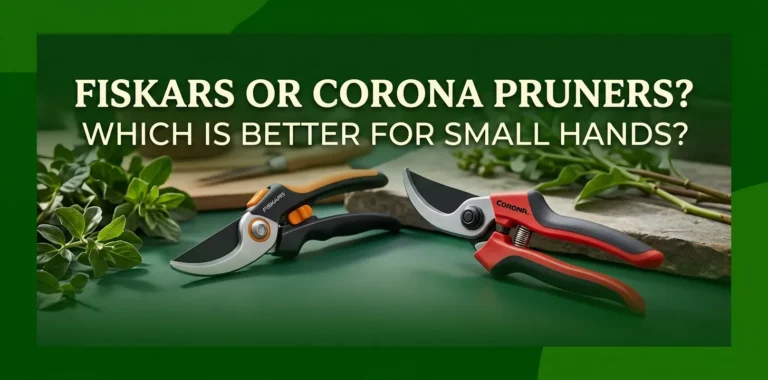
Which Is Better for Small Hands?
Fiskars gets the advantage if hand strength and leverage are major concerns.
Its PowerGear2 design is specifically built around increasing cutting power while using a contoured rolling handle.
That said, hand size is personal. A handle that feels comfortable to one gardener may feel awkward to another.
If possible, hold the pruner before buying it. Pay attention to whether you can fully open and close the handles without stretching your fingers or squeezing uncomfortably.
Which Is Better for Heavy Pruning?
For heavier work that is still within hand-pruner limits, Fiskars PowerGear is the stronger choice because of its geared cutting mechanism.
But there is an important limit.
If you regularly need to cut branches larger than your hand pruner’s rated capacity, switching to loppers or a pruning saw is usually a better solution than buying an increasingly powerful hand pruner.
Using the correct tool can also give you better control and reduce unnecessary strain.
Two Real-World Buying Scenarios
You have three backyard apple trees
Suppose you have three mature apple trees and mainly prune them once or twice each year. Most of the work involves removing small shoots and branches under about ¾ inch.
A Corona bypass pruner would be a strong choice if you prefer a traditional tool with good control.
A Fiskars PowerGear2 would make more sense if you find cutting force tiring or want additional leverage.
You have a young peach tree and limited hand strength
Suppose your peach tree is still young, but some of its branches are firm enough that a basic pruner feels difficult to squeeze.
In that situation, the Fiskars PowerGear2 has a practical advantage. Its geared mechanism is designed specifically to increase cutting power, while its handle is shaped for a more comfortable cutting motion.
You still need to stay within the model’s rated cutting capacity.
What Matters More Than the Brand
Before choosing Fiskars or Corona, check these five things:
- Branch diameter — Know the typical size of the branches you will cut.
- Bypass design — For live fruit-tree growth, bypass pruners are generally the appropriate style.
- Handle fit — A comfortable handle can matter more than a small difference in blade specifications.
- Cutting effort — If hand fatigue is a problem, look for a design that provides additional leverage.
- Maintenance — Keep the blade clean, sharp, and properly aligned.
A good pruner should make the cut cleanly without requiring you to fight the tool.
So, Fiskars or Corona Pruners for Fruit Trees?
For most backyard fruit-tree owners, Corona is the better pick if your priority is a traditional, precise pruning tool, while Fiskars is the better choice if you want extra leverage and easier cutting.
If you prune only small shoots and young branches, either brand can do the job well. If you frequently encounter tougher branches near the upper limit of a hand pruner, Fiskars’ geared models deserve a closer look.
The biggest mistake is choosing based only on brand. Match the pruner to your branch sizes, hand comfort, and pruning habits.
Frequently Asked Questions
Are Fiskars pruners good for apple trees?
Yes. Suitable Fiskars bypass pruners can handle the small live branches and shoots commonly removed from apple trees. The specific model’s cutting capacity should be checked before cutting larger branches.
Are Corona pruners good for fruit trees?
Yes. Corona bypass pruners can be a good choice for fruit-tree maintenance when the model is properly sized for the branches being cut. Their traditional design also provides good control for detailed pruning.
Should I use a pruner or lopper on fruit trees?
Use a hand pruner for smaller branches and switch to loppers or a pruning saw as branches become too large for comfortable, clean cuts with the pruner. Do not force a hand pruner beyond its rated capacity.
The Bottom Line
Choose Fiskars if easier cutting and leverage are your top priorities. Choose Corona if you prefer a traditional pruning feel and strong control for routine fruit-tree work. For most backyard growers, either can work well when the pruner is matched to the branch size.
One practical tip: before buying, measure a few of the branches you normally prune. That simple step will tell you more about which pruner you need than the brand name alone.