Ryobi 18V Cultivator or Black+Decker 20V Cultivator? Which Is Better for Small Gardens?

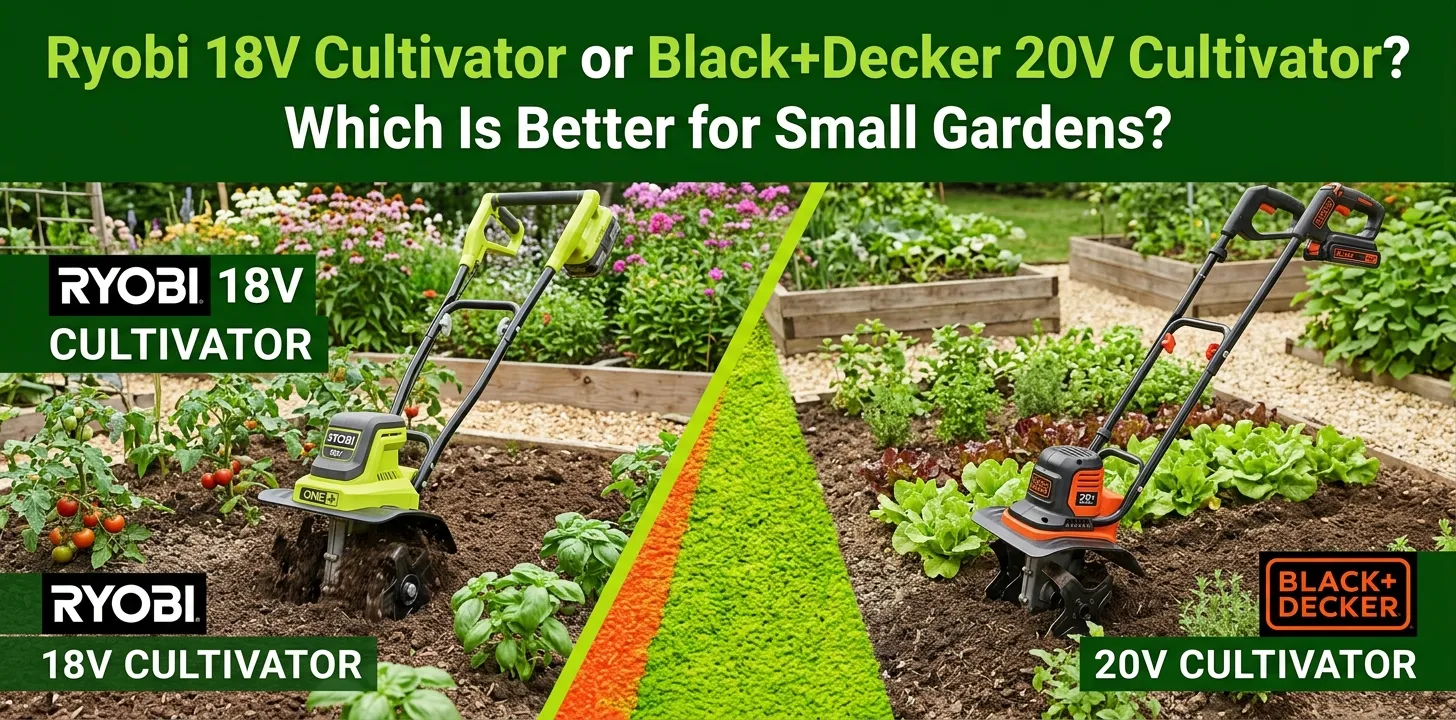
If you are choosing between the Ryobi 18V Cultivator P2750 and the Black+Decker 20V MAX LGC120, the better option depends on your garden and battery system. For most small vegetable beds, raised beds, and flower gardens, the Ryobi gets the edge because it offers an adjustable 6–8-inch working width, 4-inch tilling depth, four tines, and variable forward speed. Black+Decker is especially appealing if you already own its 20V MAX batteries and want a simple, lightweight cultivator for weeding and light soil work.
The two machines look similar at first, but they take slightly different approaches to small-garden cultivation. Ryobi gives you more control over how the tool works, while Black+Decker focuses on simple operation and counter-oscillating tines that help reduce weed tangling.
Ryobi 18V vs. Black+Decker 20V at a Glance
| Feature | Ryobi 18V P2750 | Black+Decker 20V MAX LGC120 |
|---|---|---|
| Battery platform | RYOBI ONE+ 18V | BLACK+DECKER 20V MAX POWERCONNECT |
| Working width | Adjustable, up to 8 in. | 7 in. |
| Maximum tilling depth | 4 in. | Designed for garden-bed cultivation and light tilling |
| Tines | 4 | Counter-oscillating tines |
| Speed control | Adjustable forward speed | Single operating system |
| Height adjustment | Yes | Yes |
| Battery/charger | 4.0Ah battery and charger included with P2750 kit | Available as kit or tool-only |
| Weight | Compact design | 10.8 lb tool-only version |
| Best use | Small vegetable gardens, raised beds, flower beds | Small beds, weeding, aeration, light cultivation |
Ryobi’s published specifications list an 8-inch maximum tilling width, 4-inch maximum depth, four tines, and adjustable forward speed. Black+Decker lists counter-oscillating tines, an adjustable handle and telescoping tube, and coverage of up to 325 square feet per charge.
Which Cultivator Is Better for Small Gardens?
For a typical small garden, Ryobi 18V is the better overall choice if you want more control over the cultivation process and are starting with the P2750 kit that includes a 4.0Ah battery and charger.
The adjustable working width is useful when you move between open garden soil and tighter spaces around plants. Its maximum 8-inch width is still narrow enough for many raised beds and garden rows. The adjustable forward speed also gives you more control when working around established plants.
The Black+Decker LGC120 is a better fit for simple maintenance work, particularly if you already own BLACK+DECKER 20V MAX batteries. Its counter-oscillating tines are designed to reduce weed tangling, and the upright design and adjustable height can make repeated garden-bed work easier.
So the decision is less about 18V vs. 20V and more about how you plan to use the cultivator.
Ryobi 18V Cultivator: Where It Stands Out
Adjustable Working Width
One of the biggest advantages of the Ryobi P2750 is its adjustable tilling width. It can work at widths between 6 and 8 inches, according to product information associated with the model.
That small difference can matter in a garden.
A narrow setting can be useful when working between rows or in a tighter raised bed. The wider setting lets you cover more soil when there is open space.
For a gardener with several small beds, this flexibility is more useful than simply having a higher voltage number on the label.
Four Tines and 4-Inch Maximum Depth
The P2750 has four tines and a listed maximum tilling depth of 4 inches.
That makes it better suited to tasks such as:
- Loosening previously worked garden soil
- Mixing amendments into the upper soil layer
- Preparing small beds for planting
- Breaking up compacted areas
- Cultivating between garden rows
It should not be treated like a full-size gas tiller for clearing large areas of hard, untouched ground.
Adjustable Forward Speed
Ryobi lists adjustable forward speed as one of the P2750’s features.
This is helpful when soil conditions change.
For example, you might use a slower setting when working in harder soil and a faster setting when lightly cultivating already-loose soil. It also gives you more control when working close to plants.
The ONE+ Battery System
If you already own several RYOBI ONE+ 18V tools, the battery system can be a major reason to choose this cultivator. Home Depot’s current product information also confirms that the P2750 uses RYOBI 18V batteries.
For someone starting from scratch, however, the battery ecosystem should be considered alongside the price of the complete kit.
Black+Decker 20V Cultivator: Where It Stands Out
Counter-Oscillating Tines
The LGC120 uses counter-oscillating tines. The tines move against each other rather than simply rotating together, with the goal of reducing weeds becoming wrapped around the working parts.
This is a useful feature if your main job is maintaining an existing garden rather than breaking completely new ground.
Weeds can be especially annoying when cultivating small beds, so a design that helps limit tangling can save time cleaning the tool.
Adjustable Height
Black+Decker includes an adjustable handle and telescoping tube. The company says this upright design is intended to improve comfort and reduce arm fatigue.
That can matter if you spend a longer session working across several beds.
A cultivator that lets you set the working height to a comfortable position can be easier to control than one that forces you to bend or reach awkwardly.
Up to 325 Square Feet per Charge
Black+Decker states that the LGC120 can cultivate up to 325 square feet on a single charge.
Actual results can vary with soil condition, weeds, battery capacity, and how aggressively you use the tool, so this figure should be viewed as a manufacturer’s coverage claim rather than a guaranteed runtime.
For a small raised-bed garden, however, that stated coverage is enough to show what type of job the tool is designed to handle.
A Good Choice for Existing BLACK+DECKER Owners
The LGC120 is part of the BLACK+DECKER 20V MAX POWERCONNECT battery system. The company sells both a kit with a battery and charger and a tool-only version.
That makes the tool-only model more attractive if you already have compatible batteries.
Buying a completely new battery platform just for one cultivator can change which product offers the better value.
Which One Is Better for Raised Garden Beds?
Ryobi has a slight advantage for raised beds where width and control matter.
Its adjustable 6–8-inch working width is useful in narrow spaces, and the 4-inch maximum depth gives you a defined working range for soil preparation.
Black+Decker is also well suited to raised beds. Its official description specifically lists garden beds, landscape beds, weeding, and aeration among its intended uses.
Choose Ryobi if you frequently change between narrow and wider areas. Choose Black+Decker if your beds are mostly similar in size and you value its anti-tangle tine design.
Which One Is Better for Weeding?
Black+Decker has the clearer advantage for routine weeding.
Its counter-oscillating tines are specifically designed to prevent weeds from tangling around the tines.
That does not mean the Ryobi cannot cultivate weedy soil. It means Black+Decker has a feature that directly addresses one of the common annoyances of using a small cultivator in weed-filled beds.
If your main goal is breaking up the soil and mixing it before planting, Ryobi’s adjustable speed and working width become more important.
Which One Is Better for Hard Soil?
Neither should be your first choice for large areas of very hard, untouched soil.
Small cordless cultivators are most useful when you work in manageable garden beds and prepare soil in stages. If the ground is extremely compacted, wet, filled with roots, or has never been cultivated, you may need to loosen the worst areas with another appropriate garden tool before using a small cordless cultivator.
For ordinary garden maintenance, both machines are better suited to repeated light cultivation than trying to replace a full-size tiller.
A practical example
Imagine you have a 10-by-10-foot vegetable garden that was already prepared last season. In spring, the soil has become somewhat compacted and weeds have appeared.
Either cultivator can make sense for this job. You are not asking the machine to clear an entire field; you are using it to loosen and refresh an existing garden bed.
Now imagine you are trying to turn a large patch of untouched lawn into a new garden. That is a very different job, and neither of these compact cordless cultivators should be selected simply because the label says “cultivator.”
Which One Is Easier to Control?
Ryobi is the better choice if you want more control over how the tool moves through the soil.
Its adjustable forward speed gives you an additional way to adapt to changing soil conditions.
Black+Decker focuses more on a straightforward upright design with adjustable height and a telescoping tube. The company says the design helps reduce arm fatigue during cultivation.
For a small garden, both approaches make sense. Your preference matters here: some gardeners will value variable speed, while others will care more about simple operation and comfortable height adjustment.
Battery Choice Can Decide the Winner
Voltage alone should not determine your purchase.
The Ryobi uses the RYOBI ONE+ 18V system, while Black+Decker uses its 20V MAX POWERCONNECT system.
If you already have several Ryobi 18V batteries, the Ryobi cultivator becomes easier to justify.
If your garage already contains BLACK+DECKER 20V MAX tools, the LGC120 may be the more practical choice.
This is especially important with the tool-only versions. A lower-priced tool can become less attractive if you have to buy a battery and charger separately.
What About Battery Runtime?
Battery runtime is difficult to compare directly because it depends on battery capacity and working conditions.
The Black+Decker manufacturer states coverage of up to 325 square feet per charge.
The Ryobi P2750 kit referenced here includes a 4.0Ah battery and charger, which gives it an advantage over a comparison based on tool voltage alone.
For either machine, hard soil and aggressive cultivation can use more battery power than light work in loose soil.
If your garden is close to the tool’s practical coverage limit, having a second compatible battery can be more useful than choosing a cultivator based solely on its voltage rating.
Which Cultivator Offers Better Value?
The answer depends heavily on what batteries you already own.
| Your situation | Better choice |
|---|---|
| You already own RYOBI ONE+ 18V tools | Ryobi |
| You already own BLACK+DECKER 20V MAX tools | Black+Decker |
| You want adjustable working width | Ryobi |
| You want counter-oscillating tines | Black+Decker |
| You want variable forward speed | Ryobi |
| Your main task is light weeding | Black+Decker |
| You have several different small garden beds | Ryobi |
| You want a simple maintenance cultivator | Black+Decker |
The battery ecosystem can easily outweigh a small difference in the upfront price.
What Each Cultivator Is Really Designed to Do
Neither model should be confused with a heavy-duty rear-tine or front-tine garden tiller.
These compact cordless tools make more sense for:
- Raised garden beds
- Small vegetable plots
- Flower beds
- Landscape beds
- Light soil cultivation
- Weed removal
- Soil aeration
- Preparing previously worked soil
Black+Decker specifically lists garden and landscape beds, weeding, aeration, and preparing dry or dead lawn areas for seeding among the LGC120’s applications.
Ryobi’s specifications show a maximum 8-inch width and 4-inch depth, which also points toward small-scale cultivation rather than large-acreage tilling.
Ryobi 18V or Black+Decker 20V: Which Should You Buy?
Choose the Ryobi 18V Cultivator if you want the more adjustable tool for small gardens. Its variable forward speed, adjustable working width, four tines, and 4-inch maximum tilling depth make it a strong match for gardeners who work in different beds and want more control.
Choose the Black+Decker 20V Cultivator if your priority is simple garden maintenance, especially weeding and light cultivation. Its counter-oscillating tines, adjustable height, upright design, and POWERCONNECT battery system make it a practical option for small garden beds.
If you are starting with no batteries from either brand, compare the complete kit rather than just the bare-tool price.
Frequently Asked Questions
Is the Ryobi 18V cultivator good for small vegetable gardens?
Yes. Its compact 8-inch maximum width and 4-inch maximum depth are well suited to small garden beds and previously cultivated soil. The adjustable speed and width also give you more control when working around different rows.
Is the Black+Decker 20V cultivator good for raised beds?
Yes. Black+Decker specifically describes the LGC120 as suitable for garden and landscape beds, weeding, and aeration. Its counter-oscillating tines are also designed to reduce weed tangling during cultivation.
Is 20V better than 18V for a garden cultivator?
Not necessarily. The voltage labels come from different battery systems, so they should not be treated as a direct measure of which cultivator will perform better. Features such as tine design, working width, speed control, battery capacity, soil conditions, and the battery tools you already own are more useful when choosing between these two models.
Final Verdict
For most small-garden owners, the Ryobi 18V P2750 is the better overall pick because it gives you more control over width and forward speed while offering a 4-inch maximum tilling depth and four tines.
But the Black+Decker 20V LGC120 can be the smarter buy if you already use BLACK+DECKER 20V MAX tools or mainly need a cultivator for weeding and routine bed maintenance. Its counter-oscillating tines are a useful advantage for that type of work.
The practical tip is simple: choose the battery platform you already own first, then choose the cultivator based on how you actually garden. For a small raised bed, either can be a better fit than buying a much larger tiller you will rarely need.