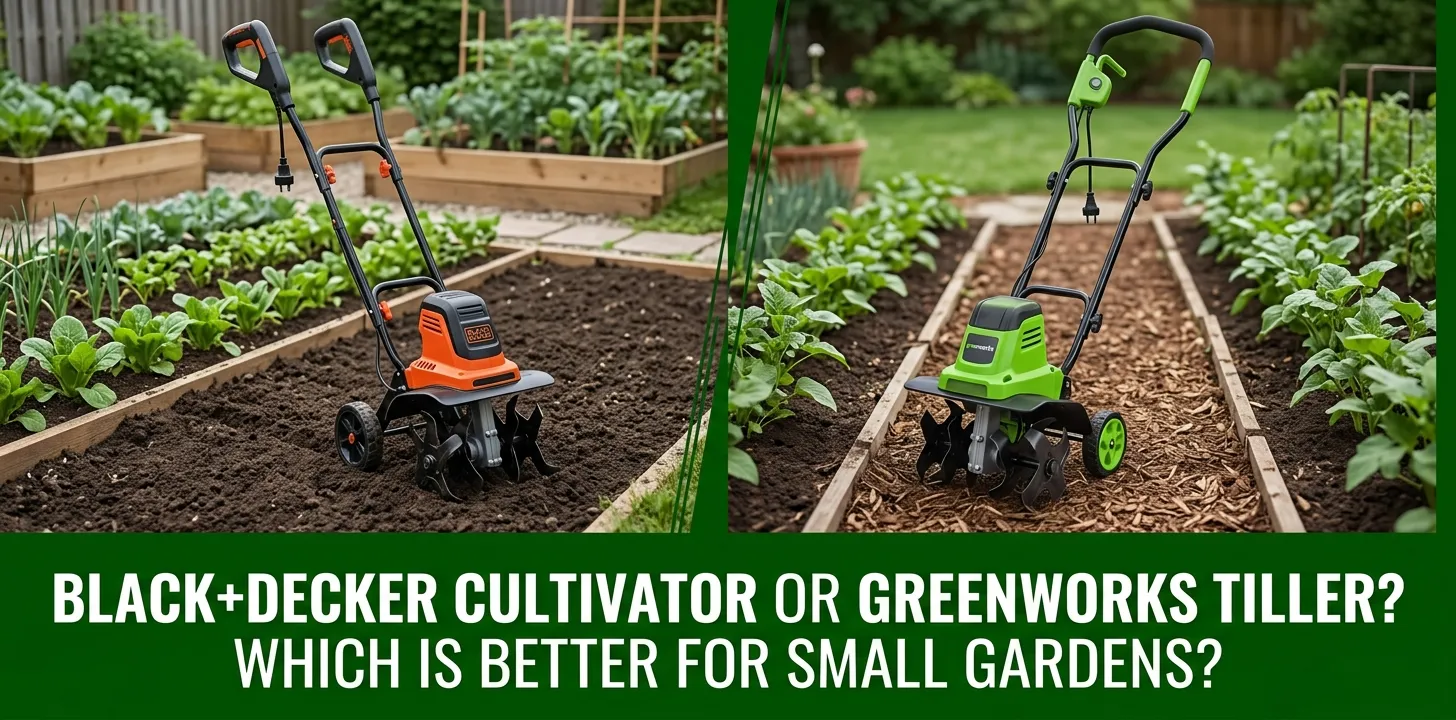
Black+Decker Cultivator or Greenworks Tiller? Which Is Better for Small Gardens?

For most small gardens, the BLACK+DECKER 20V MAX LGC120 is the better choice when you want a compact, easy-to-handle cultivator for weeding, aerating, and maintaining existing beds. The Greenworks 40V 10-inch Cultivator/Tiller is the stronger option if you need more tilling width, deeper cultivation, longer runtime, or are preparing larger areas.
The two tools look similar on paper because both are cordless and designed for garden soil. But they serve slightly different types of gardeners.
The BLACK+DECKER is more focused on small beds and routine garden maintenance. Greenworks takes a more traditional tiller approach, with four forward-rotating tines, adjustable width, wheels, and a larger 40V battery system.
BLACK+DECKER vs. Greenworks: What Is the Real Difference?
The biggest difference is not simply 20V versus 40V. It is how much soil you need to work and what kind of work you expect the machine to do.
The BLACK+DECKER LGC120 uses two counter-oscillating tines and has a 7-inch maximum tilling width and up to 4 inches of tilling depth. It is designed for garden beds, landscape beds, weeding, aeration, and preparing existing soil for planting.
The Greenworks 40V 10-inch model uses four forward-rotating steel tines. Its working width can be adjusted from 8.25 to 10 inches, and its tilling depth reaches up to 5 inches. Greenworks rates it for up to 1,000 square feet of tilling with a maximum runtime of about 40 minutes.
| Feature | BLACK+DECKER LGC120 | Greenworks 40V 10″ |
|---|---|---|
| Power system | 20V MAX | 40V |
| Tines | 2 counter-oscillating | 4 forward-rotating |
| Maximum width | 7 inches | 10 inches |
| Maximum depth | 4 inches | 5 inches |
| Rated coverage | Up to about 325 sq. ft. per charge | Up to 1,000 sq. ft. |
| Battery | 1.5Ah included in kit | 4.0Ah included in kit |
| Wheels | No rear transport wheels listed | 6-inch rear wheels |
| Battery ecosystem | BLACK+DECKER 20V MAX | Greenworks 40V |
| Warranty | 2 years | 3 years for tool and battery |
| Best fit | Small beds and light cultivation | Larger beds and heavier cultivation |
Specifications can vary by package and model, so check the exact kit before buying. The comparison above uses the currently listed BLACK+DECKER LGC120 and Greenworks 40V 10-inch models.
Choose BLACK+DECKER if You Have a Small, Established Garden
The BLACK+DECKER makes the most sense when your garden is already established and your main jobs are maintaining the soil, removing weeds, and loosening the top layer.
Its narrow 7-inch working path can be useful when you need to work around plants without taking up much space. The counter-oscillating tines are also designed to reduce weed tangling.
Its upright design, telescoping tube, adjustable handle, and soft-grip handle are practical advantages for gardeners who do not want to spend much time bent over.
Where the BLACK+DECKER stands out
Small planting beds: A narrow cultivator is easier to maneuver in tight spaces.
Weeding: The counter-oscillating tines are specifically designed to help prevent weeds from wrapping around the tines.
Existing garden soil: It is better suited to maintaining and preparing established beds than trying to turn large areas of untouched ground.
Lower battery commitment: If you already own compatible BLACK+DECKER 20V MAX tools, the tool-only version can make more sense because the same battery platform can be shared across compatible products.
Choose Greenworks if You Need More Actual Tilling Power
The Greenworks 40V model is the better match when “small garden” still means a substantial amount of soil to prepare.
It has four forward-rotating tines, up to 10 inches of working width, and up to 5 inches of depth. Greenworks also includes 6-inch rear wheels to make moving the machine around the yard easier.
The manufacturer rates it for up to 1,000 square feet and up to 40 minutes of runtime with its 4.0Ah battery. Those are manufacturer ratings, so actual results can change with soil type, depth, moisture, weeds, and how aggressively you operate the tiller.
Where Greenworks stands out
Larger garden beds: The wider path lets you cover more soil with each pass.
Deeper cultivation: Its 5-inch maximum depth gives it an advantage when you need more than surface-level cultivation.
More substantial soil preparation: Four forward-rotating tines and the 40V system make it the more appropriate choice when cultivation is a bigger part of the job.
Longer sessions: The included 4.0Ah battery and 40-minute maximum runtime rating make it better suited to larger jobs than the smaller BLACK+DECKER kit.
Which One Is Easier to Maneuver?
For very tight garden beds, BLACK+DECKER has the advantage.
Its 7-inch cultivation width is narrow, and the machine is designed around an upright form with an adjustable handle and telescoping tube. The current BLACK+DECKER listing gives the tool a weight of about 12.3 pounds for the kit configuration.
Greenworks is wider, but its rear wheels help with transportation and handling. Its four-tine design is better suited to moving through a larger area of soil rather than carefully working between closely spaced plants.
For example, imagine two gardeners:
- Gardener A has a few raised beds with vegetables already growing. They mainly need to loosen soil and remove weeds between planting areas. BLACK+DECKER is the more natural fit.
- Gardener B has a backyard vegetable plot that needs regular soil preparation before planting. Greenworks makes more sense because of its greater width, depth, and rated coverage.
Neither choice is automatically better for every garden.
Which One Is Better for Raised Beds?
For small raised beds, I would lean toward BLACK+DECKER.
The narrower working path makes it easier to control where the tines go, especially when plants are already growing nearby. Its stated applications also include garden and landscape beds and weeding.
Greenworks can work well for raised beds too, particularly when the bed is relatively large and mostly empty during soil preparation. Its adjustable 8.25- to 10-inch width gives you more flexibility, but the larger tiller is not necessarily an advantage in a crowded bed.
Which One Is Better for Breaking Up New Ground?
Greenworks is the better choice of these two for heavier soil preparation, but neither should be treated like a full-size gas rototiller.
Greenworks offers four forward-rotating tines, up to 5 inches of depth, and a 40V power system. That gives it a clear capability advantage over the BLACK+DECKER’s narrower two-tine design.
Still, soil conditions matter.
Hard, compacted ground, heavy clay, dense roots, or soil full of stones can make any small cordless cultivator work much harder. A garden tiller is not a magic solution for every piece of untouched ground.
If you are preparing a large area of hard ground for the first time, a heavier-duty tiller may be more appropriate than either of these compact models.
Battery and Runtime: Which System Makes More Sense?
Battery compatibility may be more important than the voltage printed on the tool.
BLACK+DECKER’s LGC120 uses the company’s 20V MAX battery system. The kit currently listed by BLACK+DECKER includes a 1.5Ah battery and charger, while the tool-only LGC120B does not.
Greenworks’ 40V model comes with a 4.0Ah battery and charger in the kit version. The company says that its 40V battery platform works with more than 75 compatible tools.
That creates a simple buying rule:
Already own BLACK+DECKER 20V MAX batteries? The BLACK+DECKER cultivator may be the more convenient addition.
Already own Greenworks 40V batteries? The Greenworks tool-only version may be more attractive.
Starting from zero? Compare the complete kit price, not just the tool price. A cheaper tool can become more expensive once you add a battery and charger.
What About Price?
Current manufacturer-listed prices show a meaningful difference between the two systems.
BLACK+DECKER lists the LGC120 kit with battery and charger, while Greenworks lists the 40V 10-inch kit with a 4.0Ah battery and charger. At the time of research, Greenworks listed the complete 40V kit at $299.99 and the tool-only version at $219.99.
Prices change frequently, especially during seasonal sales.
More importantly, these are not perfectly equivalent machines. The Greenworks costs more partly because you are getting a wider, deeper, four-tine tiller with a larger battery.
So the better question is not simply “Which costs less?”
Ask instead: “Will I use the extra capability?”
If your garden is only a few hundred square feet, paying more for capacity you rarely use may not make sense.
BLACK+DECKER vs. Greenworks: Which Is Better for Your Garden?
Here is the simplest way to decide:
| Your situation | Better choice |
|---|---|
| Small flower bed | BLACK+DECKER |
| Small vegetable garden | BLACK+DECKER |
| Tight spaces between plants | BLACK+DECKER |
| Routine weeding and aeration | BLACK+DECKER |
| You already own BLACK+DECKER 20V tools | BLACK+DECKER |
| Larger backyard vegetable plot | Greenworks |
| More soil to cultivate | Greenworks |
| Need up to 10-inch working width | Greenworks |
| Want up to 5-inch tilling depth | Greenworks |
| Already own Greenworks 40V tools | Greenworks |
| Regular soil preparation before planting | Greenworks |
One Important Difference: Cultivator vs. Tiller
The words cultivator and tiller are often used interchangeably in product names, which can make these tools confusing.
In practical terms, think of a cultivator as a tool for loosening and maintaining existing garden soil, mixing amendments, and handling weeds. A tiller generally suggests a machine intended to work soil more aggressively.
That distinction helps explain why the BLACK+DECKER is such a good match for established small beds, while the Greenworks 40V is the stronger choice when you want more substantial soil preparation.
The product names alone should not determine your choice. Look at the tine design, working width, depth, battery system, and intended use.
Which One Should You Buy?
For the typical homeowner with a small garden, raised beds, or narrow planting areas, I would choose the BLACK+DECKER LGC120.
It is narrower, designed for garden-bed cultivation and weeding, and has features aimed at comfortable upright use. Its counter-oscillating tines are also useful when weeds are part of the job.
Choose the Greenworks 40V 10-inch model if your definition of a small garden is closer to a larger backyard plot. Its four forward-rotating tines, adjustable 8.25- to 10-inch width, 5-inch depth, rear wheels, and 1,000-square-foot manufacturer rating give it a clear edge for larger cultivation jobs.
There is also a useful middle ground: if you like the Greenworks design but do not need the 40V model, Greenworks currently offers 60V and 80V cultivator/tiller options as well, so the 40V model is not the only configuration in its lineup.
Frequently Asked Questions
Is BLACK+DECKER or Greenworks better for a small vegetable garden?
For a truly small vegetable garden, BLACK+DECKER is usually the more practical choice because its narrow 7-inch path and compact design suit garden-bed maintenance. Greenworks becomes more attractive as the garden gets larger or requires deeper soil preparation.
Can the BLACK+DECKER LGC120 replace a full-size tiller?
Not for every job. It is designed mainly for cultivating beds, weeding, aerating, and preparing existing soil, so very hard or extensive ground may require a more powerful, heavier tiller.
Is the Greenworks 40V tiller worth the extra cost?
It can be if you will use its greater width, 5-inch maximum depth, four tines, and larger battery capacity. If you only maintain a few small beds, the additional capability may not justify the higher cost.
The Bottom Line
BLACK+DECKER wins for most small, established gardens. Greenworks wins when you need more power and coverage.
If your work is mostly weeding, loosening existing beds, and preparing a few hundred square feet, the BLACK+DECKER LGC120 keeps things simple. If you regularly prepare larger areas and want a wider, deeper tiller, the Greenworks 40V is the better long-term fit.
Before buying, measure your garden and check your existing battery platform. The right size tiller for your soil is more useful than simply choosing the tool with the higher voltage.