Ryobi Cultivator or Sun Joe Tiller? Which Is Better for Raised Beds?

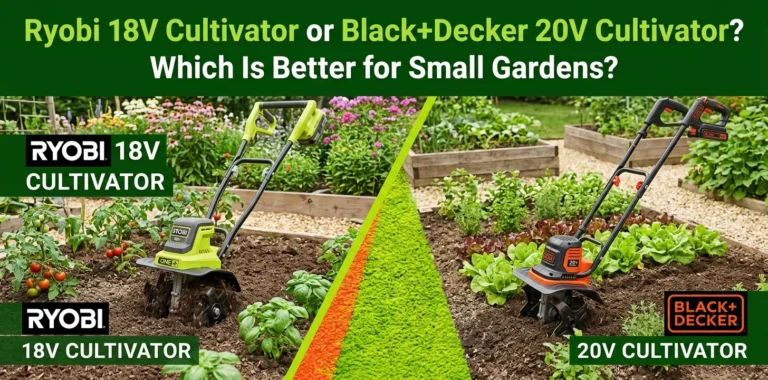
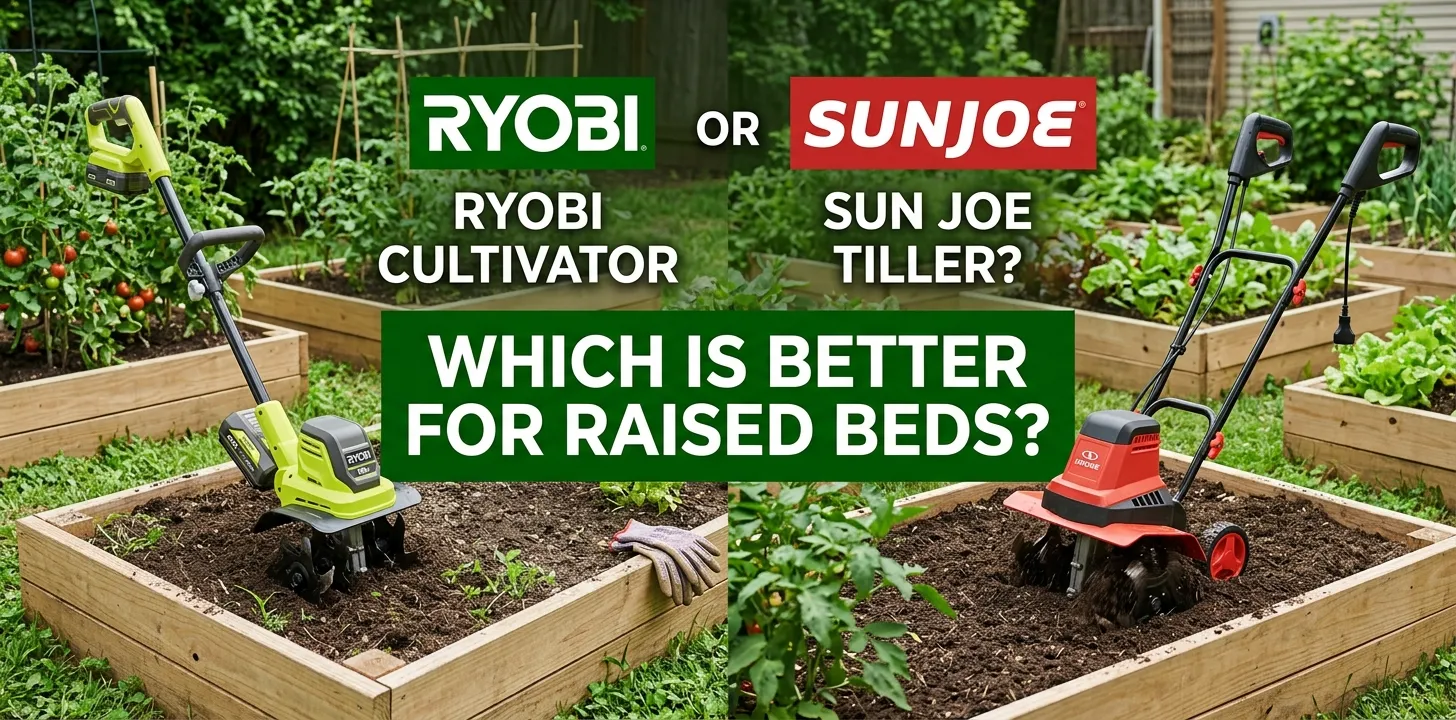
If you are choosing between the RYOBI 18V ONE+ Handheld Cultivator (P2909BTL) and the Sun Joe TJ604E 13.5-Amp Electric Tiller/Cultivator, the Sun Joe is the better choice for most raised beds that need real soil preparation. It has a much wider working path and greater digging capability. The Ryobi is better for small, established beds where light cultivation, weeding, and cordless convenience matter more.
The key is that these two machines are not really in the same class. The Ryobi is a compact handheld cultivator, while the Sun Joe TJ604E is a full-size wheeled electric tiller/cultivator. That difference matters more than the brand name when you are working inside a raised bed.
| Feature | RYOBI 18V ONE+ P2909BTL | Sun Joe TJ604E |
|---|---|---|
| Type | Handheld cultivator | Wheeled tiller/cultivator |
| Power | 18V battery | 13.5-amp corded electric |
| Tilling width | 3 inches | 16 inches |
| Listed tilling depth | 3 inches | Up to 8 inches |
| Tines | 2 | 6 steel tines |
| Best suited to | Small beds and flower beds | Soil preparation and larger beds |
| Cord | No | Yes |
| Battery | Required | Not required |
| Current listed price* | $99 tool-only | Varies by retailer |
| Main advantage | Control and cordless use | Power and coverage |
*Prices can change, and the Ryobi price shown by the manufacturer is for the tool-only configuration.
The biggest difference: cultivator vs. tiller
For raised beds, it helps to understand what you actually want the machine to do.
A cultivator is mainly for working the upper layer of soil, mixing in amendments, loosening existing soil, and managing weeds. A tiller is built for more substantial soil preparation and covers a much larger area with each pass.
That is why the Ryobi and Sun Joe can both be useful in raised beds but still feel completely different in actual use.
The RYOBI P2909BTL is specifically marketed for small gardens and flower beds, with a compact design and front handle for control.
The Sun Joe TJ604E is designed around a 13.5-amp motor, six steel tines, a 16-inch working width, and a maximum listed tilling depth of 8 inches.
For a large raised bed, those differences add up quickly.
How the Ryobi performs in raised beds
The Ryobi’s biggest strength is control.
Its narrow 3-inch working width makes it much easier to work in small spaces. If your raised bed has established vegetables growing in rows, you can use a compact cultivator to work between plants without bringing a large tiller into a tight space.
It also avoids the problem of dragging an extension cord through the garden.
RYOBI lists the P2909BTL as a compact handheld cultivator intended for small gardens and flower beds. The company currently offers it as a tool-only model or with a 2Ah battery and charger.
Where the Ryobi makes the most sense
Choose the Ryobi when your raised beds are:
- Small
- Already established
- Filled with relatively loose soil
- Planted with vegetables or flowers
- In need of light cultivation rather than deep soil preparation
- Located where managing a power cord would be annoying
For example, imagine a 4-by-8-foot raised bed that you refresh each spring with compost. You probably do not need a 16-inch tiller to work the entire bed aggressively. A narrow cordless cultivator can give you more control around plants and in tight areas.
That is where the Ryobi has a real advantage.
Where the Sun Joe makes more sense
The Sun Joe TJ604E is the better match when your raised bed needs more serious soil preparation.
Its 16-inch working width is more than five times the Ryobi’s listed 3-inch width. Its six steel tines and 13.5-amp motor also give it a much different role.
This makes it useful for:
- Preparing an empty raised bed
- Breaking up compacted soil
- Mixing compost into an established bed
- Preparing several raised beds
- Working larger garden areas
- Refreshing soil before planting
The Sun Joe also has adjustable wheels that help control how deeply the tines engage the soil.
For a gardener who has several large beds to prepare in spring, the wider working path can save a lot of time.
Which one is better for small raised beds?
For a very small raised bed, the answer is not automatically Sun Joe.
The Ryobi’s narrow profile can actually be more useful when space is tight. A large tiller can cover ground quickly, but you also have to be more careful around plants you want to keep.
The Sun Joe’s 16-inch width is excellent when the bed is empty or you need to prepare a large amount of soil. It is less attractive when your main job is carefully loosening soil between established plants.
Best for tiny, established beds: Ryobi.
Best for empty or larger raised beds: Sun Joe.
Which one handles tough soil better?
The Sun Joe wins clearly here.
A 13.5-amp corded motor and six steel tines give the TJ604E considerably more capability for demanding soil work than the small handheld Ryobi. Current retailer listings also show users reporting good results in compacted soil and clay, although individual results will depend heavily on soil conditions.
That does not mean the Sun Joe should be treated like a heavy-duty gas rototiller.
Rocks, large roots, very compact ground, and buried debris can still cause problems. User reports include damaged tines and other issues after striking obstacles.
For a raised bed, inspect the soil first and remove large rocks, thick roots, and other obstacles before tilling.
Which is easier to control around plants?
Ryobi.
This is one of the strongest reasons to choose it.
The Ryobi is a handheld tool with a narrow working area. That makes it easier to make small movements and target specific sections of soil.
The Sun Joe is designed to cover soil quickly. That is useful when the bed is empty, but you should use more care when plants are already growing.
A practical approach is:
- Use the Sun Joe before planting when you need to prepare a large bed.
- Use the Ryobi between established plants when you need more precise control.
You do not necessarily need the same tool for every gardening job.
Which is better for mixing compost into raised-bed soil?
Both can do it, but the better choice depends on the size and condition of the bed.
For a small bed with loose soil, the Ryobi can be enough. Its smaller working area lets you mix amendments where you need them without aggressively disturbing the entire bed.
For several beds or a large empty bed, the Sun Joe is more practical because it covers much more ground per pass.
One caution: you generally do not want to repeatedly pulverize raised-bed soil just because you have a powerful tiller. Excessive tilling can damage soil structure. If the soil is already loose and healthy, light cultivation or hand tools may be all you need.
Which is better for working around existing vegetables?
The Ryobi is the safer choice from a control standpoint, but neither tool should be run carelessly close to plant stems or roots.
Raised beds often contain shallow root systems, drip irrigation, plant supports, and other things that can be damaged by rotating tines.
The Ryobi’s small working width makes it easier to stay in a narrow strip of soil. The Sun Joe’s wider tines are better suited to open soil.
If your bed is already full of lettuce, peppers, tomatoes, carrots, or other crops, think of cultivation as a precision job rather than a race.
Cordless convenience vs. unlimited corded runtime
This is another major difference.
The Ryobi runs on an 18V ONE+ battery, so there is no extension cord running from the house to the garden. That is especially convenient for raised beds located away from an outlet.
The trade-off is battery management. You need a charged compatible battery, and your available working time depends on the battery and how hard the tool is being used.
The Sun Joe uses a cord. That means you have to manage the extension cord carefully, but you do not have to stop because a battery needs charging.
For a garden close to your house, the cord may be a minor inconvenience.
For raised beds at the back of a large yard, cordless operation can be much more appealing.
Which one is better for multiple raised beds?
If you have several raised beds, I would choose the Sun Joe TJ604E.
The 16-inch working width makes a major difference when you are preparing a lot of open soil. Instead of repeatedly making narrow passes, you can cover a much larger area.
This is particularly useful in spring when several beds need to be prepared before planting.
The Ryobi can certainly handle repeated small jobs, but its 3-inch working width means it is designed around precision and light cultivation rather than fast bed preparation.
What about soil spillage in raised beds?
This is an issue worth considering.
A rotating tiller can throw loose soil around, and user reports for the Sun Joe specifically mention soil being pushed or spilled outside raised beds.
That matters because raised beds have defined edges. You do not want to spend 20 minutes tilling and another 20 minutes putting soil back into the bed.
The easiest way to reduce the problem is to avoid aggressive passes near the edges. Work toward the center and use a rake or hand tool to finish the corners and edges.
The smaller Ryobi can give you more control in tight areas, although its narrow width also means more passes.
Which one takes less storage space?
Ryobi.
The P2909BTL is a compact handheld cultivator designed for small gardens and flower beds.
That makes it appealing if you live in a home with:
- A small shed
- A crowded garage
- Limited outdoor storage
- Only one or two small raised beds
The Sun Joe has a larger tiller body and handle assembly, although its handle can be folded for storage.
If storage space is tight, the Ryobi has the simpler footprint.
Which one offers better value?
The answer depends on what you already own.
RYOBI currently lists the P2909BTL at $99 for the tool-only version, while a battery-and-charger configuration is also offered.
If you already own other RYOBI 18V ONE+ tools and batteries, the cultivator becomes more attractive because you may not need to buy another battery and charger.
If you do not own a compatible battery, compare the complete kit cost rather than comparing the tool-only price with the Sun Joe’s complete operating setup.
The Sun Joe has another value advantage: there is no battery to replace or recharge. You plug it into a suitable outdoor power source and work.
Ryobi vs. Sun Joe for different raised-bed situations
| Raised-bed situation | Better choice | Why |
|---|---|---|
| One small established bed | Ryobi | Easier control |
| Several large beds | Sun Joe | Much wider coverage |
| Mixing compost | Either | Depends on bed size |
| Deep soil preparation | Sun Joe | More capable tiller design |
| Light weeding | Ryobi | Better precision |
| Working between plants | Ryobi | Narrower working area |
| Hard or compacted soil | Sun Joe | More power and larger tines |
| Garden far from an outlet | Ryobi | Cordless |
| Garden beside the house | Sun Joe | Cord is easier to manage |
| Limited storage | Ryobi | Compact handheld design |
| Existing RYOBI battery collection | Ryobi | Battery compatibility adds value |
| Empty bed before planting | Sun Joe | Faster coverage |
Two practical examples
Example 1: A single 4-by-8-foot vegetable bed
Suppose you have one raised bed with loose soil and grow tomatoes, peppers, herbs, and lettuce.
You add compost each season and mainly need to loosen the top layer before planting. Once plants are established, you may also want to cultivate small areas between rows.
The Ryobi is the better fit.
You are not trying to break new ground. You need control, easy storage, and cordless convenience more than maximum tilling power.
Example 2: Four large raised beds that need spring preparation
Now imagine four larger beds that have compacted over winter. You want to incorporate compost and prepare the soil before planting.
The Sun Joe makes more sense.
Its 16-inch working width and stronger tilling setup are much better suited to covering multiple open beds efficiently.
This is exactly where buying the smaller Ryobi could leave you wishing you had chosen a full-size tiller.
A mistake to avoid: choosing by voltage alone
It is tempting to look at 18V vs. 13.5 amps and try to decide which number is bigger.
That does not work.
They are different electrical measurements used in different systems. More importantly, these products are designed differently.
The Ryobi is a compact handheld cultivator. The Sun Joe is a wheeled corded tiller/cultivator.
For raised beds, the more useful questions are:
- How much soil do you need to work?
- Is the bed empty or planted?
- Do you need deep tilling or light cultivation?
- How much control do you need around plants?
- Do you already own RYOBI batteries?
- Is an extension cord practical in your garden?
Those answers tell you much more than the voltage number.
So, which is better for raised beds?
For most gardeners who want a true tiller for preparing raised beds, I would choose the Sun Joe TJ604E. Its wider 16-inch path, six steel tines, and 13.5-amp motor make it much better suited to preparing larger amounts of soil and dealing with tougher conditions.
But the RYOBI 18V ONE+ P2909BTL is the better choice if your raised beds are small, established, and relatively easy to work. Its compact cordless design gives you better control and makes it easier to cultivate around plants. RYOBI itself positions the tool for small gardens and flower beds.
So the simple decision is:
Choose Sun Joe for power, coverage, and pre-planting soil preparation. Choose Ryobi for precision, small beds, and cordless convenience.
Frequently Asked Questions
Is the Ryobi cultivator powerful enough for raised beds?
Yes, when the job is light cultivation in a small, established raised bed. It is better suited to loosening existing soil and working around plants than breaking deeply compacted ground.
Can the Sun Joe TJ604E be used in raised beds?
Yes. Its wide 16-inch working path and tilling capability make it useful for preparing open raised beds, mixing amendments, and working larger areas. Use extra care around bed edges and existing plants because its larger tines can disturb more soil.
Should I buy a tiller or cultivator for a raised bed?
Buy based on the work you actually need to do. For small established beds and light maintenance, a cultivator such as the Ryobi is often easier to control; for larger beds, compacted soil, and pre-planting preparation, a tiller such as the Sun Joe is the more practical choice.
Final Verdict
The Sun Joe TJ604E is the better overall choice for raised-bed soil preparation, especially if you have multiple beds or need to work compacted soil. The Ryobi P2909BTL wins for small established beds where control and cordless operation matter more than speed and digging power.
Before buying, measure your raised beds and think about what the tool will actually do most often. Expert tip: if your beds are already loose and healthy, do not buy the most powerful machine simply because it can dig deeper—controlled, lighter cultivation can be the better gardening approach.