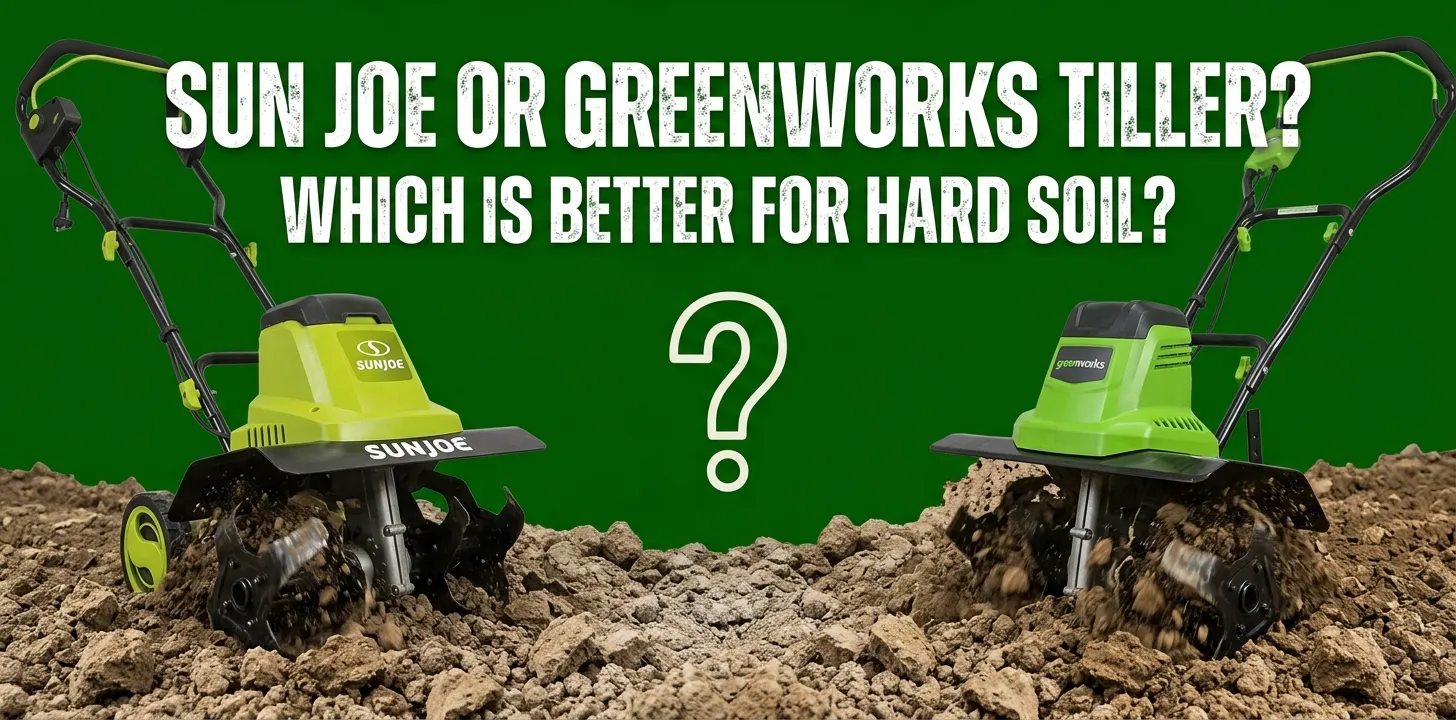
Sun Joe or Greenworks Tiller? Which Is Better for Hard Soil?

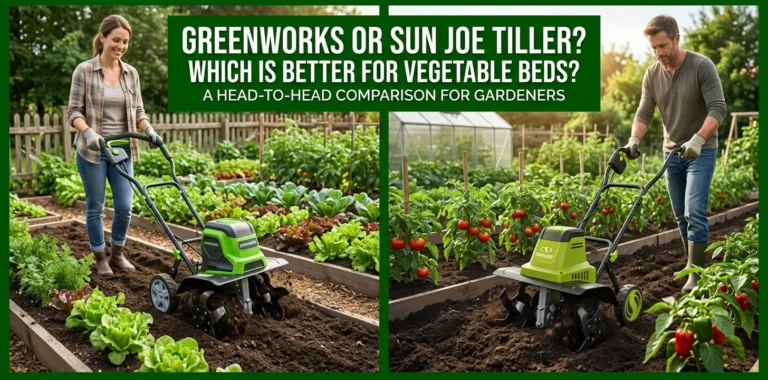
For hard, compacted soil, Sun Joe is the stronger choice for most homeowners, especially the 12-amp TJ603E. It offers a wider 16-inch tilling path and up to 8 inches of digging depth. Greenworks cordless tillers are easier to handle and more convenient, but their current 40V and 60V cultivators are generally limited to about 5 inches of depth.
Sun Joe vs. Greenworks for Hard Soil
Hard soil changes what matters most in a tiller. A machine that works well in loose garden soil may struggle when the ground is compacted, dry, or has not been cultivated for a long time.
For this specific job, I would give Sun Joe the edge for breaking new or heavily compacted ground. The Sun Joe TJ603E uses a 12-amp motor, six steel tines, and can till up to 16 inches wide and 8 inches deep.
Greenworks takes a different approach. Its 40V cordless cultivator has four forward-rotating steel tines, a working width of 8.25 to 10 inches, and a maximum depth of 5 inches. Its Pro 60V model also reaches 5 inches deep and uses a brushless motor.
| Feature | Sun Joe TJ603E | Greenworks 40V Cultivator | Greenworks Pro 60V Cultivator |
|---|---|---|---|
| Power | 12-amp corded | 40V battery | 60V battery |
| Maximum width | 16 inches | 10 inches | 8 inches |
| Maximum depth | 8 inches | 5 inches | 5 inches |
| Tines | 6 steel blades | 4 steel tines | 4 steel tines |
| Tine direction | Forward | Forward | Forward |
| Best advantage | Breaking and turning deeper soil | Cordless convenience | More powerful cordless option |
| Hard-soil suitability | Best of these three | Moderate | Better cordless option |
The numbers do not tell the entire story, but they show why Sun Joe is better suited to deeper soil preparation.
Why Sun Joe Has an Advantage in Compacted Ground
When soil is hard, the tiller needs to do more than scratch the surface. It needs to penetrate and break apart the compacted layer.
The TJ603E is designed specifically for loosening and turning soil. Its manual lists a 12-amp motor, six steel tilling blades, a maximum 16-inch working width, and a maximum 8-inch cultivating depth.
Sun Joe also describes the TJ603E as suitable for breaking through tough soil and preparing new garden beds.
That deeper working range can be useful when you are preparing a neglected vegetable garden rather than simply refreshing soil that has already been worked.
Sun Joe’s biggest drawback
The main trade-off is the power cord.
Because the TJ603E is corded, you need a suitable outdoor extension cord and access to an electrical outlet. That can become annoying if the garden is far from the house.
It also means you have to work around the cord while tilling.
So Sun Joe’s advantage in hard soil comes with less freedom of movement.
Where Greenworks Makes More Sense
Greenworks becomes more attractive when convenience matters as much as raw digging capability.
The 40V model is cordless and can operate for up to 40 minutes under the manufacturer’s stated conditions. It has adjustable tilling width from 8.25 to 10 inches and a maximum tilling depth of 5 inches.
The Pro 60V model is another step up. It uses a brushless motor, has four forward-rotating steel tines, works up to 5 inches deep, and has a stated runtime of up to 30 minutes.
That makes Greenworks a good fit when you want to avoid an extension cord or already own compatible Greenworks batteries.
Greenworks 40V vs. 60V for hard soil
If you specifically want Greenworks for tougher soil, the 60V Pro model is the more appealing choice.
It has a brushless motor and is positioned by Greenworks as part of its heavier-duty 60V tool family. However, its maximum tilling depth is still 5 inches, so it does not match the Sun Joe’s 8-inch specification.
The 40V model is better suited to smaller garden jobs and general soil cultivation.
Which Tiller Is Better for Different Types of Hard Soil?
“Hard soil” can mean several different things. A dry garden bed, compacted clay, and ground full of rocks do not present the same problem.
Dry, compacted garden soil
Sun Joe wins.
The combination of its 12-amp motor, six steel blades, and deeper maximum working depth makes it the better fit when you need to break up established soil.
But do not assume that maximum depth should always be used on the first pass. Starting shallower and making additional passes can be easier on the machine and operator.
Clay-heavy soil
Sun Joe is still the better choice, but technique matters.
Very dry clay can become extremely hard. Trying to force a tiller through it at full depth may cause the machine to bounce, stall, or struggle.
A better approach is to work the soil when it has some moisture but is not saturated. Greenworks specifically advises against cultivating overly wet ground because it can create compact clods as the soil dries.
Soil with rocks and large roots
Neither should be treated like a rock-breaking machine.
Greenworks specifically advises removing rocks and roots before using its cultivators and says its machines are not designed for large tree roots or rocky ground.
The same basic principle applies to Sun Joe: clear large obstacles before tilling and avoid deliberately driving the tines into buried objects.
If your garden contains many large rocks, removing those obstacles first can make a bigger difference than switching between these two brands.
Hard Soil Is Not the Same as Undisturbed Ground
There is an important distinction between hard garden soil and new ground that has never been cultivated.
A small electric or cordless cultivator may be fine for refreshing an existing garden bed. Breaking completely new ground is a more demanding job.
For example, imagine a homeowner converting a section of compact lawn into a vegetable garden. The soil may contain grass roots, compacted layers, and hidden stones. That is a much tougher task than loosening a garden bed that was tilled last season.
For the first situation, Sun Joe’s deeper tilling capability gives it an advantage. For the second, either brand may be adequate depending on soil condition.
How to Get Better Results in Hard Soil
Even the more capable tiller can struggle if you use it at the wrong time.
Pick the right soil moisture
Extremely dry soil can be difficult to penetrate. But saturated soil can be just as problematic.
Greenworks recommends waiting roughly one to two days after rain so the soil becomes semidry rather than working it while it is soggy.
A simple test is to squeeze a handful of soil. If it forms a wet, sticky mass, it is probably too wet. If it is extremely hard and dusty, it may be too dry.
Start with a shallow pass
Don’t immediately force the tiller to its maximum depth.
Start with a shallow pass over the compacted area. Once the surface begins to break apart, make another pass and gradually work deeper.
This is especially useful with hard clay or ground that has not been cultivated recently.
Remove rocks and large roots first
Walk through the area before starting.
Remove visible rocks, thick roots, sticks, and other large debris. This reduces the chance of damaging the tines and makes the tiller easier to control.
Greenworks explicitly recommends clearing rocks and roots before cultivating.
Two Realistic Buying Scenarios
Consider a homeowner with a 300-square-foot vegetable garden that has become compacted over several seasons. The garden is close to an exterior outlet, and the main goal is to loosen the soil deeply before planting.
Sun Joe makes more sense. Its cord is less of a problem because the work area is close to power, while its 16-inch width and 8-inch maximum depth are useful for deeper soil preparation.
Now consider someone with several small garden beds spread around a yard who already owns Greenworks 60V batteries. They want to refresh the soil without managing an extension cord.
Greenworks Pro 60V may be the better practical choice. Its cordless design and compatibility with the Greenworks 60V system can outweigh the Sun Joe’s deeper working capability.
Sun Joe or Greenworks: Which One Should You Buy?
For hard soil, choose Sun Joe if your priority is deeper soil penetration and breaking up compacted ground.
Choose Greenworks if cordless convenience is a major priority, especially if you already own compatible batteries. If you want the Greenworks option for more demanding work, the Pro 60V model is the better fit than the basic 40V cultivator.
The biggest difference is not simply brand. It is the type of tiller you are buying:
- Sun Joe TJ603E: better for deeper, tougher soil preparation.
- Greenworks 40V: better for smaller, lighter cultivation jobs.
- Greenworks Pro 60V: better Greenworks choice for tougher cordless work.
- Very rocky or root-filled ground: prepare the area first rather than expecting either machine to handle large obstacles.
Frequently Asked Questions
Can a Sun Joe tiller break hard clay soil?
Yes, the Sun Joe TJ603E is designed to loosen and turn soil and has a 12-amp motor with a maximum cultivating depth of 8 inches. Very dry clay can still be difficult, so working in stages when the soil has suitable moisture is a better approach.
Is the Greenworks 60V tiller good for hard soil?
The Greenworks Pro 60V cultivator is the stronger cordless option in this comparison, with a brushless motor and forward-rotating steel tines. However, its maximum tilling depth is 5 inches, so Sun Joe remains the better choice when deeper soil penetration is the priority.
Should you till hard soil when it is wet?
No. Soil that is too wet can compact and form hard clods as it dries. Wait until the ground is semidry; Greenworks recommends waiting about one to two days after rain for better cultivating conditions.
Final Verdict
Sun Joe is the better choice for hard soil, particularly the TJ603E 12-amp electric tiller. Its six steel blades, 16-inch working width, and 8-inch maximum depth give it a clear advantage for deeper soil preparation.
Greenworks is the better pick when cordless operation matters more than maximum tilling depth. If you already have Greenworks batteries, the Pro 60V model is worth considering.
One practical tip: don’t try to win against hard soil by forcing the tiller deeper on the first pass. Choose the right soil moisture, clear rocks and roots, start shallow, and make additional passes as the ground loosens.