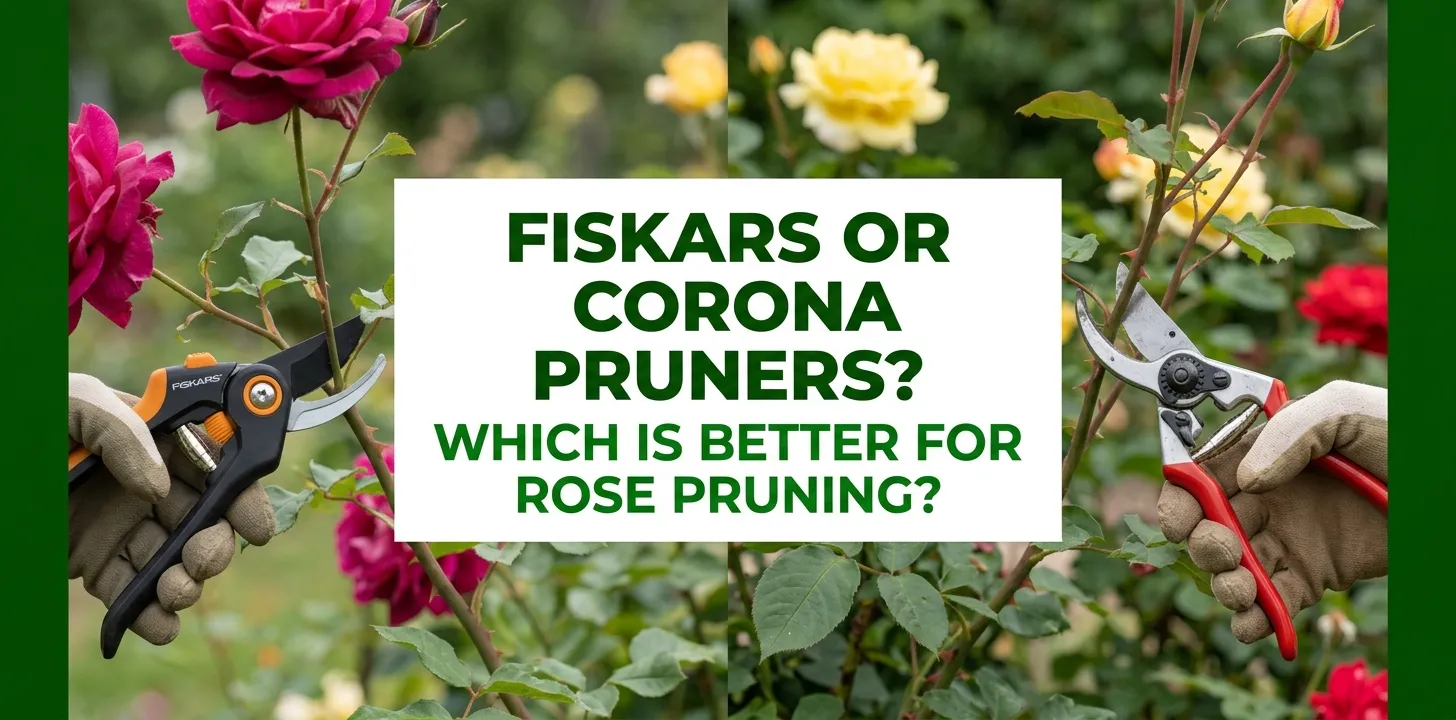
Fiskars or Corona Pruners? Which Is Better for Rose Pruning?

For rose pruning, Corona is the better choice for gardeners who want a traditional, durable bypass pruner with strong cutting control, while Fiskars is often the better value for casual home gardeners. Both can make clean cuts on live rose stems when sharp and properly aligned, but comfort, hand size, blade quality, and how often you prune can change the better pick.
The key point is that the bypass design matters more than the brand name. Bypass pruners use a curved cutting blade that passes the lower blade, producing a cleaner cut on living wood than anvil-style pruners. Extension guidance from the University of Minnesota specifically notes that bypass pruners are suited to cleaner pruning cuts.
Fiskars vs. Corona for roses at a glance
| Factor | Fiskars | Corona |
|---|---|---|
| Rose pruning | Very good | Excellent |
| Clean cuts on green stems | Very good | Excellent |
| Casual home use | Excellent | Very good |
| Frequent rose pruning | Very good | Excellent |
| Hand comfort | Good to very good, model dependent | Very good, model dependent |
| Small-hand friendliness | Depends on model | Depends on model |
| Value | Usually a strong point | Usually better for durability-focused buyers |
| Best reason to choose | Affordable, light, easy to find | Traditional feel and solid cutting control |
| Overall for roses | Best value | Best overall for frequent pruning |
Why bypass pruners are better for roses
Roses have woody stems, but many of the cuts made during routine pruning are within the range of a good hand pruner. A bypass blade works more like scissors: the sharp upper blade passes the lower blade instead of crushing the stem against a flat surface.
That matters because clean cuts are one of the main goals when pruning plants. Penn State Extension recommends sharp bypass hand pruners for small cuts and notes that dull tools can create messy cuts.
For most home rose gardens, you want a pruner that can:
- Make a clean cut without excessive squeezing
- Reach between crowded rose stems
- Stay comfortable through repeated cuts
- Handle green and reasonably small woody stems
- Be easy to clean and sharpen
- Give you enough control to cut just above a healthy bud
Both Fiskars and Corona make bypass-style pruners that can fit this job.
Fiskars for rose pruning
Fiskars has several pruning tools, so the exact model matters. Its traditional bypass hand pruners are aimed at small-to-medium garden cutting, while its newer powered bypass pruners are designed for much larger workloads. Fiskars currently lists powered models capable of cutting fresh branches up to about 25–30 mm, depending on the model.
For ordinary rose care, you generally do not need a powered pruner. A good manual bypass model is enough for deadheading, removing thin canes, and routine shaping.
Where Fiskars does well
The biggest advantage is value and accessibility. Fiskars manual bypass pruners are widely available, and several models are designed around lightweight handling and non-stick blades.
That can be useful when you are maintaining a few rose bushes rather than dozens of plants.
A Fiskars bypass pruner can also be a sensible first pair for a beginner. You do not need a premium professional pruner just to remove spent blooms or small rose canes.
Where Fiskars can fall short
The Fiskars name covers many different pruners, and their feel is not identical from model to model.
Some gardeners may also find certain Fiskars handles less natural during long pruning sessions. User reviews show that cutting performance can vary when blades become dull or misaligned, which is a reminder that maintenance matters as much as the logo on the handle.
For occasional rose pruning, those limitations are usually easy to live with. For someone spending hours pruning roses every season, a more traditional professional-style pruner may feel better.
Corona for rose pruning
Corona has a long history in hand pruning tools, and its bypass pruners are particularly appealing if you prefer a conventional garden-pruner design.
The advantage for rose growers is control. When you are working inside a rose bush, you often need to position the blade carefully rather than simply make lots of fast cuts.
A well-designed Corona bypass pruner gives you that traditional feel.
Where Corona does well
Corona is especially attractive for gardeners who prune regularly.
If you have a large rose bed, several mature bushes, or many shrubs that require seasonal pruning, spending a little more on a comfortable, durable hand pruner can make sense.
The brand also offers different handle and blade configurations, so you can choose a tool that better matches your hand size and the type of pruning you do.
Where Corona can fall short
Corona is not automatically better just because it costs more or has a professional-looking design.
A poorly maintained Corona pruner can still make rough cuts. A sharp, properly aligned Fiskars can outperform a dull Corona on the same rose stem.
You also need to compare specific models rather than comparing the two brands as if each made only one pruner.
Which cuts are you making on your roses?
This is one of the most important factors in the decision.
Deadheading roses
For removing spent flowers and small stems, Fiskars is usually enough.
These cuts are generally light, repetitive, and do not require a heavy-duty pruner. A comfortable, lightweight bypass pruner can make this job quick.
If you have only a few bushes, there is little reason to buy a more expensive tool solely for deadheading.
Annual rose pruning
For more serious seasonal pruning, Corona gets the edge if you value control and long-term use.
You may be making many cuts through thicker canes, working in tight spaces, and spending more time with the pruner in your hand.
In that situation, blade quality, handle design, spring action, and hand comfort become more important than simply getting the lowest price.
Removing thick rose canes
Neither brand should be judged only by its advertised maximum cutting capacity.
A pruner may technically be capable of cutting a particular diameter, but that does not mean you should force it through every stem at that size.
For larger branches, extension guidance recommends moving up to loppers or a pruning saw rather than forcing a hand pruner beyond its intended job.
That is particularly useful with old rose canes that have become thick and woody.
Fiskars vs. Corona: the hand-comfort question
Comfort may be more important than small differences in cutting performance.
Rose pruning can involve dozens or hundreds of individual cuts. If the handles are too large for your hand or the spring requires too much effort, fatigue can build up quickly.
Penn State Extension recommends choosing tools that fit your size and capabilities and notes that enlarged or cushioned handles can be helpful for gardeners with hand discomfort.
For that reason, do not choose between Fiskars and Corona based only on online specifications.
If possible, hold the actual model before buying.
Pay attention to:
- How far the handles open
- Whether you can operate the lock easily
- How much pressure is needed for a normal cut
- Whether your fingers fit comfortably around the handles
- Whether the pruner feels balanced
- Whether you can reach the stem without awkwardly twisting your wrist
A pruner that feels comfortable after five minutes is often a better choice than one that looks better on paper.
What about small rose stems?
For thin green rose growth, both brands can work very well when the blade is sharp.
The blade should slice through the stem rather than crush, tear, or leave a ragged edge.
If your pruner starts crushing stems, check the blade condition and alignment before immediately replacing the tool. Dull or poorly maintained blades can reduce cut quality regardless of brand.
This is one reason regular sharpening and cleaning matter.
A practical choice for two different gardeners
Imagine two gardeners.
Gardener A has four rose bushes around a suburban home. They deadhead during summer and do a little seasonal pruning each year. They do not spend hours working in the garden.
For this gardener, Fiskars is probably the smarter buy. The lower-cost, lightweight approach makes sense when the tool will see moderate use.
Gardener B has a large rose garden and spends several weekends each year doing detailed pruning. They make many cuts and want a pruner that feels solid and controlled.
For this gardener, Corona is the better bet, assuming the particular model fits their hand and pruning needs.
The difference is not that one brand can prune roses and the other cannot. It is about how much you use the tool and what you value.
How to get cleaner rose cuts from either brand
Even an excellent pruner will struggle if you use it incorrectly.
Place the cutting blade so it makes a clean slice through the cane rather than crushing it. When pruning roses, cuts are commonly made just above a healthy outward-facing bud to encourage an open growth pattern.
Keep the blade sharp and clean.
Sap and plant material can build up on pruning tools. University of Minnesota Extension recommends cleaning pruners with soap and water when needed and lubricating them afterward; it also explains that bypass blades have a single bevel that should be sharpened along its existing angle rather than creating a new bevel.
If you are moving between plants where disease may be a concern, clean or sanitize the blades appropriately. Extension guidance also recommends keeping pruning tools clean to reduce the chance of spreading plant problems.
When neither Fiskars nor Corona is the right choice
There are times when the better answer is neither.
If you are dealing with a very thick, old rose cane that is difficult to cut with one-handed pruners, do not simply squeeze harder.
Use a suitable lopper or pruning saw instead. Hand pruners are intended for smaller cuts, while larger tools provide the leverage needed for thicker branches.
Likewise, if your main problem is hand fatigue, look beyond the brand name. An ergonomic or leverage-oriented pruner may be a better fit than a standard model.
Fiskars or Corona: which should you buy for roses?
Choose Fiskars if you are a typical home gardener who wants a capable, affordable pruner for occasional rose care.
Choose Corona if you prune roses frequently and place more value on traditional handling, cutting control, and long-term use.
If both models are similarly priced at the store, I would lean toward Corona for serious rose pruning. If the Fiskars model fits your hand better or costs substantially less, it is still a very good choice for normal home rose maintenance.
The most important factor is not the brand. Choose a sharp bypass pruner that fits your hand and matches the size of the rose canes you actually cut.
Frequently Asked Questions
Are Fiskars pruners good for cutting rose bushes?
Yes. A suitable Fiskars bypass pruner can handle routine rose pruning, including deadheading and cutting smaller live canes. The blade needs to be sharp and properly aligned to produce clean cuts.
Is Corona better than Fiskars for thick rose stems?
Corona may offer better control for frequent or more demanding pruning, but neither brand should be forced beyond the tool’s practical capacity. For larger rose canes, loppers or a pruning saw are often more appropriate than squeezing harder with hand pruners.
Should I use bypass or anvil pruners for roses?
Bypass pruners are generally the better choice for live rose stems. Their blades pass each other like scissors and are designed to make cleaner cuts, while anvil pruners tend to crush material against a flat surface.
Final verdict
For most home gardeners, Fiskars offers the better value for everyday rose pruning, while Corona is the stronger choice for gardeners who prune often and want a more traditional, controlled cutting experience.
Before buying, focus on the specific model rather than the brand alone. Expert tip: if you can comfortably close the pruner around a rose cane and the blade slices cleanly without crushing it, you have a much better tool for your roses than one chosen only by brand reputation.