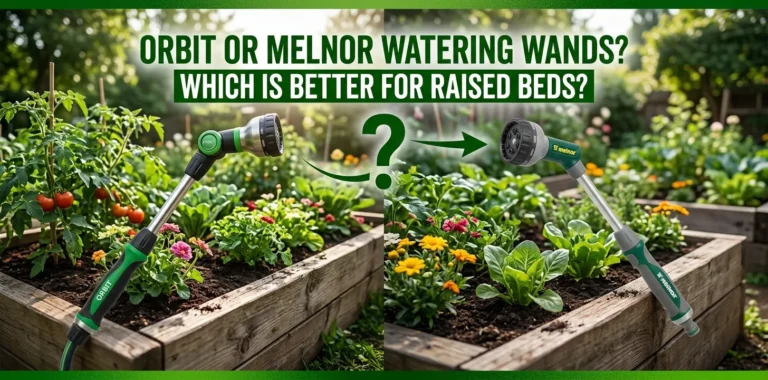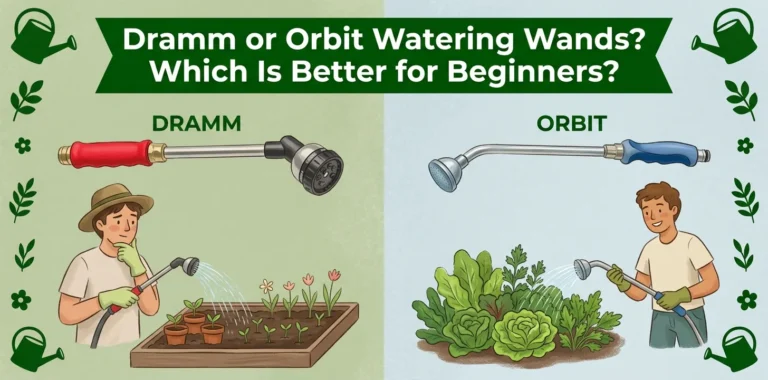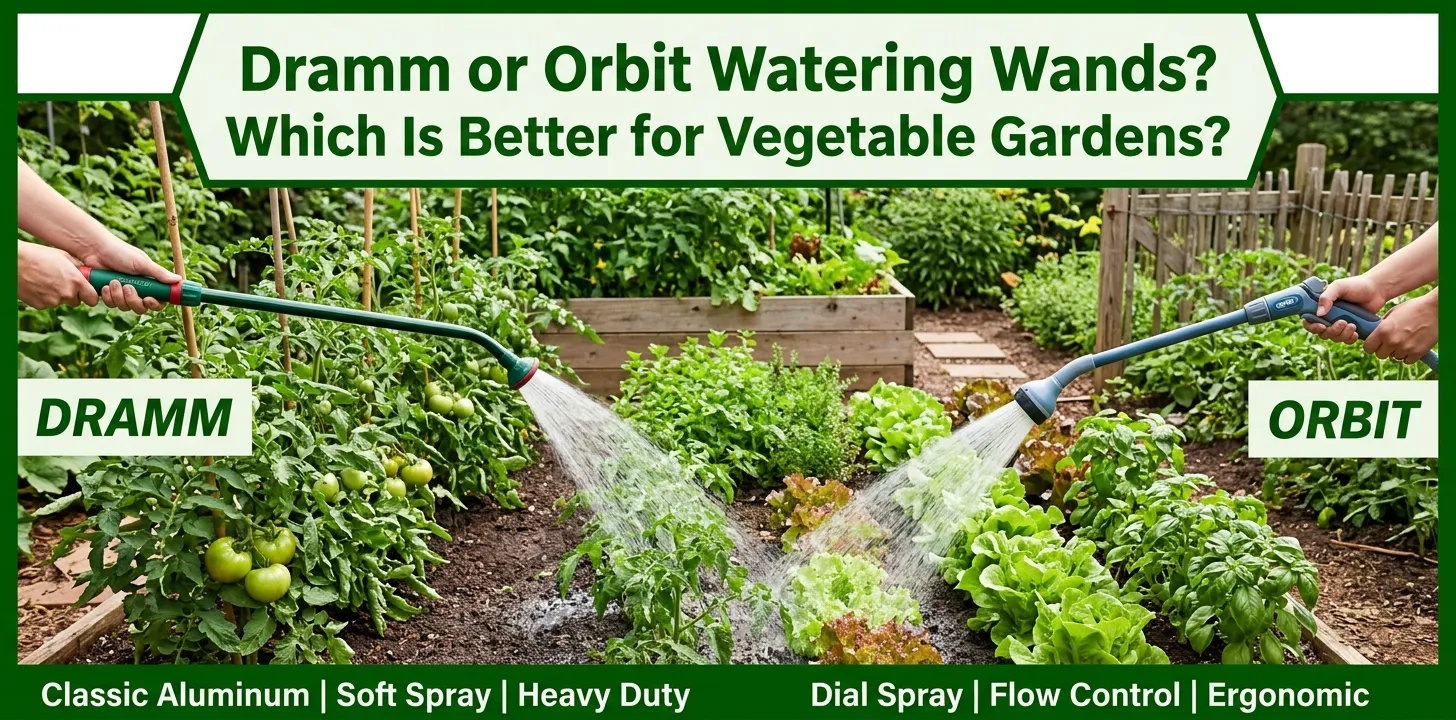
Dramm or Orbit Watering Wands? Which Is Better for Vegetable Gardens?

For most vegetable gardens, Dramm is the better choice if your priority is gentle, even watering and simple flow control, while Orbit is better if you want multiple spray patterns and more versatility from one wand. Dramm’s rain-style wands are designed to deliver a broad, gentle flow that helps avoid disturbing soil, while Orbit offers models with several spray settings for different garden tasks.
The right choice depends less on the brand name and more on how you water your vegetables. Seedlings, raised beds, mature plants, containers, and larger gardens can benefit from different wand designs.
Dramm vs. Orbit for Vegetable Gardens
When comparing the two brands, the biggest difference is their approach.
Dramm focuses heavily on rain-like, full-flow watering. Its One Touch Rain Wand uses a thumb-controlled ball valve and a full-flow shower pattern. Dramm says the wand is designed to provide fast watering without damaging plants or disturbing soil.
Orbit offers a much broader selection of watering wands. Its current lineup includes single-purpose shower wands as well as models with seven or nine spray patterns, ratcheting heads, thumb controls, and different lengths.
| Feature | Dramm | Orbit |
|---|---|---|
| Gentle vegetable watering | Excellent | Excellent with shower setting |
| Spray-pattern variety | Limited on basic rain wands | Strong |
| Flow control | Excellent on One Touch models | Available on many models |
| Seedlings | Excellent | Very good with shower/mist |
| Raised beds | Excellent | Excellent |
| Containers | Excellent | Excellent |
| General yard use | Good | Excellent |
| Simplicity | Excellent | Good to excellent |
| Long-reach options | Available | Many options |
| Best for | Focused garden watering | Versatile watering jobs |
Why Dramm Works So Well for Vegetable Gardens
Vegetable plants do not always benefit from a strong jet of water. A hard stream can move loose soil, expose roots, flatten young plants, or disturb newly planted seeds.
That is where Dramm’s rain-wand design has an advantage.
The Dramm One Touch Rain Wand uses a full-flow shower pattern intended to provide substantial water coverage without the harsh spray associated with some hose nozzles. Its thumb-controlled valve also lets you adjust or stop the flow without repeatedly squeezing a trigger.
Better for watering soil around plants
For tomatoes, peppers, cucumbers, squash, beans, and other established vegetables, a gentle shower can make it easier to water the soil evenly.
The goal is not simply to deliver water quickly. You want the water to reach the root zone without washing soil away.
Dramm’s full-flow shower is particularly useful when you are watering several plants in a row and want broad coverage rather than a narrow stream.
Good control between plants
The One Touch model has a thumb-operated valve. You can reduce or stop the flow as you move between plants instead of leaving the hose running continuously. Dramm specifically describes this feature as a way to reduce water use between plants.
That is useful in a vegetable garden because plants are rarely spaced in one perfectly uniform row.
The 16-inch and 30-inch options serve different gardens
Dramm currently offers One Touch Rain Wands in 16-inch and 30-inch versions.
A 16-inch wand is easier to handle in compact beds and containers.
A 30-inch wand gives you more reach, which can be useful when plants are crowded or when you want to water from the edge of a raised bed.
For a typical backyard vegetable garden, the 16-inch model is often enough. A 30-inch wand becomes more useful when reaching across deeper beds is a regular problem.
Where Orbit Has the Advantage
Orbit stands out when you want one watering wand to handle many different jobs.
For example, Orbit’s Pro Flo 7-Pattern Watering Wand has seven spray patterns: jet, cone, full, shower, center, flat, and mist. It also has thumb-controlled flow adjustment and a 14-inch reach.
That flexibility can be useful if your garden contains plants with different watering needs.
Multiple spray patterns give you more control
A vegetable gardener might use:
- Shower for established vegetables
- Mist for very delicate plants
- Cone for broader coverage
- Center for more focused watering
- Jet for cleaning tools or other non-plant tasks
The important point is that you should not automatically use the strongest setting on vegetables just because the wand has it.
For delicate plants and seedlings, a gentler pattern is usually the better starting point.
Orbit offers useful long-reach designs
Orbit also sells longer wands, including 36-inch models with multiple spray patterns and ratcheting heads. One current 36-inch model has nine patterns and a head that can be angled up or down.
That can be helpful in deep raised beds or when you want to avoid stepping into a planting area.
Orbit is more versatile outside the garden
This is one of Orbit’s biggest advantages.
If you want a wand that can water vegetables but also rinse outdoor surfaces, clean tools, or handle other yard tasks, a multi-pattern Orbit model gives you more options.
Dramm’s basic rain-wand approach is more focused on gentle watering.
Dramm vs. Orbit for Vegetable Seedlings
For seedlings, I would give Dramm the edge if the comparison is between a basic Dramm rain wand and a basic Orbit shower wand.
Young vegetable plants have smaller root systems and can be easier to disturb. A broad, gentle shower is preferable to a concentrated stream.
Orbit can still be an excellent choice if you select a model with a gentle shower or mist setting. Its 15-inch Ratcheting Shower Head Watering Wand, for example, is specifically described by Orbit as suitable for gardens and newly seeded areas and uses a rain-like spray.
So the decision is not simply “Dramm for seedlings, Orbit for everything else.”
Instead, look at the spray pattern.
Which Is Better for Raised Vegetable Beds?
For raised beds, Dramm is usually the better pick if you mainly want gentle, straightforward watering.
A longer wand can make a bigger difference than having nine spray patterns. If your raised bed is wide, reaching the plants in the middle without stepping into the soil is helpful.
Dramm’s 30-inch One Touch model is designed for full-flow shower watering and gives you additional reach.
Orbit is the better option if the raised bed is only one of several watering jobs you need to handle.
For example, an Orbit 36-inch multi-pattern wand can give you long reach plus different spray choices.
Which Is Better for Tomatoes, Peppers, and Other Mature Vegetables?
For established vegetables, both brands can work very well.
The key is to water the soil around the plant rather than blasting the leaves or exposing the roots.
Dramm’s full-flow shower is a strong match for this type of watering because it provides broad coverage.
Orbit’s shower or full setting can also work well, while its other patterns give you more flexibility for different jobs.
If you already know that you want a simple garden-only tool, Dramm makes more sense.
If you want a multipurpose hose-end tool, Orbit has the stronger case.
Which Has Better Water Control?
This depends on the exact model rather than just the brand.
Dramm’s One Touch Rain Wand has a thumb-controlled ball valve that lets you vary water flow with your thumb.
Orbit also offers thumb-control models. Its Pro Flo 7-Pattern wand allows flow adjustment without returning to the faucet.
So both brands can provide convenient flow control.
The bigger difference is the spray head:
- Dramm One Touch: simple full-flow shower
- Orbit 7-pattern: several spray choices
- Orbit 9-pattern models: even more flexibility
If you tend to overcomplicate watering when there are too many settings, Dramm’s simplicity can actually be an advantage.
What About Durability?
Both brands offer metal-bodied watering wands, but construction varies by model.
Dramm’s One Touch wand uses aluminum along with other components and a rubber over-molded grip. Dramm also backs its One Touch Rain Wand with a lifetime consumer guarantee.
Orbit’s Pro Flo 7-Pattern model uses a zinc metal core with a rubberized grip, while the company lists a five-year warranty for that model.
This makes warranty coverage worth considering when choosing between specific models.
Do not assume every Dramm wand has identical construction or every Orbit wand has identical durability. The individual model matters.
Which Watering Wand Should You Buy?
The simplest way to decide is to match the wand to your garden.
Choose Dramm if you mainly want:
- Gentle, even watering
- A rain-like shower pattern
- Simple flow control
- A dedicated vegetable-garden watering tool
- A durable wand with a long warranty
- Less time adjusting spray settings
Dramm is especially appealing if your main goal is to water vegetables rather than use the wand as an all-purpose outdoor sprayer.
Choose Orbit if you mainly want:
- Multiple spray patterns
- One wand for plants and other outdoor tasks
- Different settings for seedlings and mature plants
- Ratcheting or adjustable heads
- More choices in length and design
- A lower-cost option in some models
Orbit’s current lineup provides a much wider range of wand styles, so it is easier to find a model that matches a specific garden setup.
Two Practical Vegetable-Garden Examples
Imagine a gardener with a 4 × 8-foot raised bed filled with tomatoes, peppers, lettuce, and herbs.
A Dramm 30-inch rain wand would be a strong fit because the extra length can help reach across the bed while the gentle shower provides broad coverage.
Now consider a gardener with a small vegetable plot, several containers, hanging baskets, and outdoor cleaning jobs.
An Orbit multi-pattern wand may make more sense. The different spray settings allow the same tool to handle gentle plant watering and stronger general-purpose tasks.
Neither choice is universally better. The better wand is the one that fits how your garden is actually laid out.
One Important Mistake to Avoid
Do not choose a watering wand only because it has the highest number of spray patterns.
More settings do not automatically mean better vegetable watering.
A simple rain-style wand can be easier to use correctly because you are less likely to switch accidentally to a powerful jet or other unsuitable pattern.
Likewise, do not assume a gentle wand means you should water for only a few seconds. The amount of water your vegetables need depends on the plant, soil, weather, and growing conditions.
The wand controls how the water is delivered. It does not determine the correct watering schedule by itself.
Frequently Asked Questions
Is Dramm or Orbit better for vegetable seedlings?
Dramm is an excellent choice when you want a gentle, broad shower for seedlings. Orbit can also work well when using a shower or mist setting, and its 15-inch shower wand is specifically marketed for gardens and newly seeded areas.
Is a longer watering wand better for raised beds?
A longer wand can be useful for deep or wide raised beds because it lets you reach plants without stepping into the bed. A 30-inch Dramm or a 36-inch Orbit can be helpful, but the best length depends on the bed’s size and your reach.
Can you use an Orbit multi-pattern wand on vegetables?
Yes. Use a gentle shower or similarly soft setting for most vegetable watering rather than a strong jet. The main advantage of an Orbit multi-pattern wand is that you can change the spray for different plants and outdoor tasks.
Final Verdict
Dramm gets the edge for dedicated vegetable-garden watering. Its rain-wand design, gentle full-flow shower, thumb control, and long-reach options make it particularly well suited to watering soil around vegetables without making the task complicated.
Orbit is the better choice for versatility. Its multi-pattern wands give you more control over spray type and make the tool useful for vegetables, containers, hanging plants, cleaning, and other outdoor jobs.
If your main job is watering a vegetable garden, choose Dramm. If you want one wand for many different watering and outdoor tasks, choose Orbit.
A practical tip: whichever brand you choose, start with the gentlest suitable spray and water the soil around the plant rather than blasting the plant itself.